Results by title
2 books match the query 'Dead Alive'

The Dead Alive and Busy
Alan Shapiro
University of Chicago Press, 2000
In his sixth book of poems, Alan Shapiro once again shows that he is a master at articulating the secrets of the heart. The Dead Alive and Busy deals with issues of personal identity as revealed through examining the intimate bonds of family life. The poems explore these familial relations in terms of the religious, social, and literary contexts that inform them, delving into such universal themes as human frailty, illness and death, bereavement, and thwarted desires. By turns lyrical and narrative, slangy and elevated, analytical and visionary, this collection showcases one of America's most important poets in his top form.
Praise for Alan Shapiro: "Shapiro is a shrewd and sympathetic moralist. He never trivializes his subjects with high-minded flourishes or stylistic gimmicks."—J. D. McClatchy, New York Times Book Review
Praise for Alan Shapiro: "Shapiro is a shrewd and sympathetic moralist. He never trivializes his subjects with high-minded flourishes or stylistic gimmicks."—J. D. McClatchy, New York Times Book Review
[more]
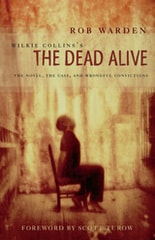
Wilkie Collins's The Dead Alive
The Novel, the Case, and Wrongful ConvictionsWilkie Collins
Northwestern University Press, 2005
On the evidence of The Dead Alive, Scott Turow writes in his foreword that Wilkie Collins might well be the first author of a legal thriller. Here is the lawyer out of sorts with his profession; the legal process gone awry; even a touch of romance to soften the rigors of the law. And here, too, recast as fiction, is the United States' first documented wrongful conviction case. Side by side with the novel, this book presents the real-life legal thriller Collins used as his model-the story of two brothers, Jesse and Stephen Boorn, sentenced to death in Vermont in 1819 for the murder of their brother-in-law, and belatedly exonerated when their "victim" showed up alive and well in New Jersey in 1820.
Rob Warden, one of the nation's most eloquent and effective advocates for the wrongly convicted, reconsiders the facts of the Boorn case for what they can tell us about the systemic flaws that produced this first known miscarriage of justice-flaws that continue to riddle our system of justice today. A tale of false confessions and jailhouse snitches, of evidence overlooked, and justice more blinkered than blind, the Boorns' story reminds us of the perennial nature of the errors at the heart of American jurisprudence-and of the need to question and correct a system that regularly condemns the innocent.
Rob Warden, one of the nation's most eloquent and effective advocates for the wrongly convicted, reconsiders the facts of the Boorn case for what they can tell us about the systemic flaws that produced this first known miscarriage of justice-flaws that continue to riddle our system of justice today. A tale of false confessions and jailhouse snitches, of evidence overlooked, and justice more blinkered than blind, the Boorns' story reminds us of the perennial nature of the errors at the heart of American jurisprudence-and of the need to question and correct a system that regularly condemns the innocent.
[more]