Results by title
10 books match the query 'Decentralization in government'

Anti-Politics Machine
Development, Depoliticization, and Bureaucratic Power in LesothoJames Ferguson
University of Minnesota Press, 1994
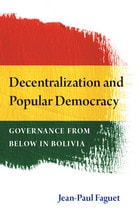
Decentralization and Popular Democracy
Governance from Below in BoliviaJean-Paul Faguet
University of Michigan Press, 2013
Bolivia decentralized in an effort to deepen democracy, improve public services, and make government more accountable. Unlike many countries, Bolivia succeeded. Over the past generation, public investment shifted dramatically toward primary services and resource distribution became far more equitable, partly due to the creation of new local governments. Many municipalities responded to decentralization with transparent, accountable government, yet others suffered ineptitude, corruption, or both. Why? Jean-Paul Faguet combines broad econometric data with deep qualitative evidence to investigate the social underpinnings of governance. He shows how the interaction of civic groups and business interests determines the quality of local decision making.
In order to understand decentralization, Faguet argues, we must understand governance from the ground up. Drawing on his findings, he offers an evaluation of the potential benefits of decentralization and recommendations for structuring successful reform.
Decentralization, Local Governance, and Inequality in the Middle East and North Africa
Kristen Kao and Ellen M. Lust, Editors
University of Michigan Press, 2025
A group of international scholars brings together methodologically diverse, original research in Lebanon, Morocco, Syria, and Tunisia to expand the literature on decentralization. Following a preface by Hicham Alaoui, the empirical chapters are arranged into three thematic sections. These focus on subnational variations in the relationships between central and local actors, citizen engagement with state and non-state institutions, and the extent to which representatives reflect their local communities. Together, these chapters provide important insights into governance, participation, and representation in the MENA and open new questions for furthering the study of governance and local development. Only by unpacking perspectives and governance experiences at the micro-level can we understand how decentralization policies affect citizens’ everyday lives.

Democratic Dilemmas in the Age of Ecology
Trees and Toxics in the American WestDaniel Press
Duke University Press, 1994
Press introduces the primary debate in this confrontation as a choice between political centralization and decentralization. Do citizens faced with environmental crises tend to look first to a centralized leadership for solutions or do they tend to respond at a more local and grassroots level? What is the role of technical expertise in this process and how does it effect public participation in these matters? Do confrontations over environmental issues increase support for a more fully democratic decisionmaking process? Representing social, political, and economic challenges to democracy, these and other questions are then investigated empirically through analyses of case studies. Focusing on two recent controversies in the western United States, ancient-forest logging in Oregon and California and hazardous waste management in California, and drawing on in-depth interviews with individuals involved, Press clarifies the relationship between environmentalism and democracy and explores the characteristics of "new" democratic forms of environmental policymaking.
Revealing a need for a more decentralized process and increased individual and collective action in response to environmental crises, Democratic Dilemmas in the Age of Ecology will be of interest to a wide range of audiences, from scholars concerned with applications of democratic theory, to activists and policymakers seeking to change or implement environmental policy.
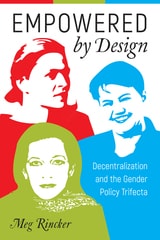
Empowered by Design
Decentralization and the Gender Policy TrifectaMeg Rincker
Temple University Press, 2017
In her probing book, Empowered by Design, Meg Rincker asks, Under what conditions will decentralization lead to women’s empowerment in countries around the globe? Using three case studies—the United Kingdom, Poland, and Pakistan—she shows how decentralization reforms create new institutional offices as power shifts from the national level to a meso-tier level, which is located between the national government and local municipalities. These shifts impact a country’s political, administrative, and fiscal reforms as well as women’s representation.
Rincker argues that this shift should be inclusive of women—or at least lead more women to participate in institutions—but this is not always the case. She indicates that three conditions, “the gender policy trifecta,” need to be met to achieve this: legislative gender quotas, women’s policy agencies, and gender-responsive budgeting at the level of governance in question. Rincker's innovative research uses original comparative data about what women want, quantitative cross-national analyses, and interviews with women’s organization leaders and politicians to show how cross-institutional policymaking can empower women.
Rincker’s fine-grained analysis makes a significant contribution to the study of representation and gendered implications of decentralization, as well as how representatives go about understanding and aggregating our diverse policy preferences.
Local Governments and Rural Development
Comparing Lessons from Brazil, Chile, Mexico, and PeruKrister Andersson, Gustavo Gordillo de Anda, and Frank van Laerhoven
University of Arizona Press, 2009
Based on interviews with more than 1,200 mayors, local officials, and farmers in 390 municipal territories in four Latin American nations, the authors analyze the ways in which different forms of decentralization affect the governance arrangements for rural development “on the ground.” Their comparative analysis suggests that rural development outcomes are systemically linked to locally negotiated institutional arrangements—formal and informal—between government officials, NGOs, and farmer groups that operate in the local sphere. They find that local-government actors contribute to public services that better assist the rural poor when local actors cooperate to develop their own institutional arrangements for participatory planning, horizontal learning, and the joint production of services.
This study brings substantive data and empirical analysis to a discussion that has, until now, more often depended on qualitative research in isolated cases. With more than 60 percent of Latin America’s rural population living in poverty, the results are both timely and crucial.

Nationalism, Devolution and the Challenge to the United Kingdom State
Arthur Aughey
Pluto Press, 2001
Networked
Business and Politics in Decentralizing Indonesia, 1998-2004Wahyu Prasetyawan
National University of Singapore Press, 2018
Networked Business and Politics in Decentralizing Indonesia evaluates three cases of deep-seated political conflict and intrigue including central government, local governments, and multinational companies. It looks at how the structure of the national political economy has changed as the result of local politicians becoming involved in disputes with the national government over control of natural resources. It also analyzes how these changes will affect the distribution of wealth in the country as well as Indonesia’s evolving democratic politics and modes of governance.

Organizing Locally
How the New Decentralists Improve Education, Health Care, and TradeBruce Fuller
University of Chicago Press, 2015
Fuller first untangles the economic and cultural currents that have eroded the efficacy of—and our trust in—large institutions over the past half century. From there we meet intrepid leaders who have been doing things differently. Traveling from a charter school in San Francisco to a veterans service network in Iowa, from a Pennsylvania health-care firm to the Manhattan branch of a Swedish bank, he explores how creative managers have turned local staff loose to craft inventive practices, untethered from central rules and plain-vanilla routines. By holding their successes and failures up to the same analytical light, he vividly reveals the key cornerstones of social organization on which motivating and effective decentralization depends. Ultimately, he brings order and evidence to the often strident debates about who has the power—and on what scale—to structure how we work and live locally.
Written for managers, policy makers, and reform activists, Organizing Locally details the profound decentering of work and life inside firms, unfolding across postindustrial societies. Its fresh theoretical framework explains resurging faith in decentralized organizations and the ingredients that deliver vibrant meaning and efficacy for residents inside. Ultimately, it is a synthesizing study, a courageous and radical new way of conceiving of American vitality, creativity, and ambition.

Rival Claims
Ethnic Violence and Territorial Autonomy under Indian FederalismBethany Lacina
University of Michigan Press, 2017
Using new data on ethnicity and sub-national discrimination in India, national and state archives, parliamentary records, cross-national analysis and her original fieldwork, Lacina explains ethnoterritorial politics as a three-sided interaction of the center and rival interests in the periphery. Ethnic entrepreneurs use militancy to create national political pressure in favor of their goals when the prime minister lacks clear electoral reasons to court one regional group over another. Second, ethnic groups rarely win autonomy or mobilize for violence in regions home to electorally influential anti-autonomy interests. Third, when a regional ethnic majority is politically important to the prime minister, its leaders can deter autonomy demands within their borders, while actively discriminating against minorities.
Rival Claims challenges the conventional beliefs that territorial autonomy demands are a reaction to centralized power and that governments resist autonomy to preserve central prerogatives. The center has allegiances in regional politics, and ethnoterritorial violence reflects the center’s entanglement with rival interests in the periphery.