Results by title
6 books match the query 'Decisions'

Algebras, Diagrams and Decisions in Language, Logic and Computation
Edited by Kees Vermeulen and Ann Copestake
CSLI, 2002

Controversies and Decisions
The Social Sciences and Public PolicyCharles Frankel
Russell Sage Foundation, 1976
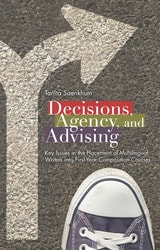
Decisions, Agency, and Advising
Key Issues in the Placement of Multilingual Writers into First-Year Composition CoursesTanita Saenkhum
Utah State University Press, 2016
Tanita Saenkhum follows eleven multilingual students who made their decisions about placement into first-year composition courses during one academic year at a large public university. She identifies the need for the process of making placement decisions to be understood more clearly, describes how to use that knowledge to improve placement practices for these students—particularly in advising—and offers hands-on recommendations for writing programs.
Decisions, Agency, and Advising is a significant contribution to the field and particularly valuable to writing program administrators, academic advisors, writing teachers, researchers investigating second language writing and writing program administration, composition and second language writing scholars, and graduate students.
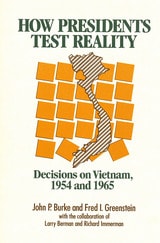
How Presidents Test Reality
Decisions on Vietnam, 1954 and 1965John P. Burke, Fred L. Greenstein, Larry Berman, and Richard Immerman
Russell Sage Foundation, 1991
Just as famines and plagues can provide opportunities for medical research, the unhappy course of United States relations with Vietnam is a prime source of evidence for students of American political institutions. How Presidents Test Reality draws on the record of American decision making about Vietnam to explore the capacity of top government executives and their advisers to engage in effective reality testing.
Authors Burke and Greenstein compare the Vietnam decisions of two presidents whose leadership styles and advisory systems diverged as sharply as any in the modern presidency. Faced with a common challenge—an incipient Communist take-over of Vietnam—presidents Eisenhower and Johnson engaged in intense debates with their aides and associates, some of whom favored intervention and some of whom opposed it. In the Dien Bien Phu Crisis of 1954, Eisenhower decided not to enter the conflict; in 1965, when it became evident that the regime in South Vietnam could not hold out much longer, Johnson intervened.
How Presidents Test Reality uses declassified records and interviews with participants to assess the adequacy of each president’s use of advice and information. This important book advances our historical understanding of the American involvement in Vietnam and illuminates the preconditions of effective presidential leadership in the modern world.
"An exceptionally thoughtful exercise in what ‘contemporary history’ ought to be. Illuminates the past in a way that suggests how we might deal with the present and the future." —John Lewis Gaddis
"Burke and Greenstein have written what amounts to an owner's manual for operating the National Security Council....This is a book Reagan's people could have used and George Bush ought to read." —Bob Schieffer, The Washington Monthly
Revisiting U.S. Trade Policy
Decisions in PerspectiveAlfred E. Eckes Jr.
Ohio University Press, 2000
In trade policy, as in many other areas of public policy, decision makers often confront present and future problems with little understanding of how similar disputes were resolved in the past. Too often, busy public officials had no time to write or record negotiating histories. Revisiting U.S. Trade Policy, which is certain to become a classic in the literature of trade negotiations, is just such a record.
Built on the oral histories of thirty-five former U.S. trade policymakers—including Michael Blumenthal, Alonzo McDonald, William Roth, and Robert S. Strauss—this unique record, prepared for publication by Alfred E. Eckes, revisits some of the most important moments of America’s trade liberalization program in the years after World War II.
From GATT to the World Trade Organization, these major players look back in candid hindsight at their decisions concerning trade policy and the effects that those decisions had on shaping the new international economic order.

Shaping Science
Organizations, Decisions, and Culture on NASA’s TeamsJanet Vertesi
University of Chicago Press, 2020
In Shaping Science, Janet Vertesi draws on a decade of immersive ethnography with NASA’s robotic spacecraft teams to create a comparative account of two great space missions of the early 2000s. Although these missions featured robotic explorers on the frontiers of the solar system bravely investigating new worlds, their commands were issued from millions of miles away by a very human team. By examining the two teams’ formal structures, decision-making techniques, and informal work practices in the day-to-day process of mission planning, Vertesi shows just how deeply entangled a team’s local organizational context is with the knowledge they produce about other worlds.
Using extensive, embedded experiences on two NASA spacecraft teams, this is the first book to apply organizational studies of work to the laboratory environment in order to analyze the production of scientific knowledge itself. Engaging and deeply researched, Shaping Science demonstrates the significant influence that the social organization of a scientific team can have on the practices of that team and the results they yield.