Results by title
10 books match the query 'Verb'
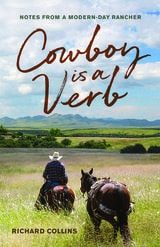
Cowboy is a Verb
Notes from a Modern-day RancherRichard Collins
University of Nevada Press, 2019
A born storyteller with a flair for words, Collins breathes life into the geology, history, and interdependency of land, water, and native and introduced plants and animals. He conjures indelible portraits of the hardworking, dedicated people he comes to know. With both humor and humility, he recounts the day-to-day challenges of ranch life such as how to build a productive herd, distribute your cattle evenly across a rough and rocky landscape, and establish a grazing system that allows pastures enough time to recover. He also intimately recounts a battle over the endangered Gila topminnow and how he and his neighbors worked with university range scientists, forest service conservationists, and funding agencies to improve their ranches as well as the ecological health of the Redrock Canyon watershed.
Ranchers who want to stay in the game don’t dominate the landscape; instead, they have to continually study the land and the animals it supports. Collins is a keen observer of both. He demonstrates that patience, resilience, and a common-sense approach to conservation and range management are what counts, combined with an enduring affection for nature, its animals, and the land. Cowboy is a Verb is not a romanticized story of cowboy life on the range, rather it is a complex story of the complicated work involved with being a rancher in the twenty-first-century West.
English Verb Classes and Alternations
A Preliminary InvestigationBeth Levin
University of Chicago Press, 1993
The first part of the book sets out alternate ways in which verbs can express their arguments. The second presents classes of verbs that share a kernel of meaning and explores in detail the behavior of each class, drawing on the alternations in the first part. Levin's discussion of each class and alternation includes lists of relevant verbs, illustrative examples, comments on noteworthy properties, and bibliographic references. The result is an original, systematic picture of the organization of the verb inventory.
Easy to use, English Verb Classes and Alternations sets the stage for further explorations of the interface between lexical semantics and syntax. It will prove indispensable for theoretical and computational linguists, psycholinguists, cognitive scientists, lexicographers, and teachers of English as a second language.
French Verbs Made Simple(r)
By David Brodsky
University of Texas Press, 2006
It's time for a new approach to learning French verbs. Unlike popular verb guides that require the rote memorization of hundreds of verb forms, this book clearly explains the rules that govern the conjugation of all classes of French verbs—especially the irregular ones that give second-language learners the most trouble. These straightforward, easy-to-understand rules for conjugating French verbs are effective learning tools for both beginning students and more advanced speakers who want to perfect their usage of French verb forms.
French Verbs Made Simple(r) has many helpful features that you won't find in any other verb guide:
- Clear explanations of all verb tenses and forms.
- The simple patterns and rules that govern the conjugation of all verbs—including those verbs whose irregularities follow patterns that can be easily learned.
- A detailed discussion of how each verb form is used, with numerous examples.
- A full explanation of whether a verb should be conjugated with avoir or être, and the conditions under which the past participle is variable—two of the thorniest problems for students of French.
- An extended treatment of the subjunctive that will help you understand why it is used in some situations but not others.
- Complete conjugations for 57 basic model verbs (along with 27 "variants") and a comprehensive listing of some 6,200 verbs that indicates which of the models each verb follows.
Going well beyond any other guide in the clarity and detail of its explanations—as well as the innovative manner in which individual verbs are linked to model conjugations—French Verbs Made Simple(r) is the only guide to French verbs a learner needs.
Linking by Types in the Hierarchical Lexicon
Anthony R. Davis
CSLI, 2001
Many previous approaches to this problem have employed a set of thematic roles, such as agent and patient, to classify varieties of participants. The alternative developed here fits within the framework of Head-Driven Phrase Structure Grammar while utilizing typed feature structures, certain basic features of verb meaning, a hierarchical classification of verb meanings, and constraints from more general to more specific word classes. Relying on no special mechanisms or components of grammar, this book is unique in its ability to account for the observed range of verb types in human languages with a simple yet widely applicable set of principles.
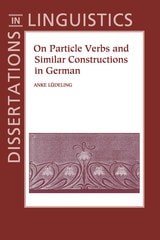
On Particle Verbs and Similar Constructions in German
Anke Lüdeling
CSLI, 2001
Particle verbs have previously been analyzed as morphological objects or as phrasal constructions, but neither approach fits cleanly within its chosen framework. The resolution presented here is that particle verbs should be seen as lexicalized phrasal constructions. Emphasizing morphological and syntactic testability, over a hundred colloquial examples are shown to break the rules of previous approaches while remaining consistent with this book's proposition. To distinguish particle verbs from similar constructions, and to demonstrate how structural and morphological factors have been misidentified in the past, preverb verb constructions (PVCs) are introduced and diagrammed. This reveals the roles of listedness and non-transparency in word formation and clarifies the conclusion that particle verbs do not form a definable class of words.
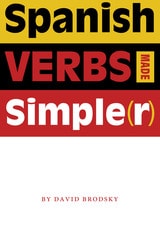
Spanish Verbs Made Simple(r)
By David Brodsky
University of Texas Press, 2005
It's time for a new approach to learning Spanish verbs. Unlike popular verb guides that require the rote memorization of hundreds of verb forms, this book clearly explains the rules that govern the conjugation of all classes of Spanish verbs—especially the irregular ones that give second-language learners the most trouble. These simple, easy-to-understand rules for conjugating Spanish verbs are effective learning tools for both beginning students and more advanced speakers who want to perfect their usage of Spanish verb forms.
Spanish Verbs Made Simple(r) has many helpful features that you won't find in any other verb guide:
- Clear explanations of all verb tenses and forms.
- The simple rules that govern the conjugation of all verbs—including the 90% of irregular verbs whose irregularities are entirely predictable.
- A detailed discussion of how each verb form is used, with numerous examples.
- A full explanation of the distinction between ser and estar—the single most confusing element in the Spanish verbal system.
- An extended treatment of the subjunctive that will help you understand why it is used in some situations but not others.
- Conjugations for 35 model Spanish verbs and a comprehensive listing of 4,800 verbs that indicates which of the models each verb follows.
Going well beyond any other guide in the clarity and detail of its explanations—as well as the innovative manner in which individual verbs are linked to model conjugations—Spanish Verbs Made Simple(r) is the only guide to Spanish verbs a learner needs.
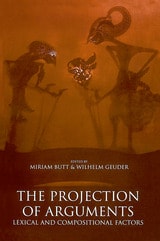
The Projection of Arguments
Lexical and Compositional FactorsEdited by Miriam Butt and Wilhelm Geuder
CSLI, 1998
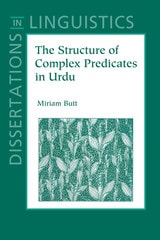
The Structure of Complex Predicates in Urdu
Miriam Butt
CSLI, 1995
This book takes a detailed look at two differing complex predicates in the South Asian language Urdu. The Urdu permissive in particular brings into focus the problem of the syntax-semantics mismatch. An examination of the syntactic properties of this complex predicate shows that it is formed by the combination of two semantic heads, but that this combination is not mirrored in the syntax in terms of any kind of syntactic or lexical incorporation.
The Syntax and Semantics of the Verb in Classical Greek
An Introduction: Third EditionAlbert Rijksbaron
University of Chicago Press, 2007
The verb is, in any language, the motor of all communication: no verb, no action. In Greek, verb forms change not only with person, number, tense, and voice, but in four possible moods as well. Available now in a special reprint for the North American market, The Syntax and Semantics of the Verb in Classical Greek is an incomparable resource to students and scholars charged with the considerable task of untangling the Greek language’s many complexities. With clear, concise instruction, Albert Rijksbaron shows how the various verb forms contribute to the richness of the Greek literature as we know it, in this essential guide for both novices and experienced practitioners.
“[This study] belongs in the library of any Hellenist and any linguist interested in ancient Greek.”—Classics Newsletter (Anzeiger für die Altertumswissenschaft)
“Every use is described with concision and clarity.”—Kratylos
“The book offers an example of how the empirical thoroughness of traditional Classical scholarship can be brought into contact with general linguistic theory.”—Language
Voice and Grammatical Functions in Austronesian Languages
Edited by Peter K. Austin and Simon Musgrave
CSLI, 2005