Results by title
4 books match the query 'Decolonial Imagination'
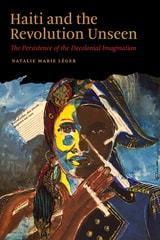
Haiti and the Revolution Unseen
The Persistence of the Decolonial ImaginationNatalie Marie Léger
Vanderbilt University Press, 2025
With Haiti and the Revolution Unseen, Natalie Marie Léger alters the genealogy of the Haitian revolutionary subject in the archive of Caribbean cultural thought and shifts our attention to the revolutionists previously left out of the archive: Saint Domingue’s Africanized captives. She posits that canonical Caribbean writers of the Haitian Revolution (1791–1804), like C. L. R. James, Aimé Césaire, Alejo Carpentier, and Édouard Glissant, ignore the conditions of difference that inspired the captive populace’s dreams of freedom from French colonial rule. These authors replicate the forms of colonial power that they sought to vilify with their Haitian revolutionist texts because they excise the African Haitian revolutionist from the story of the Revolution. Despite the fact that two-thirds of the enslaved population were African born on the eve of the Revolution, canonized Caribbean literature of the Revolution writes the Haitian revolutionist as acculturated into the West. The absence of African Haitian revolutionists results in narratives that do not see Haitian ideas about Haiti and the Haitian Revolution. They are the stories of a Haiti and the Haitian Revolution unseen.
Léger writes against a Haiti- and Haitians-less idea of the Revolution. She asks scholars and artists of the Revolution to know Haitians as Ginens (African Haitians) and Haiti as Ayiti Ginen (Africa Haiti). This form of knowing demands a decolonial understanding of the Haitian Revolution and a reevaluation of its stories as told by influential twentieth-century Caribbean writers. The story she tells showcases the immense political impact of the African Haitian revolutionist’s philosophies of freedom in Saint Domingue and Haiti thereafter; and she argues that the absence of these philosophies in Caribbean classics of the Revolution demands consideration of why these classics continue to shape how the Revolution and Haiti are discussed in Caribbean Studies, Black Studies, Postcolonial Studies and Haitian Studies. More pressingly, Léger calls on artists and scholars of the Revolution to be mindful of how Haiti and Haitians are figured in narratives of the Revolution. The immense space Haiti holds in Caribbean imaginings of freedom and revolution makes mediating it, its Revolution, and peoples through a prejudiced gaze that serves the West hugely problematic, since a denigrated Haiti yields stunted visions of the Caribbean’s future. These conditions require attention to the pervasive presence of colonial paradigms for being in classic literatures of the Revolution and the way they undermine the generative manner Caribbean writers have used Haiti to think through their past, present, and future.
Léger writes against a Haiti- and Haitians-less idea of the Revolution. She asks scholars and artists of the Revolution to know Haitians as Ginens (African Haitians) and Haiti as Ayiti Ginen (Africa Haiti). This form of knowing demands a decolonial understanding of the Haitian Revolution and a reevaluation of its stories as told by influential twentieth-century Caribbean writers. The story she tells showcases the immense political impact of the African Haitian revolutionist’s philosophies of freedom in Saint Domingue and Haiti thereafter; and she argues that the absence of these philosophies in Caribbean classics of the Revolution demands consideration of why these classics continue to shape how the Revolution and Haiti are discussed in Caribbean Studies, Black Studies, Postcolonial Studies and Haitian Studies. More pressingly, Léger calls on artists and scholars of the Revolution to be mindful of how Haiti and Haitians are figured in narratives of the Revolution. The immense space Haiti holds in Caribbean imaginings of freedom and revolution makes mediating it, its Revolution, and peoples through a prejudiced gaze that serves the West hugely problematic, since a denigrated Haiti yields stunted visions of the Caribbean’s future. These conditions require attention to the pervasive presence of colonial paradigms for being in classic literatures of the Revolution and the way they undermine the generative manner Caribbean writers have used Haiti to think through their past, present, and future.
[more]

Junot Díaz and the Decolonial Imagination
Monica Hanna, Jennifer Harford Vargas, José David Saldívar, editors
Duke University Press, 2016
The first sustained critical examination of the work of Dominican-American writer Junot Díaz, this interdisciplinary collection considers how Díaz's writing illuminates the world of Latino cultural expression and trans-American and diasporic literary history. Interested in conceptualizing Díaz's decolonial imagination and his radically re-envisioned world, the contributors show how his aesthetic and activist practice reflect a significant shift in American letters toward a hemispheric and planetary culture. They examine the intersections of race, Afro-Latinidad, gender, sexuality, disability, poverty, and power in Díaz's work. Essays in the volume explore issues of narration, language, and humor in The Brief Wondrous Life of Oscar Wao, the racialized constructions of gender and sexuality in Drown and This Is How You Lose Her, and the role of the zombie in the short story "Monstro." Collectively, they situate Díaz’s writing in relation to American and Latin American literary practices and reveal the author’s activist investments. The volume concludes with Paula Moya's interview with Díaz.
Contributors: Glenda R. Carpio, Arlene Dávila, Lyn Di Iorio, Junot Díaz, Monica Hanna, Jennifer Harford Vargas, Ylce Irizarry, Claudia Milian, Julie Avril Minich, Paula M. L. Moya, Sarah Quesada, José David Saldívar, Ramón Saldívar, Silvio Torres-Saillant, Deborah R. Vargas
[more]
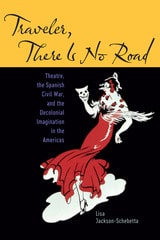
Traveler, There Is No Road
Theatre, the Spanish Civil War, and the Decolonial Imagination in the AmericasLisa Jackson-Schebetta
University of Iowa Press, 2017
Traveler, There Is No Road offers a compelling and complex vision of the decolonial imagination in the United States from 1931 to 1943 and beyond. By examining the ways in which the war of interpretation that accompanied the Spanish Civil War (1936–1939) circulated through Spanish and English language theatre and performance in the United States, Lisa Jackson-Schebetta demonstrates that these works offered alternative histories that challenged the racial, gender, and national orthodoxies of modernity and coloniality. Jackson-Schebetta shows how performance in the US used histories of American empires, Islamic legacies, and African and Atlantic trades to fight against not only fascism and imperialism in the 1930s and 1940s, but modernity and coloniality itself.
This book offers a unique perspective on 1930s theatre and performance, encompassing the theatrical work of the Cuban, Puerto Rican, and Spanish diasporas in the United States, as well as the better-known Anglophone communities. Jackson-Schebetta situates well-known figures, such as Langston Hughes and Clifford Odets, alongside lesser-known ones, such as Erasmo Vando, Franca de Armiño, and Manuel Aparicio. The milicianas, female soldiers of the Spanish Republic, stride on stage alongside the male fighters of the Lincoln Brigade. They and many others used the multiple visions of Spain forged during the civil war to foment decolonial practices across the pasts, presents, and futures of the Americas. Traveler conclusively demonstrates that theatre and performance scholars must position US performances within the Americas writ broadly, and in doing so they must recognize the centrality of the hemisphere’s longest-lived colonial power, Spain.
This book offers a unique perspective on 1930s theatre and performance, encompassing the theatrical work of the Cuban, Puerto Rican, and Spanish diasporas in the United States, as well as the better-known Anglophone communities. Jackson-Schebetta situates well-known figures, such as Langston Hughes and Clifford Odets, alongside lesser-known ones, such as Erasmo Vando, Franca de Armiño, and Manuel Aparicio. The milicianas, female soldiers of the Spanish Republic, stride on stage alongside the male fighters of the Lincoln Brigade. They and many others used the multiple visions of Spain forged during the civil war to foment decolonial practices across the pasts, presents, and futures of the Americas. Traveler conclusively demonstrates that theatre and performance scholars must position US performances within the Americas writ broadly, and in doing so they must recognize the centrality of the hemisphere’s longest-lived colonial power, Spain.
[more]
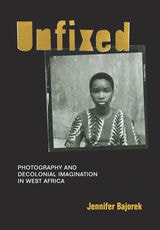
Unfixed
Photography and Decolonial Imagination in West AfricaJennifer Bajorek
Duke University Press, 2020
In Unfixed Jennifer Bajorek traces the relationship between photography and decolonial political imagination in Francophone west Africa in the years immediately leading up to and following independence from French colonial rule in 1960. Focusing on images created by photographers based in Senegal and Benin, Bajorek draws on formal analyses of images and ethnographic fieldwork with photographers to show how photography not only reflected but also actively contributed to social and political change. The proliferation of photographic imagery—through studio portraiture, bureaucratic ID cards, political reportage and photojournalism, magazines, and more—provided the means for west Africans to express their experiences, shape public and political discourse, and reimagine their world. In delineating how west Africans' embrace of photography was associated with and helped spur the democratization of political participation and the development of labor and liberation movements, Bajorek tells a new history of photography in west Africa—one that theorizes photography's capacity for doing decolonial work.
[more]