Results by title
8 books match the query 'Defense (Criminal procedure)'
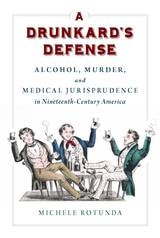
A Drunkard's Defense
Alcohol, Murder, and Medical Jurisprudence in Nineteenth-Century AmericaMichele Rotunda
University of Massachusetts Press, 2021
Is drunkenness a defense for murder? In the early nineteenth century, the answer was a resounding no. Intoxication was considered voluntary, and thus provided no defense. Yet as the century progressed, American courts began to extend exculpatory value to heavy drinking. The medicalization of alcohol use created new categories of mental illness which, alongside changes in the law, formed the basis for defense arguments that claimed unintended consequences and lack of criminal intent. Concurrently, advocates of prohibition cast “demon rum” and the “rum-seller” as the drunkard's accomplices in crime, mitigating offenders' actions. By the postbellum period, a backlash, led by medical professionals and an influential temperance movement, left the legacy of an unsettled legal standard.
In A Drunkard's Defense, Michele Rotunda examines a variety of court cases to explore the attitudes of nineteenth-century physicians, legal professionals, temperance advocates, and ordinary Americans toward the relationship between drunkenness, violence, and responsibility, providing broader insights into the country's complicated relationship with alcohol.

Deathwork
Defending The CondemnedMichael Mello
University of Minnesota Press, 2002
A gripping exposé of what lawyers face when they defend prisoners in capital cases.
Legal cases are stories, and some of the most compelling-and the most disturbing-are those that take place on death row: the innocent man executed, juveniles and the mentally ill condemned to die, a smoking electric chair, a napping defense attorney, a senile hit man. These are the stories in which Michael Mello, as a capital public defender, played a crucial role, and they are the cases that make up Deathwork, a moment-by-moment, behind-the-scenes look at the life and work of a death row lawyer and his clients.
Part memoir, part legal casebook, Deathwork offers a gritty, often anguishing picture of what Supreme Court Justice Harry Blackmun called the American legal "machinery of death." The stories Mello tells raise questions about legal issues-from prosecutorial misconduct to the racial inequities of sentencing, from the rules of evidence to the rights of the mentally ill-that here take on a life-and-death urgency. They describe in detail how constitutional issues are raised postconviction, and how those issues are adjudicated by the courts and in accordance with bizarre claims of objectivity. And they show, with a painful immediacy and authenticity, what it is like to live and work under an impending death sentence, the adrenaline rush of the stay or unexpected success, the inconsolable sadness upon the execution of the sick, the afflicted, the innocent.As DNA reversals, last-minute confessions, and revelations of corruption are bringing capital punishment to the forefront of public debate nationwide, this firsthand account of the legalities and realities of the death penalty is as relevant as it is enthralling, as edifying as it is impossible to ignore.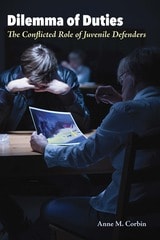
Dilemma of Duties
The Conflicted Role of Juvenile DefendersAnne M. Corbin
Southern Illinois University Press, 2018
In Dilemma of Duties, Corbin outlines patterns of role conflict that defenders experience, details its impact on counselors and clients in the juvenile justice system, and addresses the powerful influence of the juvenile court culture and the lack of resources for defenders. Tasked with guiding these children, counselors frequently must contend with and manage their clients’ general distrust of adults as they attempt to serve as their voices to the court.
Understanding how juvenile defenders define their role and experience role conflict provides valuable insights into our juvenile justice system, especially its role in upholding due process rights. Such knowledge points to the importance of the training and practices of juvenile court functionaries and the efficacy, credibility, and legitimacy of the juvenile justice system itself.
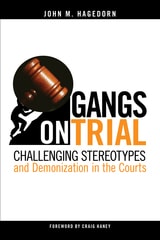
Gangs on Trial
Challenging Stereotypes and Demonization in the CourtsJohn M. Hagedorn
Temple University Press, 2022
John Hagedorn, who has long been an expert witness in gang-related court cases, claims that what transpires in the trials of gang members is a far cry from what we would consider justice. In Gangs on Trial, he recounts his decades of experience to show how stereotypes are used against gang members on trial and why that is harmful. Hagedorn uses real-life stories to explain how implicit bias often replaces evidence and how the demonization of gang members undermines fairness. Moreover, a “them and us” mentality leads to snap judgments that ignore the complexity of gang life in America.
Gangs on Trial dispels myths about gangs and recommends tactics for lawyers, mitigation specialists, and expert witnesses as well as offering insights for jurors. Hagedorn describes how minds are subconsciously “primed” when a defendant is identified as a gang member, and discusses the “backfire effect,” which occurs when jurors hear arguments that run counter to their beliefs. He also reveals how attributional errors, prejudice, and racism impact sentences of nonwhite defendants.
Hagedorn argues that dehumanization is the psychological foundation of mass incarceration. Gangs on Trial advocates for practical sentencing reforms and humanizing justice.
Guilty People
Abbe Smith
Rutgers University Press, 2020
In Guilty People, law professor and longtime criminal defense attorney Abbe Smith gives us a thoughtful and honest look at guilty individuals on trial. Each chapter tells compelling stories about real cases she handled; some of her clients were guilty of only petty crimes and misdemeanors, while others committed offenses as grave as rape and murder. In the process, she answers the question that every defense attorney is routinely asked: How can you represent these people?
Smith’s answer also tackles seldom-addressed but equally important questions such as: Who are the people filling our nation’s jails and prisons? Are they as dangerous and depraved as they are usually portrayed? How did they get caught up in the system? And what happens to them there?
This book challenges the assumption that the guilty are a separate species, unworthy of humane treatment. It is dedicated to guilty people—every single one of us.
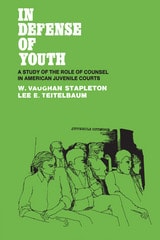
In Defense of Youth
A Study of the Role of Counsel in American Juvenile CourtsWilliam Vaughn Stapleton
Russell Sage Foundation, 1972
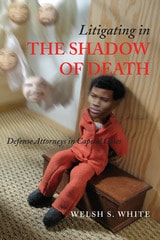
Litigating in the Shadow of Death
Defense Attorneys in Capital CasesWelsh S. White
University of Michigan Press, 2005
"Anyone who cares about capital punishment should read this compelling, lucid account of the obstacles defense attorneys face and the strategies they adopt."
--John Parry, University of Pittsburgh School of Law
"With its compelling narratives of cases, strategies, and ethical dilemmas, Litigating in the Shadow of Death is difficult to put down. . . . This pathbreaking book encapsulates the experience of the most respected capital defenders in America and shows how they save even the worst of the worst from execution. It also shows how sleeping and otherwise incompetent lawyers bring death sentences to their clients. Litigating in the Shadow of Death explores the lawyers' tasks at every stage of the criminal process--investigation, client interviewing, conferring with victims' families, plea bargaining, trial, appeal, and post-conviction proceedings."
--Albert W. Alschuler, Julius Kreeger Professor of Law and Criminology, University of Chicago
"A unique and profoundly important contribution to the literature on the death penalty. White allows the leading capital defense attorneys to speak in their own voices. His work reveals a new source of arbitrariness in the death system--whether the penalty is imposed turns more on who is your lawyer than on how evil was your deed or your character. Litigating in the Shadow of Death offers concrete guidelines for better lawyering, protection of the innocent, and understanding the artistry of the best capital attorneys. This is vivid, gripping stuff."
--Andrew Taslitz, Professor of Law, Howard University
"A most illuminating book by a splendid writer and an eminent critic of the capital punishment system."
--Yale Kamisar, Professor of Law, University of San Diego
"Welsh White has written another excellent book on the death penalty--this one on how defense attorneys in capital cases successfully prevent the state from executing their clients. Based on original research, Litigating in the Shadow of Death is informative and insightful. This is a book that all serious students of American capital punishment must read."
--Richard Leo, University of California, Irvine
Welsh S. White was Bessie McKee Walthour Endowed Chair and Professor of Law at the University of Pittsburgh.
Reproducing Rape
Domination through Talk in the CourtroomGregory M. Matoesian
University of Chicago Press, 1993
Matoesian examines the language of the courtroom, focusing on how defense lawyers interpret and classify rape in a way that makes the victim's experience appear as a normal sexual encounter. He analyzes the language that defense attorneys use in cross-examination to argue that courtroom talk can shape the victim's testimony to fit male standards of legitimate sexual practice. On this view, cross-examination is an adversarial war of words through which lawyers manipulate reality and perpetuate the patriarchal domination of women.
Reproducing Rape will interest students and professionals in law, criminology, sociology, feminist theory, linguistics, and anthropology.