Results by title
6 books match the query 'Dementia'
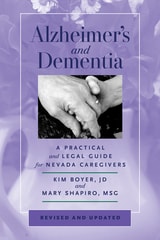
Alzheimer's and Dementia
A Practical and Legal Guide for Nevada Caregivers, Revised and UpdatedKim Boyer
University of Nevada Press, 2025
The book, specific to Nevada, covers state laws including Medicaid planning, asset protection, guardianship, probate, advance directives, and patient rights. It also addresses estate and financial planning, and provides a detailed list of resources available to assist caregivers. Written by an elder law attorney and a gerontologist, Alzheimer’s and Dementiaoffers insights from two professionals who provide practical solutions to common obstacles faced by caregivers, helping them support the needs and overcome the challenges facing those coping with these diseases.
Boyer and Shapiro coauthored The Essential Eldercare Handbook for Nevada also available from the University of Nevada Press.
Alzheimer’s and Dementia
A Practical and Legal Guide for Nevada CaregiversKim Boyer
University of Nevada Press, 2012
Dementia Caregivers Share Their Stories
A Support Group in a BookLynda A. Markut
Vanderbilt University Press, 2005
Highlighting the ingenuity and resourcefulness of caregivers, the book brims with inspirational stories, practical advice, and creative approaches to problem-solving. Among the issues addressed are:
Becoming a caregiver, whether for a spouse or parent
Dealing with the personality changes caused by dementia, from anxiety and paranoia to hallucinations and impulsive behavior
Keeping dementia sufferers meaningfully involved in life
Handling the emotions and stresses of caregiving
Seeking help through support groups and other sources, including medical professionals, clergy, and other family members The authors, who have both been caregivers themselves, augment their interviewees' stories with connective commentary and their own personal stories. A useful resource section is included to refer readers to associations and help-lines.

The Black Rose of Halfeti
By Nazli Eray, translated by Robert Finn
University of Texas Press, 2017
The Black Rose of Halfeti opens with a letter delivered at midnight in Ankara, Turkey. In this letter, an elderly doctor who has begun to experience the first signs of dementia professes his love and desire for a relationship with the narrator, a woman in middle age beginning to contemplate her own mortality. From there, the novel moves between Mardin, Izmir, and Ankara; the past and the present; and the real and the imagined as the narrator seeks to know the doctor both in his prime and in his struggle to hold senility at bay. In these dreamlike landscapes, the author effortlessly introduces King Darius, the Spanish director Luis Buñuel, the actress Silvia Pinal, and the archetypal dream woman as the narrator’s guides in her efforts to understand the human psyche.
Nazli Eray has established herself as a master of magical realism, the perfect tool to bring to life this poignant meditation on love, aging, and the role of memory. And, as in her earlier novels, she paints vivid images of the urban landscapes of Turkey, capturing both the present and the past.
Thinking About Dementia
Culture, Loss, and the Anthropology of SenilityLeibing, Annette
Rutgers University Press, 2006
Bringing together essays by nineteen respected scholars, this volume approaches dementia from a variety of angles, exploring its historical, psychological, and philosophical implications. The authors employ a cross-cultural perspective that is based on ethnographic fieldwork and focuses on questions of age, mind, voice, self, loss, temporality, memory, and affect.
Taken together, the essays make four important and interrelated contributions to our understanding of the mental status of the elderly. First, cross-cultural data show that the aging process, while biologically influenced, is also culturally constructed. Second, ethnographic reports raise questions about the diagnostic criteria used for defining the elderly as demented. Third, case studies show how a diagnosis affects a patient's treatment in both clinical and familial settings. Finally, the collection highlights the gap that separates current biological understandings of aging from its cultural meanings.
As Alzheimer's disease and other forms of dementia continue to command an ever-increasing amount of attention in medicine and psychology, this book will be essential reading for anthropologists, social scientists, and health care professionals.
Your Own Will Leave You
My Mother's DementiaManash Firaq Bhattacharjee
Temple University Press, 2026
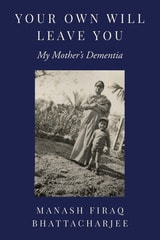
“Memory’s barriers are without barriers,” writes Manash Firaq Bhattacharjee in the opening of his touching and thoughtful memoir, Your Own Will Leave You. Bhattacharjee eloquently reflects on family, care, and memory as he chronicles his experiences with his elderly mother who suffers from dementia. Working from his journal, Bhattacharjee ruminates on the ways we understand dementia and memory as well as end-of-life issues. He is not only a loving son, but also an Indian with a universal sensibility who turns to ancient and contemporary thinkers that inform his perspective.
Bhattacharjee focuses on the last months of his mother’s life and her changing demeanor—her stubbornness, humor, and vulnerability. He traces her interactions with family members, neighbors, and caregivers, while also addressing burden-of-care issues. Recounting his moments of grief and guilt with candor, Bhattacharjee also re-evaluates how Western culture prejudices popular perceptions of mental illness.
Lyrical, penetrating, occasionally aphoristic, and full of insights, Your Own Will Leave You is a heartfelt, and at times heartbreaking, memoir and a warm elegy for the author’s late mother.