Results by title
6 books match the query 'Democratic National Convention'
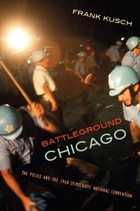
Battleground Chicago
The Police and the 1968 Democratic National ConventionFrank Kusch
University of Chicago Press, 2008
Working from interviews with eighty former Chicago police officers who were on the scene, Frank Kusch uncovers the other side of the story of ’68, deepening our understanding of a turbulent decade.
“Frank Kusch’s compelling account of the clash between Mayor Richard Daley’s men in blue and anti-war rebels reveals why the 1960s was such a painful era for many Americans. . . . to his great credit, [Kusch] allows ‘the pigs’ to speak up for themselves.”—Michael Kazin
“Kusch’s history of white Chicago policemen and the 1968 Democratic National Convention is a solid addition to a growing literature on the cultural sensibility and political perspective of the conservative white working class in the last third of the twentieth century.”—David Farber, Journal of American History
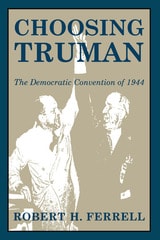
Choosing Truman
The Democratic Convention of 1944Robert H. Ferrell
University of Missouri Press, 2000
As Franklin D. Roosevelt's health deteriorated in the months leading up to the Democratic National Convention of 1944, Democratic leaders confronted a dire situation. Given the inevitability of the president's death during a fourth term, the choice of a running mate for FDR was of profound importance. The Democrats needed a man they could trust. They needed Harry S. Truman.
Robert Ferrell tells an engrossing tale of ruthless ambition, secret meetings, and party politics. Roosevelt emerges as a manipulative leader whose desire to retain power led to a blatant disregard for the loyalty of his subordinates and the aspirations of his vice presidential hopefuls. Startling in its conclusions, impeccable in its research, Choosing Truman is an engrossing, behind-the-scenes look at the making of the nation's thirty-third president.
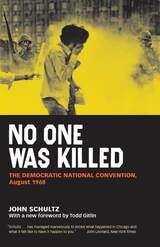
No One Was Killed
The Democratic National Convention, August 1968John Schultz
University of Chicago Press, 2009
While other writers contemplated the events of the 1968 Chicago riots from the safety of their hotel rooms, John Schultz was in the city streets, being threatened by police, choking on tear gas, and listening to all the rage, fear, and confusion around him. The result, No One Was Killed, is his account of the contradictions and chaos of convention week, the adrenalin, the sense of drama and history, and how the mainstream press was getting it all wrong.
"A more valuable factual record of events than the city’s white paper, the Walker Report, and Theodore B. White’s Making of a President combined."—Book Week
"As a reporter making distinctions between Yippie, hippie, New Leftist, McCarthyite, police, and National Guard, Schultz is perceptive; he excels in describing such diverse personalities as Julian Bond and Eugene McCarthy."—Library Journal
"High on my short list of true, lasting, inspired evocations of those whacked-out days when the country was fighting a phantasmagorical war (with real corpses), and police under orders were beating up demonstrators who looked at them funny."—Todd Gitlin, from the foreword
Troubled Pasts
News and the Collective Memory of Social UnrestJill A. Edy
Temple University Press, 2006
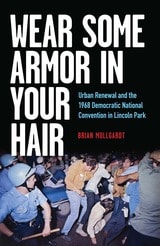
Wear Some Armor in Your Hair
Urban Renewal and the 1968 Democratic National Convention in Lincoln ParkBrian Mullgardt
Southern Illinois University Press, 2024
WINNER, 2025 Illinois State Historical Society Russell P. Strange Book of the Year Award!
Police brutality, gentrification, and grassroots activism in 1960s Chicago
In August of 1968, approximately 7,000 people protested the Vietnam War against the backdrop of the Democratic National Convention in Chicago. This highly televised event began peacefully but quickly turned into what was later termed a “police riot.” Brian Mullgardt’s investigation of this event and the preceding tensions shines a light on the ministers, Yippies, and community members who showed up and stood together against the brutality of the police. Charting a complex social history, Wear Some Armor in Your Hair brings together Chicago history, the 1960s, and urbanization, focusing not on the national leaders, but on the grassroots activists of the time.
Beginning in 1955, two competing visions of urban renewal existed, and the groups that propounded each clashed publicly, but peacefully. One group, linked to city hall, envisioned a future Lincoln Park that paid lip service to diversity but actually included very little. The other group, the North Side Cooperative Ministry, offered a different vision of Lincoln Park that was much more diverse in terms of class and race. When the Yippies announced anti-war protests for the summer of ‘68, the North Side Cooperative Ministry played an instrumental role. Ultimately, the violence of that week altered community relations and the forces of gentrification won out.
Mullgardt’s focus on the activists and community members of Lincoln Park, a neighborhood at the nexus of national trends, broadens the scope of understanding around a pivotal and monumental chapter of our history. The story of Lincoln Park, Chicago, is in many ways the story of 1960s activism writ small, and in other ways challenges us to view national trends differently.
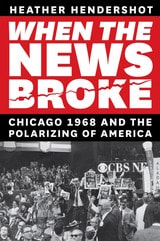
When the News Broke
Chicago 1968 and the Polarizing of AmericaHeather Hendershot
University of Chicago Press, 2022
“The whole world is watching!” cried protestors at the 1968 Democratic convention as Chicago police beat them in the streets. When some of that violence was then aired on network television, another kind of hell broke loose. Some viewers were stunned and outraged; others thought the protestors deserved what they got. No one—least of all Chicago mayor Richard J. Daley—was happy with how the networks handled it.
In When the News Broke, Heather Hendershot revisits TV coverage of those four chaotic days in 1968—not only the violence in the streets but also the tumultuous convention itself, where Black citizens and others forcefully challenged southern delegations that had excluded them, anti-Vietnam delegates sought to change the party’s policy on the war, and journalists and delegates alike were bullied by both Daley’s security forces and party leaders. Ultimately, Hendershot reveals the convention as a pivotal moment in American political history, when a distorted notion of “liberal media bias” became mainstreamed and nationalized.
At the same time, she celebrates the values of the network news professionals who strived for fairness and accuracy. Despite their efforts, however, Chicago proved to be a turning point in the public’s trust in national news sources. Since those critical days, the political Right in the United States has amplified distrust of TV news, to the point where even the truest and most clearly documented stories can be deemed “fake.” As Hendershot demonstrates, it doesn’t matter whether the “whole world is watching” if people don’t believe what they see.