Results by title
15 books match the query 'Descartes, René'
Cartesian Poetics
The Art of ThinkingAndrea Gadberry
University of Chicago Press, 2020
Gadberry’s approach to seventeenth-century writings poses questions urgent for the twenty-first. Bringing literature and philosophy into rich dialogue, Gadberry centers close reading as a method uniquely equipped to manage skepticism, tolerate critical ambivalence, and detect feeling in philosophy. Helping us read classic moments of philosophical argumentation in a new light, this elegant study also expands outward to redefine thinking in light of its poetic formations.
Cartesian Questions
Method and MetaphysicsJean-Luc Marion
University of Chicago Press, 1999
"Besides the impact of their content, the clarity and reach of these essays force one to consider foundational questions concerning philosophy and its history."—Richard Watson, Journal of the History of Philosophy

Descartes and His Contemporaries
Meditations, Objections, and RepliesEdited by Roger Ariew and Marjorie Grene
University of Chicago Press, 1995
Descartes and his Contemporaries recreates the tumultuous intellectual community of seventeenth-century Europe and provides a detailed, modern analysis of the Meditations in its historical context. The book's chapters examine the arguments and positions of each of the objectors—Hobbes, Gassendi, Arnauld, Morin, Caterus, Bourdin, and others whose views were compiled by Mersenne. They illuminate Descartes' relationships to the scholastics and particularly the Jesuits, to Mersenne's circle with its debates about the natural sciences, to the Epicurean movements of his day, and to the Augustinian tradition. Providing a glimpse of the interactions among leading 17th-century intellectuals as they grappled with major philosophical issues, this book sheds light on how Descartes' thought developed and was articulated in opposition to the ideas of his contemporaries.
Descartes and the Resilience of Rhetoric
Varieties of Cartesian Rhetorical TheoryThomas M. Carr, Jr.
Southern Illinois University Press, 2009
A careful analysis of the rhetorical thought of René Descartes and of a distinguished group of post-Cartesians. Covering a unique range of authors, including Bernard Lamy and Nicolas Malebranche, Carr attacks the idea, which has become commonplace in contemporary criticism, that the Cartesian system is incompatible with rhetoric.
Carr analyzes the writings of Balzac, the Port-Royalists Arnauld and Nicole, Malebranche, and Lamy, exploring the evolution of Descartes’ thought into their different theories of rhetoric. He constructs his arguments, probing each author’s writings on rhetoric, persuasion, and attention, to demonstrate the basis for rhetorical thought present in Descartes’ theory of persuasion when it is combined with his psychophysiology of attention.
Descartes' Metaphysical Physics
Daniel Garber
University of Chicago Press, 1992
Garber achieves a philosophically rigorous reading of Descartes that is sensitive to the historical and intellectual context in which he wrote. What emerges is a novel view of this familiar figure, at once unexpected and truer to the historical Descartes.
The book begins with a discussion of Descartes' intellectual development and the larger project that frames his natural philosophy, the complete reform of all the sciences. After this introduction Garber thoroughly examines various aspects of Descartes' physics: the notion of body and its identification with extension; Descartes' rejection of the substantial forms of the scholastics; his relation to the atomistic tradition of atoms and the void; the concept of motion and the laws of motion, including Descartes' conservation principle, his laws of the persistence of motion, and his collision law; and the grounding of his laws in God.
Descartes's Grey Ontology
Cartesian Science and Aristotelian Thought in the RegulaeJean-Luc Marion
St. Augustine's Press, 2022
Dying to Know
Scientific Epistemology and Narrative in Victorian EnglandGeorge Levine
University of Chicago Press, 2002
In Dying to Know, eminent critic George Levine makes a landmark contribution to the history and theory of scientific knowledge. This long-awaited book explores the paradoxes of our modern ideal of objectivity, in particular its emphasis on the impersonality and disinterestedness of truth. How, asks Levine, did this idea of selfless knowledge come to be established and moralized in the nineteenth century?
Levine shows that for nineteenth-century scientists, novelists, poets, and philosophers, access to the truth depended on conditions of such profound self-abnegation that pursuit of it might be taken as tantamount to the pursuit of death. The Victorians, he argues, were dying to know in the sense that they could imagine achieving pure knowledge only in a condition where the body ceases to make its claims: to achieve enlightenment, virtue, and salvation, one must die.
Dying to Know is ultimately a study of this moral ideal of epistemology. But it is also something much more: a spirited defense of the difficult pursuit of objectivity, the ethical significance of sacrifice, and the importance of finding a shareable form of knowledge.
Lines of Thought
Discourse, Architectonics, and the Origin of Modern PhilosophyClaudia Brodsky Lacour
Duke University Press, 1996
While Cartesianism has long served as a synonym for rationalism, the contents of Descartes’s method and cogito have remained infamously resistant to rational analysis. Similarly, although modern phenomenological analyses descend from Descartes’s notion of intuition, the “things” Cartesian intuitions represent bear no resemblance to phenomena. By returning to what Descartes calls the construction of his “foundation” in the Discours, Brodsky Lacour identifies the conceptual problems at the root of Descartes’s literary and aesthetic theory as well as epistemology. If, for Descartes, linear extension and “I” are the only “things” we can know exist, the Cartesian subject of thought, she shows, derives first from the intersection of discourse and drawing, representation and matter. The crux of that intersection, Brodsky Lacour concludes, is and must be the cogito, Descartes’s theoretical extension of thinking into material being. Describable in accordance with the Géométrie as a freely constructed line of thought, the cogito, she argues, extends historically to link philosophy with theories of discursive representation and graphic delineation after Descartes. In conclusion, Brodsky Lacour analyzes such a link in the writings of Claude Perrault, the architectural theorist whose reflections on beauty helped shape the seventeenth-century dispute between “the ancients and the moderns.”
Part of a growing body of literary and interdisciplinary considerations of philosophical texts, Lines of Thought will appeal to theorists and historians of literature, architecture, art, and philosophy, and those concerned with the origin and identity of the modern.
Nihilism Before Nietzsche
Michael Allen Gillespie
University of Chicago Press, 1994
Reconstructing nihilism's intellectual and spiritual origins before it was given its determinitive definition by Nietzsche, Gillespie focuses on the crucial turning points in the development of nihilism, from Ockham and the nominalist revolution to Descartes, Fichte, the German Romantics, the Russian nihilists and Nietzsche himself. His analysis shows that nihilism is not the result of the death of God, as Nietzsche believed; but the consequence of a new idea of God as a God of will who overturns all eternal standards of truth and justice. To understand nihilism, one has to understand how this notion of God came to inform a new notion of man and nature, one that puts will in place of reason, and freedom in place of necessity and order.
On Descartes' Metaphysical Prism
The Constitution and the Limits of Onto-theo-logy in Cartesian ThoughtJean-Luc Marion
University of Chicago Press, 1999
Expertly translated by Jeffrey Kosky, this work will appeal to historians of philosophy, students of religion, and anyone interested in the genealogy of contemporary thought and its contradictions.
On Descartes’ Passive Thought
The Myth of Cartesian DualismJean-Luc Marion
University of Chicago Press, 2018
Descartes has long been associated with mind-body dualism, but Marion argues here that this is a historical misattribution, popularized by Malebranche and popular ever since both within the academy and with the general public. Actually, Marion shows, Descartes held a holistic conception of body and mind. He called it the meum corpus, a passive mode of thinking, which implies far more than just pure mind—rather, it signifies a mind directly connected to the body: the human being that I am. Understood in this new light, the Descartes Marion uncovers through close readings of works such as Passions of the Soul resists prominent criticisms leveled at him by twentieth-century figures like Husserl and Heidegger, and even anticipates the non-dualistic, phenomenological concepts of human being discussed today. This is a momentous book that no serious historian of philosophy will be able to ignore.
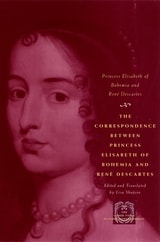
The Correspondence between Princess Elisabeth of Bohemia and René Descartes
Princess Elisabeth of Bohemia and René Descartes
University of Chicago Press, 2007
Between the years 1643 and 1649, Princess Elisabeth of Bohemia (1618–80) and René Descartes (1596–1650) exchanged fifty-eight letters—thirty-two from Descartes and twenty-six from Elisabeth. Their correspondence contains the only known extant philosophical writings by Elisabeth, revealing her mastery of metaphysics, analytic geometry, and moral philosophy, as well as her keen interest in natural philosophy. The letters are essential reading for anyone interested in Descartes’s philosophy, in particular his account of the human being as a union of mind and body, as well as his ethics. They also provide a unique insight into the character of their authors and the way ideas develop through intellectual collaboration.
Philosophers have long been familiar with Descartes’s side of the correspondence. Now Elisabeth’s letters—never before available in translation in their entirety—emerge this volume, adding much-needed context and depth both to Descartes’s ideas and the legacy of the princess. Lisa Shapiro’s annotated edition—which also includes Elisabeth’s correspondence with the Quakers William Penn and Robert Barclay—will be heralded by students of philosophy, feminist theorists, and historians of the early modern period.
The Good Life in the Scientific Revolution
Descartes, Pascal, Leibniz, and the Cultivation of VirtueMatthew L. Jones
University of Chicago Press, 2006
Amid the unrest, dislocation, and uncertainty of seventeenth-century Europe, readers seeking consolation and assurance turned to philosophical and scientific books that offered ways of conquering fears and training the mind—guidance for living a good life.
The Good Life in the Scientific Revolution presents a triptych showing how three key early modern scientists, René Descartes, Blaise Pascal, and Gottfried Leibniz, envisioned their new work as useful for cultivating virtue and for pursuing a good life. Their scientific and philosophical innovations stemmed in part from their understanding of mathematics and science as cognitive and spiritual exercises that could create a truer mental and spiritual nobility. In portraying the rich contexts surrounding Descartes’ geometry, Pascal’s arithmetical triangle, and Leibniz’s calculus, Matthew L. Jones argues that this drive for moral therapeutics guided important developments of early modern philosophy and the Scientific Revolution.
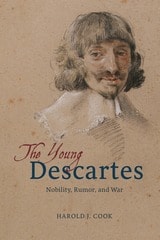
The Young Descartes
Nobility, Rumor, and WarHarold J. Cook
University of Chicago Press, 2018
In The Young Descartes, Harold J. Cook tells the story of a man who did not set out to become an author or philosopher—Descartes began publishing only after the age of forty. Rather, for years he traveled throughout Europe in diplomacy and at war. He was present at the opening events of the Thirty Years' War in Central Europe and Northern Italy, and was also later involved in struggles within France. Enduring exile, scandals, and courtly intrigue, on his journeys Descartes associated with many of the most innovative free thinkers and poets of his day, as well as great noblemen, noblewomen, and charismatic religious reformers. In his personal life, he expressed love for men as well as women and was accused of libertinism by his adversaries.
These early years on the move, in touch with powerful people and great events, and his experiences with military engineering and philosophical materialism all shaped the thinker and philosopher Descartes became in exile, where he would begin to write and publish, with purpose. But though it is these writings that made ultimately made him famous, The Young Descartes shows that this story of his early life and the tumultuous times that molded him is sure to spark a reappraisal of his philosophy and legacy.
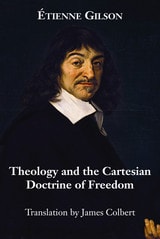
Theology and the Cartesian Doctrine of Freedom
Etienne Gilson
St. Augustine's Press, 2015