Results by title
6 books match the query 'Descent'

Ballad of Descent
Martin Vopenka
Northwestern University Press, 1995
Crossroads Modernism
Descent And Emergence In African-American Literary CultureEdward M. Pavlic
University of Minnesota Press, 2002
An essential reconsideration of black literature and culture and its response to modernity
In the African American encounter with modernism, all was not confrontation. Rather, as Edward M. Pavli´c demonstrates here, African American artists negotiated the intersection of high modernism in Europe and American discourse to fashion their own distinctive response to American modernity. A deft repositioning of black literature and culture, Pavli´c’s book re-envisions the potentials and dilemmas where the different traditions of modernism meet and firmly establishes African American modernism at this cultural crossroads.
Offering new insights into the work of a variety of African American artists—including Ralph Ellison, Richard Wright, Zora Neale Hurston, James Baldwin, Toni Morrison, Robert Hayden, David Bradley, Yusef Komunyakaa, Romare Bearden, and John Coltrane—Pavli´c explores the complex ways in which key modernist philosophical ideas and creative techniques have informed black culture. Crossroads Modernism also provides an in-depth look at how West African cultural legacies are brought to bear in the structure of a truly African American modernist creative process. The book brings to light two interrelated strains of black modernism: Afro-Modernism, which employs established modernist concerns and conceits to illuminate internal and psychological experience; and Diasporic Modernism, which places greater emphasis on shared cultural space and builds on traditions rooted in West African cultures.Whereas much has been said about the (generally racist) use of "blackness" in constituting modernism, Crossroads Modernism is the first book to expose the key role that modernism has played in the constitution of "blackness" in African-American aesthetics. In light of this work, canonical texts in African American literature can no longer be read as devoid of their own singular contribution to international modernism.
Descent
Arria Deepwater
Omnidawn, 2025
Arria Deepwater’s Descent is a modern fairy tale exploring the vulnerability and strength that come with living in an unconventional body, especially for those living with the experience of disabilities, chronic illness, hyper-medicalization, objectification, and 2SLGBTQIA+ identities. The reader is invited to become an observer of isolation, violation, and the magic of secret joy. Descent moves through entangled connections and dissolving boundaries between humanity and the natural world as it seeks to weave a spell of protection for those whose bodies do not conform, for whom existence is a radical act of rebellion and creativity.
Exploring boundaries of intimacy, fluidity, and grief, Deepwater brings an eco-feminist speculative twist to the growing canon of writers with marginalized identities. Deepwater considers the fractured reality of living in a queer disabled body and how we might find freedom, safety, and spiritual healing despite grief.
Descent is the winner of Omnidawn’s 2022 Fabulist Fiction Contest, chosen by Michelle Ruiz Keil.
Plotinus ENNEAD IV.8
On the Descent of the Soul into Bodies: Translation, with an Introduction, and CommentaryBarrie Fleet
Parmenides Publishing, 2012
Rules of Descent
Studies in the Sociology of ParentageGuy E. Swanson
University of Michigan Press, 1969
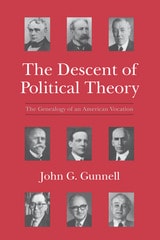
The Descent of Political Theory
The Genealogy of an American VocationJohn G. Gunnell
University of Chicago Press, 1993
Gunnell reconstructs the evolution of the field by locating it within the broader development of political science and American social science in general. During the behavioral revolution that swept political science in the 1950s, the relationship between political theory and political science changed dramatically, relegating theory to the margins of an increasingly empirical discipline. Gunnell demonstrates that the estrangement of political theory is rooted in a much older quarrel: the authority of knowledge versus political theory is rooted in a much older quarrel: the authority of knowledge versus political authority, academic versus public discourse. By disclosing the origin of this dispute, he opens the way for a clearer understanding of the basis and purpose of political theory.
As critical as it is revelatory, this thoughtful book should be read by any one interested in the history of political theory or science—or in the relationship of social science to political practice in the United States.