Results by title
13 books match the query 'Destruction and pillage'
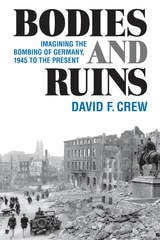
Bodies and Ruins
Imagining the Bombing of Germany, 1945 to the PresentDavid F. Crew
University of Michigan Press, 2017
Bodies and Ruins examines a range of local publications that carried photographic images of German cities destroyed in the air war, images that soon entered the visual memory of World War II. Despite its obvious importance, historians have paid very little attention to the visual representation of the bombing war. This book follows the search for what were considered to be the “right” stories and the “right” pictures of the bombing war in local publications and picture books from 1945 to the present, and is intended for historians as well as general readers interested in World War II, the Allied bombing of German cities, the Holocaust, the history of memory and photographic/visual history.
Bombing Pompeii
World Heritage and Military NecessityNigel Pollard
University of Michigan Press, 2020
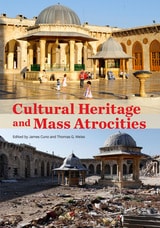
Cultural Heritage and Mass Atrocities
James Cuno
J. Paul Getty Trust, The, 2022
Intentional destruction of cultural heritage has a long history. Contemporary examples include the Bamiyan Buddhas in Afghanistan, mosques in Xinjiang, mausoleums in Timbuktu, and Greco-Roman remains in Syria. Cultural heritage destruction invariably accompanies assaults on civilians, making heritage attacks impossible to disentangle from the mass atrocities of genocide, war crimes, crimes against humanity, and ethnic cleansing. Both seek to eliminate people and the heritage with which they identify.
Cultural Heritage and Mass Atrocities assembles essays by thirty-eight experts from the heritage, social science, humanitarian, legal, and military communities. Focusing on immovable cultural heritage vulnerable to attack, the volume's guiding framework is the Responsibility to Protect (R2P), a United Nations resolution adopted unanimously in 2005 to permit international intervention against crimes of war or genocide. Based on the three pillars of prevent, react, and rebuild, R2P offers today's policymakers a set of existing laws and international norms that can and—as this book argues—must be extended to the protection of cultural heritage. Contributions consider the global value of cultural heritage and document recent attacks on people and sites in China, Guatemala, Iraq, Mali, Sri Lanka and Afghanistan, Syria, and Yemen. Comprehensive sections on vulnerable populations as well as the role of international law and the military offer readers critical insights and point toward research, policy, and action agendas to protect both people and cultural heritage. A concise abstract of each chapter is offered online in Arabic, Chinese, French, Russian, and Spanish to facilitate robust, global dissemination of the strategies and tactics offered in this pathbreaking call to action.
The free online edition of this publication is available at getty.edu/publications/cultural-heritage-mass-atrocities. Also available are free PDF, EPUB, and Kindle/MOBI downloads of the book.
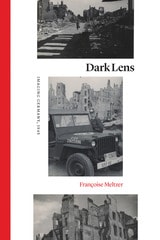
Dark Lens
Imaging Germany, 1945Françoise Meltzer
University of Chicago Press, 2019
The ruins of war have long held the power to stupefy and appall. Can such ruins ever be persuasively depicted and comprehended? Can images of ruins force us to identify with the suffering of the enemy and raise uncomfortable questions about forgiveness and revenge?
Françoise Meltzer explores these questions in Dark Lens, which uses the images of war ruins in Nazi Germany to investigate problems of aestheticization and the representation of catastrophe. Through texts that give accounts of bombed-out towns in Germany in the last years of the war, painters’ attempts to depict the destruction, and her own mother’s photographs taken in 1945, Meltzer asks if any medium offers a direct experience of war ruins for the viewer. Refreshingly accessible and deeply personal, Dark Lens is a compelling look at the role images play in constructing memory.
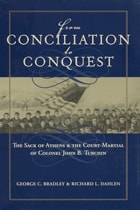
From Conciliation to Conquest
The Sack of Athens and the Court-Martial of Colonel John B. TurchinGeorge C. Bradley and Richard L. Dahlen
University of Alabama Press, 2006
In the summer of 1862, the U.S. Army court martialed Colonel John B. Turchin, a Russian-born Union officer, for "outrages" committed by his troops in Athens, Alabama
In the summer of 1862, the U.S. Army court martialed Colonel John B. Turchin, a Russian-born Union officer, for offenses committed by his troops in Athens, Alabama, including looting, safe cracking, the vandalization of homes, and the rape of young black women. The pillage of Athens violated a government policy of conciliation; it was hoped that if Southern civilians were treated gently as citizens of the United States, they would soon return their allegiance to the federal government.
By examining the volunteers who made up Turchin’s force, the colonel's trial, his subsequent promotion, the policy debate surrounding the incident and the public reaction to the outcome, the authors further illuminate one of the most provocative questions in Civil War studies: how did the policy set forth by President Lincoln evolve from one of conciliation to one far more modern in nature, placing the burden of war on the civilian population of the South?
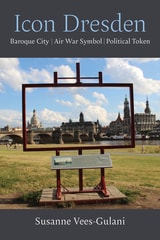
Icon Dresden
Baroque City, Air War Symbol, Political TokenSusanne Vees-Gulani
University of Michigan Press, 2026
Drawing on urban, heritage, and tourism studies, visual and memory studies, and environmental psychology, Icon Dresden examines Dresden’s history, identity, visual representations, and rebuilding decisions. It exposes the narratives that define its place in German and international memory and how, paradoxically, they support both Dresden’s current image as a symbol of peace and reconciliation and its backing of nativist and far-right movements.

Operation Defensive Shield
Witnesses to Israeli War CrimesEdited by Muna Hamzeh and Todd June
Pluto Press, 2003
On March 29, 2002 the Israeli army launched Operation Defensive Shield, the largest military offensive against Palestinian civilians since the 1948 Arab-Israeli War. During the operation, the military used the most advanced weaponry at its disposal: Merkava tanks, Apache attack helicopters and F-15 fighter jets. When the operation ended on April 21, Israel had destroyed the Palestinian economic and social infrastructure, leveled large swathes of residential area, killed 220 people, injured hundreds more and arrested thousands.
This book documents these events through a collection of electronic witness narratives written by Palestinians who were under attack and by Israeli and international peace activists who witnessed the results of these attacks. Deeply moving and courageous, these narratives offer a uniquely powerful and intimate account of the daily reality for Palestinians who endured Ariel Sharon's military strategy, and the death and destruction that strategy has caused throughout the Occupied Territories.
Most important, the witnesses' voices bring to life the aggressive nature of this strategy -- they belie the noble motives ascribed to Sharon and those in his government and military who designed and carried it out. The editors argue that Operation Defensive Shield is a prelude to Israel's ethnic cleansing of the Palestinians. They provide historical context, a chronology, and an analysis of the conflict that situates the horror of these days in their proper perspective.
Operation Defensive Shield: Witnesses to Israeli War Crimes is an essential record for those who want to understand what happened in the West Bank in the spring of 2002, and what it portends for the future of the region.
The Afterlife of Greek and Roman Sculpture
Late Antique Responses and PracticesTroels Myrup Kristensen and Lea Stirling, editors
University of Michigan Press, 2016
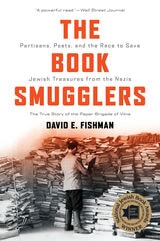
The Book Smugglers
Partisans, Poets, and the Race to Save Jewish Treasures from the NazisDavid E. Fishman
University Press of New England, 2018
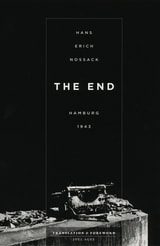
The End
Hamburg 1943Hans Erich Nossack
University of Chicago Press, 2004
Novelist Hans Erich Nossack was forty-two when the Allied bombardments of German cities began, and he watched the destruction of Hamburg—the city where he was born and where he would later die—from across its Elbe River. He heard the whistle of the bombs and the singing of shrapnel; he watched his neighbors flee; he wondered if his home—and his manuscripts—would survive the devastation. The End is his terse, remarkable memoir of the annihilation of the city, written only three months after the bombing. A searing firsthand account of one of the most notorious events of World War II, The End is also a meditation on war and hope, history and its devastation. And it is the rare book, as W. G. Sebald noted, that describes the Allied bombing campaign from the German perspective.
In the first English-language edition of The End, Nossack's text has been crisply translated by Joel Agee and is accompanied by the photographs of Erich Andres. Poetic, evocative, and yet highly descriptive, The End will prove to be, as Sebald claimed, one of the most important German books on the firebombing of that country.
"A small but critical book, something to read in those quiet moments when we wonder what will happen next."—Susan Salter Reynolds, Los Angeles Times
The Idols of ISIS
From Assyria to the InternetAaron Tugendhaft
University of Chicago Press, 2020
Beginning with the Islamic State’s claim that the smashed objects were idols of the “age of ignorance,” Aaron Tugendhaft questions whether there can be any political life without idolatry. He then explores the various roles Mesopotamian sculpture has played in European imperial competition, the development of artistic modernism, and the formation of Iraqi national identity, showing how this history reverberates in the choice of the Mosul Museum as performance stage. Finally, he compares the Islamic State’s production of images to the ways in which images circulated in ancient Assyria and asks how digitization has transformed politics in the age of social media. An elegant and accessibly written introduction to the complexities of such events, The Idols of ISIS is ideal for students and readers seeking a richer cultural perspective than the media usually provides.
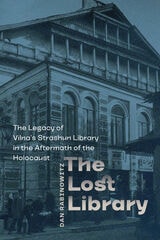
The Lost Library
The Legacy of Vilna's Strashun Library in the Aftermath of the HolocaustDan Rabinowitz
Brandeis University Press, 2018
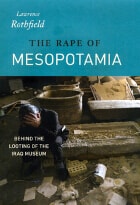
The Rape of Mesopotamia
Behind the Looting of the Iraq MuseumLawrence Rothfield
University of Chicago Press, 2009
On April 10, 2003, as the world watched a statue of Saddam Hussein come crashing down in the heart of Baghdad, a mob of looters attacked the Iraq National Museum. Despite the presence of an American tank unit, the pillaging went unchecked, and more than 15,000 artifacts—some of the oldest evidence of human culture—disappeared into the shadowy worldwide market in illicit antiquities. In the five years since that day, the losses have only mounted, with gangs digging up roughly half a million artifacts that had previously been unexcavated; the loss to our shared human heritage is incalculable.
With The Rape of Mesopotamia, Lawrence Rothfield answers the complicated question of how this wholesale thievery was allowed to occur. Drawing on extensive interviews with soldiers, bureaucrats, war planners, archaeologists, and collectors, Rothfield reconstructs the planning failures—originating at the highest levels of the U.S. government—that led to the invading forces’ utter indifference to the protection of Iraq’s cultural heritage from looters. Widespread incompetence and miscommunication on the part of the Pentagon, unchecked by the disappointingly weak advocacy efforts of worldwide preservation advocates, enabled a tragedy that continues even today, despite widespread public outrage.
Bringing his story up to the present, Rothfield argues forcefully that the international community has yet to learn the lessons of Iraq—and that what happened there is liable to be repeated in future conflicts. A powerful, infuriating chronicle of the disastrous conjunction of military adventure and cultural destruction, The Rape of Mesopotamia is essential reading for all concerned with the future of our past.