Results by title
2 books match the query 'Dick, Howard'
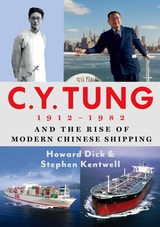
C. Y. Tung (1912–1982) and the Rise of Modern Chinese Shipping
Howard Dick and Stephen Kentwell
Hong Kong University Press, 2026
A business biography of C. Y. Tung, founder of the Orient Overseas Container Line and philanthropist.
Shanghai-born and later Hong Kong–resident shipowner Tung Chao-Yung (1912–1982) is remembered worldwide as a champion for Chinese shipping, founding the companies Chinese Maritime Transport and Island Navigation, and pioneering container shipping for Asia in Orient Overseas Container Line/OOCL. Despite coming from a humble background, by the time of his death he controlled a huge fleet of passenger liners, bulk carriers, tankers, and container ships, while also being diversified into port terminals, dockyards, banks, and prime real estate. This business biography sets out his pathway from a junior executive in the early 1930s to one of the world’s leading private shipowners. The authors argue that Tung achieved his desire to develop Chinese ocean shipping through his ability to learn, innovate, network, and devise strategies through decades of rapid technical and organizational change. He also earned respect for his generous philanthropy. After his death, sons Tung Chee-Hwa and Tung Chee-Chen were able to navigate a financial crisis, restructure the group in the face of intensifying competition in the 1980s, and grow through the challenges and opportunities of globalization and advancement in supply chain management and technology within the industry in the 1990s through 2010s. OOCL became one of the most competitive liner companies in the industry until divestment in 2017. Eight decades since their establishment, privately owned Island Navigation and, now independently, Chinese Maritime Transport continue to trade globally in dry-bulk and tanker markets. C. Y. Tung (1912–1982) and the Rise of Modern Chinese Shipping concludes with an overview of the emergence of the state-owned PRC fleet and brief histories of other multi-generational family companies.
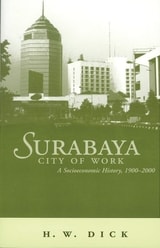
Surabaya, City of Work
A Socioeconomic History, 1900–2000Howard Dick
Ohio University Press, 2002
Surabaya is Indonesia’s second largest city but is not well known to the outside world. Yet in 1900, Surabaya was a bigger city than Jakarta and one of the main commercial centers of Asia. Collapse of sugar exports during the 1930s depression, followed by the Japanese occupation, revolution, and independence, brought on a long period of stagnation and retreat from the international economy. Not until the export boom of the 1990s did Surabaya regain prominence as Southeast Asia’s leading non–capital–city industrial area.
Previous thinking on Indonesia is being reassessed in light of recent political and economic upheaval. Surabaya, City of Work offers an alternative to the Jakarta-centric focus of most writing on the country. It is a multifaceted view of a fascinating and complex city in the dimensions of time and space, economy and society, and the current transition toward decentralization makes it highly topical.
Exploration of this eventful economic history gives new insight into Indonesia’s modern economic development. Industrialization is recognized as being associated with rapid urbanization, but this is the first study of Indonesia from an explicitly urban perspective. Surabaya, City of Work takes a broad approach that links industrialization to socioeconomic trends, the increasing role of government, changing land use, and trade patterns.
This well–illustrated local history encompassing national events and trends will be a central work on Indonesia for years to come.