Results by title
70 books match the query 'Essay' and 8 start with a
A Reading of Mansfield Park
An Essay in Critical SynthesisAvrom Fleishman
University of Minnesota Press, 1967

A Rule of Property for Bengal
An Essay on the Idea of Permanent SettlementRanajit Guha
Duke University Press, 1996
By proclaiming the Permanent Settlement in 1793, the British hoped to promote a prosperous capitalist agriculture of the kind that had developed in England. The act renounced for all time the state’s right to raise the assessment already made upon landowners and thus sought to establish a system of property that was, in the British view, necessary for the creation of a stable government. Guha traces the origins of the Permanent Settlement to the anti-feudal ideas of Phillip Francis and the critique of feudalism provided by physiocratic thought, the precursor of political economy. The central question the book asks is how the Permanent Settlement, founded in anti-feudalism and grafted onto India by the most advanced capitalist power of the day became instrumental in the development of a neo-feudal organization of landed property and in the absorption and reproduction of precapitalist elements in a colonial regime.
Guha’s examination of the British attempt to mold Bengal to the contours of its own society without an understanding of the traditions and obligations upon which the Indian agrarian system was based is a truly pioneering work. The implications of A Rule of Property for Bengal remain rich for the current discussions from the postcolonialist perspective on the meaning of modernity and enlightenment.
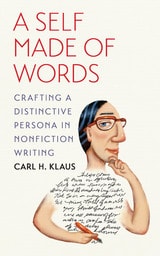
A Self Made of Words
Crafting a Distinctive Persona in Nonfiction WritingCarl H. Klaus
University of Iowa Press, 2013
Klaus divides his book into two parts: first, an introduction to the nature and function of a persona, then a survey of the most important elements of writing that contribute to the character of a persona, from point of view and organization to diction and sentence structure. Both parts contain exercises that will give you practice in developing a persona of your choice. Challenging and stimulating, each of his exercises focuses on a distinctly different aspect of composition and style, so as to help you develop the skills of a versatile and personable writer. By focusing on the most important ways of projecting your self in nonfiction prose, you can learn to craft a distinctive self in your writing.

An Essay on African Philosophical Thought
Kwame Gyekye
Temple University Press, 1995
An Essay on Contraction
André Fuhrmann
CSLI, 1996
An Essay on Facts
Kenneth Russel Olson
CSLI, 1987
An Essay on Negation
For a Linguistic AnthropologyPaolo Virno
Seagull Books, 2018
As speaking animals, we continuously make use of an unassuming grammatical particle, without suspecting that what is at work in its inconspicuousness is a powerful apparatus, which orchestrates language, signification, and the world at large. What particle might this be? The word not.
In Essay on Negation, Paolo Virno argues that the importance of the not is perhaps comparable only to that of money—that is, the universality of exchange. Negation is what separates verbal thought from silent cognitive operations, such as feelings and mental images. Speaking about what is not happening here and now, or about properties that are not referable to a given object, the human animal deactivates its original neuronal empathy, which is prelinguistic; it distances itself from the prescriptions of its own instinctual endowment and accesses a higher sociality, negotiated and unstable, which establishes the public sphere. In fact, the speaking animal soon learns that the negative statement does not amount to the linguistic double of unpleasant realities or destructive emotions: while it rejects them, negation also names them and thus includes them in social life. Virno sees negation as a crucial effect of civilization, one that is, however, also always exposed to further regressions. Taking his cue from a humble word, the author is capable of unfolding the unexpected phenomenology of the negating consciousness.
An Essay on Philosophical Method
R.G. Collingwood
St. Augustine's Press, 2011
“My best book in matter, in style. I may call it my only book.”
An Essay on Philosophical Method contains the most sustained discussion in the twentieth century of the subject matter and method of philosophy and an unparalleled explanation of why philosophy has a distinctive domain of enquiry that differs from that of the sciences of nature.
Collingwood’s mature work of metaphysics seeks to overhaul the notion of philosophical method, assigning philosophy the task of “thinking out the idea of an object that shall completely satisfy the demands of reason.” The Essay is particularly interesting as an embodiment of the idealistic metaphysics Collingwood abandoned in later life.
This edition (a reprint of the 1933 edition) of the Essay focuses on Collingwood’s contribution to metaphilosophy and locates his argument for the autonomy of philosophy against the twentieth-century trend to naturalize its subject matter. Collingwood argues that the distinctions which philosophers make, for example, between the concepts of duty and utility in moral philosophy, or between the concepts of mind and body in the philosophy of mind, are not empirical taxonomies that cut nature at the joints but semantic distinctions to which there may correspond no empirical classes. This identification of philosophical distinctions with semantic distinctions provides the basis for an argument against the naturalization of the subject matter of philosophy for it entails that not all concepts are empirical concepts and not all classifications are empirical classifications. Collingwood’s explanation of why philosophy has a distinctive subject matter thus constitutes a clear challenge to the project of radical empiricism.
“One of the finest restatements in contemporary British philosophy of a Platonic and Hegelian metaphysic viewed from a modern standpoint.” – Times Literary Supplement