Results by title
6 books match the query 'Dictators'
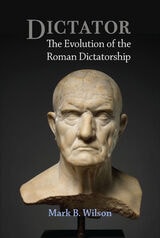
Dictator
The Evolution of the Roman DictatorshipMark B. Wilson
University of Michigan Press, 2021
Roman consuls were routinely trained by background and experience to handle the usual problems of a twelve-month turn in office. But what if a crisis arose that wasn’t best met by whoever happened to be in office that year? The Romans had a mechanism for that: the dictatorship, an alternative emergency executive post that granted total, unanswerable power to that man who was best suited to resolve the crisis and then stand down, restoring normality. This office was so useful and effective that it was invoked at least 85 times across three centuries against every kind of serious problem, from conspiracies and insurgencies to the repelling of invaders to propitiation of the gods.
In Dictator: The Evolution of the Roman Dictatorship, Mark B. Wilson makes the first detailed and comprehensive examination of the role and evolution of the dictatorship as an integral element of the Roman Republic. Each stage of a dictatorship—need, call, choice, invocation, mandate, imperium, answerability, colleague, and renunciation—is explored, with examples and case studies illustrating the dictators’ rigorous adherence to a set of core principles, or, in rare cases of deviation, showing how exceptions tended to demonstrate the rule as vividly as instances. Wilson also charts the flexibility of the dictatorship as it adapted to the needs of the Republic, reshaping its role in relation to the consuls, the senate, and the people.
The routine use of the dictatorship is only part of the story. The abandonment and disuse of the dictatorship for 120 years, its revival under Sulla, and its appropriation and transformation under Caesar are all examined in detail, with attention paid to what the dictatorship meant to the Romans of the late Republic, alternative means of crisis resolution in contrast with the dictatorship, and the groundwork laid in those last two centuries for that which was to come. Dictator provides a new basis for discussion and debate relating to the Roman dictatorship, Roman crisis management, and the systems and institutions of the Roman Republic.
Dictators and the Higher Education Dilemma
State Power and the University in Modern IranSaeid Golkar
Rutgers University Press, 0
Dictators and the Higher Education Dilemma explores a powerful contradiction at the heart of modern authoritarian regimes: While universities are essential for producing skilled labor and projecting national progress, they also cultivate critical thinkers who can challenge state power. Drawing on Iran’s modern history, from the Pahlavi monarchy to the Islamic Republic, Saeid Golkar shows how dictators use universities not only to train technocrats and showcase development but also as tools for shaping ideology, suppressing dissent, and co-opting academics. In authoritarian systems, education becomes a double-edged sword, essential for growth yet dangerous when it empowers independent thought. Golkar reveals how regimes manipulate admissions, censor curricula, and reward loyalty to create compliant intellectuals and loyal elites. Blending personal experience with rich historical and political analysis, this book exposes the tactics used to turn universities into instruments of social control. It speaks to a growing trend worldwide, offering vital insights into the clash between authoritarian power and academic freedom from Iran to China, Russia, and beyond.

Dispatches and Dictators
Ralph Barnes for the Herald TribuneBarbara S. Mahoney
Oregon State University Press, 2002
Dispatches and Dictators uncovers the fascinating story of Oregon native Ralph Barnes, the New York Herald Tribune’s European correspondent, who served in Paris, Rome, Moscow, Berlin, and London in the years between the two world wars. Barnes has been praised by colleagues and competitors alike as one of the best reporters of that pivotal era. But since his death in the 1940 crash of a British bomber in Yugoslavia, he has been largely forgotten.
With persistence and unusually keen insight, Ralph Barnes reported on Fascism, Communism, Nazism, and the events leading to World War II. Stalin confined Barnes to Moscow for disclosing that millions were dying during the Soviet collectivization of agriculture, and Hitler expelled Barnes from Germany for predicting the Nazi attack on the Soviet Union.
In Dispatches and Dictators, historian Barbara Mahoney chronicles the short life and brilliant career of Ralph Barnes. Her biography of this extraordinary reporter provides new insights into the tumultuous decade leading up to World War II.
Fame, Money, and Power
The Rise of Peisistratos and "Democratic" Tyranny at AthensB. M. Lavelle
University of Michigan Press, 2005
--David Tandy, University of Tennessee
"Well researched and engaging, [Fame, Money, and Power] painstakingly builds [its] case for how the various phases of Peisistratos's career developed."
--Tony Podlecki, University of British Columbia
The Athenian "golden age" occurred in the fifth century B.C.E. and was attributed to their great achievements in art, literature, science, and philosophy. However, the most important achievement of the time was the political movement from tyranny to democracy. Though tyranny is thought to be democracy's opposite and deadly enemy, that is not always the case. In Fame, Money, and Power, Brian Lavelle states that the perceived polarity between tyranny and democracy does not reflect the truth in this instance.
The career of the tyrant Peisistratos resembles the careers and successes of early democratic soldier-politicians. As with any democratic political system, Peisistratos' governance depended upon the willingness of the Athenians who conceded governance to him. This book attempts to show how the rise of Peisistratos fits into an essentially democratic system already entrenched at Athens in the earlier sixth century B.C.E.
Emerging from the apparent backwater of eastern Attika, Peisistratos led the Athenians to victory over their neighbors, the Megarians, in a long, drawn out war. That victory earned him great popularity from the Athenians and propelled him along the road to monarchy. Yet, political success at Athens, even as Solon implies in his poems, depended upon the enrichment of the Athenian d?mos, not just fame and popularity. Peisistratos tried and failed two times to "root" his tyranny, his failures owing to a lack of sufficient money with which to appease the demos. Exiled from Athens, he spent the next ten years amassing money to enrich the Athenians and power to overcome his enemies. He then sustained his rule by grasping the realities of Athenian politics. Peisistratos' tyrannies were partnerships with the d?mos, the first two of which failed. His final formula for success, securing more money than his opponents possessed and then more resources for enriching the d?mos, provided the model for future democratic politicians of Athens who wanted to obtain and keep power in fifth-century Athens.

I Ask for Justice
Maya Women, Dictators, and Crime in Guatemala, 1898–1944By David Carey Jr.
University of Texas Press, 2013
This study of the Guatemalan legal system during the regimes of two of Latin America’s most repressive dictators reveals the surprising extent to which Maya women used the courts to air their grievances and defend their human rights.
Winner, Bryce Wood Book Award, Latin American Studies Association, 2015
Given Guatemala’s record of human rights abuses, its legal system has often been portrayed as illegitimate and anemic. I Ask for Justice challenges that perception by demonstrating that even though the legal system was not always just, rural Guatemalans considered it a legitimate arbiter of their grievances and an important tool for advancing their agendas. As both a mirror and an instrument of the state, the judicial system simultaneously illuminates the limits of state rule and the state’s ability to co-opt Guatemalans by hearing their voices in court.
Against the backdrop of two of Latin America’s most oppressive regimes—the dictatorships of Manuel Estrada Cabrera (1898–1920) and General Jorge Ubico (1931–1944)—David Carey Jr. explores the ways in which indigenous people, women, and the poor used Guatemala’s legal system to manipulate the boundaries between legality and criminality. Using court records that are surprisingly rich in Maya women’s voices, he analyzes how bootleggers, cross-dressers, and other litigants crafted their narratives to defend their human rights. Revealing how nuances of power, gender, ethnicity, class, and morality were constructed and contested, this history of crime and criminality demonstrates how Maya men and women attempted to improve their socioeconomic positions and to press for their rights with strategies that ranged from the pursuit of illicit activities to the deployment of the legal system.

Ideological Storms
Intellectuals, Dictators, and the Totalitarian TemptationBogdan C. Iacob
Central European University Press, 2019
This volume gathers authors who wrote important works in the fields of the history of ideologies, the comparative study of dictatorships, and intellectual history. The book is a state of the art reassessment and analysis of the ideological commitments of intellectuals and their relationships with dictatorships during the twentieth century. The contributions focus on turning points or moments of breakage as well as on the continuities. Though its focus is on an East–West comparison in Europe, there are texts also dealing with Latin America, China, and the Middle East giving the book a global outlook.
The first part of the book deals with intellectuals' involvement with communist regimes or parties; the second looks at the persistence of utopianism in the trajectory of intellectuals who had been associated earlier in their lives with either communism or fascism; the third tackles intellectuals' role in national imaginations from either the left or the right; and, the fourth ties late twentieth century phenomena to current phenomena such as the persistence of anti-Semitism in the West, the slow erosion of the values upon which the EU is built, the quagmire in Iraq, and China's rise in the post-Cold War era. The collection provides a comprehensive big-picture of intellectual genealogies and dictatorial developments.