Results by title
8 books match the query 'Didi-Huberman, Georges'

Atlas, or the Anxious Gay Science
Georges Didi-Huberman
University of Chicago Press, 2018
In this illustrated exploration of Warburg and his great work, Georges Didi-Huberman leaps from Mnemosyne Atlas into a set of musings on the relation between suffering and knowledge in Western thought, and on the creative results of associative thinking. Deploying writing that delights in dramatic jump cuts reminiscent of Warburg’s idiosyncratic juxtapositions, and drawing on a set of sources that ranges from ancient Babylon to Walter Benjamin, Atlas, or the Anxious Gay Science is rich in Didi-Huberman’s trademark combination of elan and insight.
Being a Skull
Site, Contact, Thought, SculptureGeorges Didi-Huberman
University of Minnesota Press, 2016
What would a sculpture look like that has as its task to touch thought? For the French philosopher and Art Historian, Georges Didi-Huberman, this is the central question that permeates throughout the work of Italian artist Giuseppe Penone. Through a careful study of Penone’s work regarding a sculptural and haptic process of contact with place, thought, and artistic practice, Didi-Huberman takes the reader on a journey through various modes of thinking by way of being. Taking Penone’s artwork “Being the river” as a thematic starting point, Didi-Huberman sketches a sweeping view of how artists through the centuries have worked with conceptions of the skull, that is, the mind, and ruminates on where thought is indeed located.
From Leonardo da Vinci to Albrecht Dürer, Didi-Huberman guides us to the work of Penone and from there, into the attempts of a sculptor whose works strives to touch thought. What we uncover is a sculptor whose work becomes a series of traces of the site of thought. Attempting to trace, by way of a series of frottages, reports, and developments, this imperceptible zone of contact. The result is a kind of fossil of the brain: the site of thought, namely, the site for getting lost and for disproving space. Sculpting at the same time what inhabits as well as what incorporates us.

Fra Angelico
Dissemblance and FigurationGeorges Didi-Huberman
University of Chicago Press, 1995
A Florentine painter who took Dominican vows, Fra Angelico (1400-1455) approached his work as a largely theological project. For him, the problems of representing the unrepresentable, of portraying the divine and the spiritual, mitigated the more secular breakthroughs in imitative technique. Didi-Huberman explores Fra Angelico's solutions to these problems—his use of color to signal approaching visibility, of marble to recall Christ's tomb, of paint drippings to simulate (or stimulate) holy anointing. He shows how the painter employed emptiness, visual transformation, and displacement to give form to the mystery of faith.
In the work of Fra Angelico, an alternate strain of Renaissance painting emerges to challenge rather than reinforce verisimilitude. Didi-Huberman traces this disruptive impulse through theological writings and iconographic evidence and identifies a widespread tradition in Renaissance art that ranges from Giotto's break with Byzantine image-making well into the sixteenth century. He reveals how the techniques that served this ultimately religious impulse may have anticipated the more abstract characteristics of modern art, such as color fields, paint spatterings, and the absence of color.
Images in Spite of All
Four Photographs from AuschwitzGeorges Didi-Huberman
University of Chicago Press, 2008
Available today because they were smuggled out of the camp and into the hands of Polish resistance fighters, the photographs show a group of naked women being herded into the gas chambers and the cremation of corpses that have just been pulled out. Georges Didi-Huberman’s relentless consideration of these harrowing scenes demonstrates how Holocaust testimony can shift from texts and imaginations to irrefutable images that attempt to speak the unspeakable. Including a powerful response to those who have criticized his interest in these images as voyeuristic, Didi-Huberman’s eloquent reflections constitute an invaluable contribution to debates over the representability of the Holocaust and the status of archival photographs in an image-saturated world.
La danse des valeurs
Sergueï Eisenstein et le Capital de MarxElena Vogman
Diaphanes, 2020
Le Capital de Sergueï Eisenstein (1927-1928) est un fantôme à plus d’un titre: bien que le film n’ait jamais été réalisé, il a néanmoins hanté l'imagination de nombreux cinéastes, historiens et écrivains jusqu’à aujourd’hui et même récemment avec les Nouvelles de l’Antiquité idéologique : Marx – Eisenstein – Le Capital d’Alexander Kluge. De plus, sa première matérialisation publique – un fragment d’une dizaine de pages issu des carnets du réalisateur – était marquée par ce qui demeurait absent : les images et le matériau de travail d’Eisenstein.
La Danse des valeurs ambitionne d’invoquer à nouveaux frais le fantôme du Capital mais en se fondant cette fois-ci sur l’ensemble de son corps d’archives. Cette « instruction visuelle à la méthode dialectique », selon les mots-mêmes d’Eisenstein, comprend plus de 500 pages de notes, de dessins, de coupures de presse, de diagrammes d’expression, de plans d’articles, de négatifs d’Octobre, de réflexions théoriques et de longues citations. La Danse des valeurs explore la nécessité formelle qui sous-tend les choix d’Eisenstein dans le Capital. Sa lecture fait valoir que sa complexité visuelle ainsi que son efficacité épistémique résident précisément dans l’état de son matériau : une danse de thèmes hétérogènes et de fragments disparates, un flux non-linéaire, provisoire et inarticulé.
Les séquences visuelles d’archives, publiées ici pour la première fois en France, ne sont pas bâties à titre de simples illustrations, mais en tant qu’arguments à part entière, donnant à voir ce qui se joue pour Eisenstein dans le Capital : une théorisation visuelle de la valeur. Une lecture des archives d’Eisenstein, dans leur logique interne, permet non seulement de reconstituer des éléments morphologiques présents dans le concept de valeur chez Marx, mais également de théoriser une crise plus fondamentale de la représentation politique, un présent qui s’étend de son contexte contemporain jusqu’à nos jours. Mettant en œuvre un procédé morphologique sans équivoque, les séquences de montage d’Eisenstein produisent une sorte de plus-value qui leur est propre, un excès sémiotique qui brasse les matériaux et présente les corps dans une danse analogue à la « danse » des « conditions pétrifiées » de Marx. C’est dans ce langage polymorphe et « diffus » – associé au stream of consciousness de l’Ulysse de Joyce – qu’Eisenstein perçoit le potentiel critique et affectif d’un cinéma à venir.
Movements of Air
The Photographs from Étienne-Jules Marey’s Wind TunnelsGeorges Didi-Huberman and Laurent Mannoni
Diaphanes, 2022
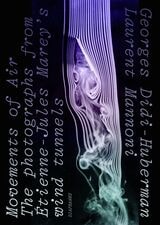
Featuring more than one hundred and fifty photographs and images, Movements of Air reprints the breathtaking pictures of Étienne-Jules Marey—images captured between 1899 and 1901 during his scientific experiments with moving air and smoke—and complements them with essays by Georges Didi-Huberman and Laurent Mannoni.
Mannoni begins by reflecting on Marey’s experimental approach. As the founder of the “graphic method,” Marey was also the developer of an aerodynamic wind tunnel. His experiments’ photographs of fluid motion introduced a whole world of movements and turbulences, and fluids, and influenced generations of scientists and artists alike. Didi-Huberman expands on the philosophical debates surrounding these aesthetically and technically instructive images. Even though Marey’s main interest was graphic information, Didi-Huberman shows us how the flow of all things drew this ingenious experimenter to a photographic practice that creates drags, streaks, expansions, and visual dances. Marey’s wind tunnel photographs were also themselves causes of turbulence in the history of images. The artists Dombois and Oeschger explore these “graphical” vortices of the last 120 years, providing at the end of the book a collage from historical and contemporary material interlaced with their own image-making in Dombois’s wind tunnel at the Zurich University of the Arts.

Survival of the Fireflies
Georges Didi-Huberman
University of Minnesota Press, 2018
Seeking out the minor lights of friendship in a time of fascism
Dante once spoke, in his Divine Comedy, of the miniscule lights, in the twenty-sixth canto of the Inferno, who, contrary to the great lights that shined bright within the sublime circles of Paradise, frailly wandered in the somber pockets of glimmering light within the darkness. Pliny the Elder was once preoccupied by a type of fly named pyrallis or pyrotocon, which was only able to fly within fire: “as long as it remains in the fire, it can fly; when its flight takes it out too far a distance, it dies.”
Through his readings of Dante, Pasolini, Walter Benjamin, and others, Georges Didi-Huberman seeks again to understand this strange, minor light, the signals of small beings in search of love and friendship. Their flickering presence serves as a counterforce to the blinding sovereign power that Giorgio Agamben calls The Kingdom and the Glory, that artificial brilliance that once surrounded dictators and today emanates from every screen. In this timely reflection, much needed in our time of excessive light, Didi-Huberman’s Survival of the Fireflies offers a humble yet powerful image of individual hope and desire: the firefly-image.
The Cube and the Face
Around a Sculpture by Alberto GiacomettiGeorges Didi-Huberman. Edited by Mira Fliescher and Elena Vogman
Diaphanes, 2015
With The Cube and the Face, renowned French art historian and philosopher Georges Didi-Huberman has conducted a careful analysis of Cube, consulting the artist’s sketches, etchings, texts, and other sculptural works in the years just before and after Cube was created. Cube, he finds, is indeed exceptional—a work without clear stylistic kinship to the works that came before or after it. At the same time, Didi-Huberman shows, Cube marks the transition between the artist’s surrealist and realist phases and contains many elements of Giacometti’s aesthetic consciousness, including his interest in dimensionality, the relation of the body to geometry, and the portrait—or what Didi-Huberman terms “abstract anthropomorphism.” Drawing on Freud, Bataille, Leiris, and others Giacometti counted as influence, Didi-Huberman presents fans and collectors of Giacometti’s art with a new approach to transitional work.