Results by title
16 books match the query 'Digital cinematography'
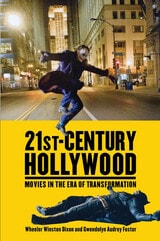
21st-Century Hollywood
Movies in the Era of TransformationDixon, Wheeler Winston
Rutgers University Press, 2011
They are shot on high-definition digital cameras—with computer-generated effects added in postproduction—and transmitted to theaters, websites, and video-on-demand networks worldwide. They are viewed on laptop, iPod, and cell phone screens. They are movies in the 21st century—the product of digital technologies that have revolutionized media production, content distribution, and the experience of moviegoing itself.
21st-Century Hollywood introduces readers to these global transformations and describes the decisive roles that Hollywood is playing in determining the digital future for world cinema. It offers clear, concise explanations of a major paradigm shift that continues to reshape our relationship to the moving image. Filled with numerous detailed examples, the book will both educate and entertain film students and movie fans alike.
Action Bodies
VFX, Identity, and Embodiment in Blockbuster CinemaDrew Ayers
University of Texas Press, 2026
Exploring how digital visual effects have changed the representations of the body and identity in action films.
When Harrison Ford appeared digitally de-aged in Indiana Jones and the Dial of Destiny, audiences witnessed more than a technical feat; they saw how visual effects are reshaping what bodies can be on screen. In Action Bodies, Drew Ayers examines how the contemporary action genre redefines embodiment across human, superhuman, animal, and machine forms. Ayers argues that action films are a crucial site for understanding how popular media both reflect and shape cultural debates about identity, citizenship, disability, and ethics in the era of big data and algorithmic culture.
Through case studies including Top Gun: Maverick, The Woman King, The Fast & the Furious franchise, and Avatar: The Way of Water, Ayers explores how VFX-altered bodies carry ideological weight. While the action genre has long leaned conservative in its politics of identity, its digitally mediated bodies also generate unexpected opportunities: glimpses of more inclusive and flexible modes of embodiment. As artificial intelligence and synthetic imagery continue to transform film production, Action Bodies demonstrates why careful attention to action cinema is essential for understanding how contemporary culture imagines and engineers the future of the body.
Bigger Than Life
The Close-Up and Scale in the CinemaMary Ann Doane
Duke University Press, 2021
Border Cinema
Reimagining Identity through AestheticsEdited by Monica Hanna and Rebecca A. Sheehan
Rutgers University Press, 2019
Cinemachines
An Essay on Media and MethodGarrett Stewart
University of Chicago Press, 2020
Engaging in fresh ways with revelatory special effects in the history of cinematic storytelling—from Buster Keaton’s breaching of the film screen in Sherlock Jr. to the pixel disintegration of a remotely projected hologram in Blade Runner 2049—Stewart’s book puts unprecedented emphasis on technique in moving image narrative. Complicating and revising the discourse on historical screen processes, Cinemachines will be crucial reading for anyone interested in the evolution of the movies from a celluloid to a digital medium.
Cinematography
Keating, Patrick
Rutgers University Press, 2014
The essays in this volume introduce us to the visual conventions of the Hollywood style, explaining how these first arose and how they have subsequently been challenged by alternative aesthetics. In order to frame this fascinating history, the contributors employ a series of questions about technology (how did new technology shape cinematography?), authorship (can a cinematographer develop styles and themes over the course of a career?), and classicism (how should cinematographers use new technology in light of past practice?). Taking us from the hand-cranked cameras of the silent era to the digital devices used today, the collection of original essays explores how the art of cinematography has been influenced not only by technological advances, but also by trends in the movie industry, from the rise of big-budget blockbusters to the spread of indie films.
The book also reveals the people behind the camera, profiling numerous acclaimed cinematographers from James Wong Howe to Roger Deakins. Lavishly illustrated with over 50 indelible images from landmark films, Cinematography offers a provocative behind-the-scenes look at the profession and a stirring celebration of the art form. Anyone who reads this history will come away with a fresh eye for what appears on the screen because of what happens behind it.
D-Passage
The Digital WayTrinh T. Minh-ha
Duke University Press, 2013
Digital Cinema
Stephen Prince
Rutgers University Press, 2019
Stephen Prince offers a clear, concise account of how digital cinema both extends longstanding traditions of filmmaking and challenges some fundamental assumptions about film. It is essential reading for anyone interested in understanding how movies are shot, produced, distributed, and consumed in the twenty-first century.
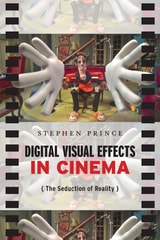
Digital Visual Effects in Cinema
The Seduction of RealityPrince, Stephen
Rutgers University Press, 2012
Avatar. Inception. Jurassic Park. Lord of the Rings. Ratatouille. Not only are these some of the highest-grossing films of all time, they are also prime examples of how digital visual effects have transformed Hollywood filmmaking. Some critics, however, fear that this digital revolution marks a radical break with cinematic tradition, heralding the death of serious realistic movies in favor of computer-generated pure spectacle.
Digital Visual Effects in Cinema counters this alarmist reading, by showing how digital effects–driven films should be understood as a continuation of the narrative and stylistic traditions that have defined American cinema for decades. Stephen Prince argues for an understanding of digital technologies as an expanded toolbox, available to enhance both realist films and cinematic fantasies. He offers a detailed exploration of each of these tools, from lighting technologies to image capture to stereoscopic 3D. Integrating aesthetic, historical, and theoretical analyses of digital visual effects, Digital Visual Effects in Cinema is an essential guide for understanding movie-making today.
Discorrelated Images
Shane Denson
Duke University Press, 2020

Documenting Iran
Filmmakers and Social ChangePersheng Vaziri
University of Texas Press, 2026
An ethnographic study of how Iranian documentary filmmakers navigate censorship and creativity to shape civic discourse.
Iranian filmmakers have overcome significant obstacles to create a distinctive, globally renowned cinema. Filmmaker and educator Persheng Vaziri explores how documentarians, in particular, have developed a dynamic and creative environment by negotiating limited resources and official constraints. Through their films, they share hard truths—and artful narratives—with fellow Iranians and viewers the world over.
Documenting Iran introduces key historical foundations of documentary filmmaking amid generations of political change—first under the shah and later the Islamic government—with a focus on contemporary filmmakers between 2000 and 2022. Drawing on interviews and ethnographic encounters, Vaziri describes the creative practices and pragmatic choices that provide documentarians relative independence from state censorship and other restrictions on artistic production. Relying on poetic aesthetics, observational filmmaking, international connections, and the accumulated knowledge of a tight-knit local community, filmmakers engage with controversial topics like women’s rights, marriage and divorce laws, environmental degradation, and encounters with Western culture. Documentarians have thus created an activist cinema both subtle and persuasive enough to challenge dogmatic rule and uphold progressive elements of Iranian society.
Dying in Full Detail
Mortality and Digital DocumentaryJennifer Malkowski
Duke University Press, 2017
From Light to Byte
Toward an Ethics of Digital CinemaMarkos Hadjioannou
University of Minnesota Press, 2012
Cinema has been undergoing a profound technological shift: celluloid film is being replaced by digital media in the production, distribution, and reception of moving images. Concerned with the debate surrounding digital cinema’s ontology and the interrelationship between cinema cultures, From Light to Byte investigates the very idea of change as it is expressed in the current technological transition. Markos Hadjioannou asks what is different in the way digital movies depict the world and engage with the individual and how we might best address the issue of technological shift within media archaeologies.
Hadjioannou turns to the technical basis of the image as his first point of departure, considering the creative and perceptual activities of moviemakers and viewers. Grounded in film history, film theory, and philosophy, he explores how the digital configures its engagement with reality and the individual while simultaneously replaying and destabilizing celluloid’s own structures. He observes that, where film’s photographic foundation encourages an existential association between individual and reality, digital representations are graphic renditions of mathematical codes whose causal relations are more difficult to trace.
Throughout this work Hadjioannou examines how the two technologies set themselves up with reference to reality, physicality, spatiality, and temporality, and he concludes that the question concerning digital cinema is ultimately one of ethical implications—a question, that is, of the individual’s ability to respond to the image of the world.
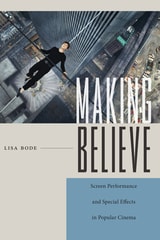
Making Believe
Screen Performance and Special Effects in Popular CinemaBode, Lisa
Rutgers University Press, 2017
Making Believe incorporates North American film reviews and editorials, actor and crew interviews, trade and fan magazine commentary, actor training manuals, and film production publicity materials to discuss the shifts in screen acting practice and philosophy around transfiguring makeup, doubles, motion capture, and acting to absent places or characters. Along the way it considers how performers and visual and special effects crew work together, and struggle with the industry, critics, and each other to define the aesthetic value of their work, in an industrial system of technological reproduction. Bode opens our eyes to the performing illusions we love and the tensions we experience in wanting to believe in spite of our knowledge that it is all make believe in the end.
Reinventing Cinema
Movies in the Age of Media ConvergenceTryon, Chuck
Rutgers University Press, 2009
Reinventing Cinema examines film culture at the turn of this century, at the precise moment when digital media are altering our historical relationship with the movies. Spanning multiple disciplines, Chuck Tryon addresses the interaction between production, distribution, and reception of films, television, and other new and emerging media.Through close readings of trade publications, DVD extras, public lectures by new media leaders, movie blogs, and YouTube videos, Tryon navigates the shift to digital cinema and examines how it is altering film and popular culture.
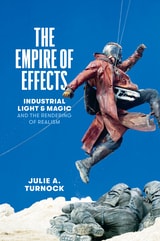
The Empire of Effects
Industrial Light and Magic and the Rendering of RealismJulie A. Turnock
University of Texas Press, 2022
2024 Finalist, Marshall McLuhan Outstanding Book Award, Media Ecology Association
How one company created the dominant aesthetic of digital realism.
Just about every major film now comes to us with an assist from digital effects. The results are obvious in superhero fantasies, yet dramas like Roma also rely on computer-generated imagery to enhance the verisimilitude of scenes. But the realism of digital effects is not actually true to life. It is a realism invented by Hollywood—by one company specifically: Industrial Light & Magic.
The Empire of Effects shows how the effects company known for the puppets and space battles of the original Star Wars went on to develop the dominant aesthetic of digital realism. Julie A. Turnock finds that ILM borrowed its technique from the New Hollywood of the 1970s, incorporating lens flares, wobbly camerawork, haphazard framing, and other cinematography that called attention to the person behind the camera. In the context of digital imagery, however, these aesthetic strategies had the opposite effect, heightening the sense of realism by calling on tropes suggesting the authenticity to which viewers were accustomed. ILM’s style, on display in the most successful films of the 1980s and beyond, was so convincing that other studios were forced to follow suit, and today, ILM is a victim of its own success, having fostered a cinematic monoculture in which it is but one player among many.