Results by title
8 books match the query 'Digital storytelling'
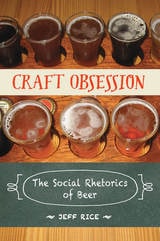
Craft Obsession
The Social Rhetorics of BeerJeff Rice
Southern Illinois University Press, 2016
Rice weaves together theories of writing, narrative, new media, and rhetoric with a personal story of his passion for craft beer. He identifies six key elements of social media rhetoric—anecdotes, repetition, aggregation, delivery, sharing, and imagery—and examines how each helps to transform small, personal experiences with craft into a more widespread movement. When shared via social media, craft anecdotes—such as the first time one had a beer—interrupt and repeat one another, building a sense of familiarity and identity among otherwise unconnected people. Aggregation, the practice of joining unlike items into one space, builds on this network identity, establishing a connection to particular brands or locations, both real and virtual. The public releases of craft beers are used to explore the concept of craft delivery, which involves multiple actors across multiple spaces and results in multiple meanings. Finally, Rice highlights how personal sharing operates within the community of craft beer enthusiasts, who share online images of acquiring, trading for, and consuming a wide variety of beers. These shared stories and images, while personal for each individual, reflect the dependence of craft on systems of involvement. Throughout, Rice relates and reflects on his own experience as a craft beer enthusiast and his participation via social media in these systems.
Both an objective scholarly study and an engaging personal narrative about craft beer, Craft Obsession provides valuable insights into digital writing, storytelling, and social media.
Disrupting Narrative Rhetoric
Experimental Fictionality on Digital PlatformsStefan Iversen
The Ohio State University Press, 2026
Media of Serial Narrative
Frank Kelleter
The Ohio State University Press, 2017
Media of Serial Narrative focuses on key sites and technologies of popular seriality since the mid-nineteenth century and up to today: newspapers, comics, cinema, television, and digital communication. Paying close attention to the affordances of individual media, as well as to their historical interactions, the fourteen chapters survey the forms, processes, and functions of popular serial storytelling. With individual chapters by Frank Kelleter, Jared Gardner, Daniel Stein, Christina Meyer, Scott Higgins, Shane Denson, Ruth Mayer, Kathleen Loock, Constantine Verevis, Jason Mittell, Sudeep Dasgupta, Sean O’Sullivan, Henry Jenkins, Christine Hämmerling, Mirjam Nast, and Andreas Sudmann, Media of Serial Narrative is an exciting and broad-ranging intervention in the fields of seriality, media, and narrative studies.
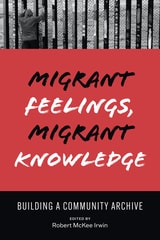
Migrant Feelings, Migrant Knowledge
Building a Community ArchiveRobert McKee Irwin
University of Texas Press, 2022
The digital storytelling project Humanizing Deportation invites migrants to present their own stories in the world’s largest and most diverse archive of its kind. Since 2017, more than 300 community storytellers have created their own audiovisual testimonial narratives, sharing their personal experiences of migration and repatriation. With Migrant Feelings, Migrant Knowledge, the project’s coordinator, Robert Irwin, and other team members introduce the project’s innovative participatory methodology, drawing out key issues regarding the human consequences of contemporary migration control regimes, as well as insights from migrants whose world-making endeavors may challenge what we think we know about migration.
In recent decades, migrants in North America have been treated with unprecedented harshness. Migrant Feelings, Migrant Knowledge outlines this recent history, revealing stories both of grave injustice and of seemingly unsurmountable obstacles overcome. As Irwin writes, “The greatest source of expertise on the human consequences of contemporary migration control are the migrants who have experienced them,” and their voices in this searing collection jump off the page and into our hearts and minds.
Playing at Narratology
Digital Media as Narrative TheoryDaniel Punday
The Ohio State University Press, 2019
Returning to terms such as narrator, setting, event, character, and world, Playing at Narratology reveals new ways of thinking about these basic narrative concepts—concepts that are not so basic when applied to games and web-based narratives. What are thought of as narrative innovations in these digital forms are a product of technological ability and tied to how we physically interact with a medium, creating new and complicated questions: Is the game designer the implied author or the narrator? Is the space on the screen simply the story’s setting? Playing at Narratology guides us through the evolution of narrative in new media without abandoning the field’s theoretical foundations.
Serial Mexico
Storytelling across Media, from Nationhood to NowAmy E. Wright
Vanderbilt University Press, 2023
Honorable Mention, Premio al Mejor Libro en Humanidades, Latin American Studies Association–Mexico Section, 2025
No book until now has tied in two centuries of Mexican serial narratives—tales of glory, of fame, and of epic characters, grounded in oral folklore—with their subsequent retelling in comics, radio, and television soap operas. Wright’s multidisciplinary Serial Mexico delves into this storytelling tradition: examining the nostalgic tales reimagined in novelas, radionovelas, telenovelas and onwards, and examining the foundational figures who have been woven into society.
This panorama shows the Mexican experience of storytelling from the country’s early days until now, showcasing protagonists that mock authority, make light of hierarchy, and embrace the hybridity and mestizaje of Mexico. These tales reflect on and respond to crucial cultural concerns such as family, patriarchy, gender roles, racial mixing, urbanization, modernization, and political idealism. Serial Mexico thus examines how serialized storytelling’s melodrama and sensationalism reveals key political and cultural messaging.
In a detailed yet accessible style, Wright describes how these stories have continued to morph with current times’ concerns and social media. Will tropes and traditions carry on in new and reimagined serial storytelling forms? Only time will tell. Stay tuned for the next episode.
Story Tech
Power, Storytelling, and Social Change AdvocacyFilippo Trevisan, Michael Vaughan, and Ariadne Vromen
University of Michigan Press, 2025
Story Tech explores the increasingly influential impact of technologies—such as databases, algorithms, and digital story banks—that are usually invisible to the public. It shows that hidden “story tech” enables political organizations to treat stories as data that can be queried for storylines and used to intervene in news and information cycles in real time. In particular, the authors review successful story-centered campaigns that helped change dominant narratives on disability rights, marriage equality, and essential workers’ rights in the United States and Australia. They compare the use of storytelling advocacy across different types of organizations including volunteer grassroots groups, large national advocacy coalitions, and trade unions, and examine how trends differ for storytellers, organizers, and their technology partners. As political stories shift to being “on demand,” they reshape power relationships in key public debates in ways that produce moments of tension as well as positive narrative change. Story Tech examines these trends and illustrates how storytelling success can—and should—be achieved in conjunction with personal dignity, privacy, and empowerment for storytellers and their communities, particularly marginalized ones.
Twining
Critical and Creative Approaches to Hypertext NarrativesAnastasia Salter
Amherst College Press, 2021
"While there have certainly been attempts to study Twine historically and theoretically... no single publication has provided such a detailed account of it. And no publication has even attempted to situate Twine amongst its many different conversations and traditions, something this book does masterfully." —James Brown, Rutgers University, Camden