Results by title

24 books match the query 'Dignity'
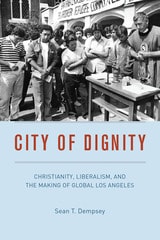
cover of City of Dignity: Christianity, Liberalism, and the Making of Global Los Angeles

City of Dignity

Christianity, Liberalism, and the Making of Global Los Angeles

Sean T. Dempsey

University of Chicago Press, 2023

City of Dignity illuminates how liberal Protestants quietly, yet indelibly, shaped the progressive ethics of postwar Los Angeles.
 
Contemporary Los Angeles is commonly seen as an American bulwark of progressive secular politics, a place that values immigration, equity, diversity, and human rights. But what accounts for the city’s embrace of such staunchly liberal values, which are more hotly contested in other parts of the country? The answer, Sean Dempsey reveals, lies not with those frequent targets of credit and blame—Democrats in Hollywood—but instead with liberal Protestants and other steadfast religious organizations of the postwar era.

As the Religious Right movement emerged in the 1970s, progressive religious activists quietly began promoting an ethical vision that made waves worldwide but saw the largest impact in its place of origin: metropolitan Los Angeles. At the center of this vision lay the concept of human dignity—entwining the integral importance of political and expressive freedom with the moral sanctity of the human condition—which suffused all of the political values that arose from it, whether tolerance, diversity, or equality of opportunity. The work of these religious organizations birthed such phenomena as the Sanctuary Movement—which provided safe haven for refugees fleeing conflict-torn Central America—and advocacy for the homeless, both of which became increasingly fraught issues amid the rising tides of neoliberalism and conservatism. City of Dignity explores how these interwoven spiritual and theological strands found common ground—and made common impacts—in the humanitarian ecosystem of one of America’s largest and most dynamic metro areas.
[more]
cover of City of Dignity: Christianity, Liberalism, and the Making of Global Los Angeles

City of Dignity

Christianity, Liberalism, and the Making of Global Los Angeles

Sean T. Dempsey

University of Chicago Press, 2023

This is an auto-narrated audiobook edition of this book.

City of Dignity illuminates how liberal Protestants quietly, yet indelibly, shaped the progressive ethics of postwar Los Angeles.

 
Contemporary Los Angeles is commonly seen as an American bulwark of progressive secular politics, a place that values immigration, equity, diversity, and human rights. But what accounts for the city’s embrace of such staunchly liberal values, which are more hotly contested in other parts of the country? The answer, Sean Dempsey reveals, lies not with those frequent targets of credit and blame—Democrats in Hollywood—but instead with liberal Protestants and other steadfast religious organizations of the postwar era.

As the Religious Right movement emerged in the 1970s, progressive religious activists quietly began promoting an ethical vision that made waves worldwide but saw the largest impact in its place of origin: metropolitan Los Angeles. At the center of this vision lay the concept of human dignity—entwining the integral importance of political and expressive freedom with the moral sanctity of the human condition—which suffused all of the political values that arose from it, whether tolerance, diversity, or equality of opportunity. The work of these religious organizations birthed such phenomena as the Sanctuary Movement—which provided safe haven for refugees fleeing conflict-torn Central America—and advocacy for the homeless, both of which became increasingly fraught issues amid the rising tides of neoliberalism and conservatism. City of Dignity explores how these interwoven spiritual and theological strands found common ground—and made common impacts—in the humanitarian ecosystem of one of America’s largest and most dynamic metro areas.
[more]
cover of Death of Dignity: Angola's Civil War

Death of Dignity

Angola's Civil War

Victoria Brittain

Pluto Press, 1998

[more]
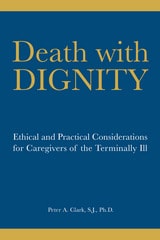
cover of Death with Dignity: Ethical and Practical Considerations for Caregivers of the Terminally Ill

Death with Dignity

Ethical and Practical Considerations for Caregivers of the Terminally Ill

Peter A. Clark, S.J

University of Scranton Press, 2010

End-of-life issues and questions are complex and frequently cause confusion and anxiety.  In Death with Dignity,theologian, medical ethicist, and pastoral caregiver Peter A. Clark examines numerous issues that are pertinent to patients, family members, and health care professionals, including physiology, consciousness, the definition of death, the distinction between extraordinary and ordinary means, medical futility, “Do Not Resuscitate” orders, living wills, power of attorney, pain assessment and pain management, palliative and hospice care, the role of spirituality in end-of-life care, and physicians’ communication with terminal patients. Patients, family members, medical students, and health care professionals will find in Death with Dignity thepractical and ethical knowledge they need to capably and confidently cope with end-of-life challenges.
[more]
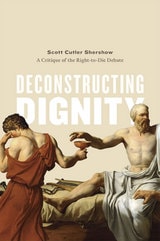
cover of Deconstructing Dignity: A Critique of the Right-to-Die Debate

Deconstructing Dignity

A Critique of the Right-to-Die Debate

Scott Cutler Shershow

University of Chicago Press, 2013

The right-to-die debate has gone on for centuries, playing out most recently as a spectacle of protest surrounding figures such as Terry Schiavo. In Deconstructing Dignity, Scott Cutler Shershow offers a powerful new way of thinking about it philosophically. Focusing on the concepts of human dignity and the sanctity of life, he employs Derridean deconstruction to uncover self-contradictory and damaging assumptions that underlie both sides of the debate.

Shershow examines texts from Cicero’s De Officiis to Kant’s Groundwork of the Metaphysics of Morals to court decisions and religious declarations. Through them he reveals how arguments both supporting and denying the right to die undermine their own unconditional concepts of human dignity and the sanctity of life with a hidden conditional logic, one often tied to practical economic concerns and the scarcity or unequal distribution of medical resources. He goes on to examine the exceptional case of self-sacrifice, closing with a vision of a society—one whose conditions we are far from meeting—in which the debate can finally be resolved. A sophisticated analysis of a heated topic, Deconstructing Dignity is also a masterful example of deconstructionist methods at work. 

[more]
cover of Dignity and Health

Dignity and Health

Nora Jacobson

Vanderbilt University Press, 2012

In these hard times of global financial peril and growing social inequality, injuries to dignity are pervasive. "Indignity has many faces," one man told Nora Jacobson as she conducted interviews for this book. Its expressions range from rudeness, indifference, and condescension to objectification, discrimination, and exploitation. Yet dignity can also be promoted. Another man described it as "common respect," suggesting dignity's ordinariness, and the ways we can create and share it through practices like courtesy, leveling, and contribution.


Dignity and Health examines the processes and structures of dignity violation and promotion, traces their consequences for individual and collective health, and uses the model developed to imagine how we might reform our systems of health and social care.


With its focus on the dignity experiences of those often excluded from the mainstream--people who are poor, or homeless, or dealing with mental health problems--as well as on vulnerabilities like age or sickness or unemployment that threaten to make us all feel "less than," Dignity and Health recognizes dignity as a moral matter embedded in the choices we make every day.
[more]
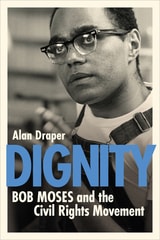
cover of Dignity: Bob Moses and the Civil Rights Movement

Dignity

Bob Moses and the Civil Rights Movement

Alan Draper

University of Illinois Press, 2027

Soft-spoken yet magnetic, Bob Moses became revered within the civil rights movement for his humility, courage, and unparalleled organizing talents. Moses’s organizing skills produced results that retained the commitment of embattled local people and sustained Student Nonviolent Coordinating Committee staff morale. But this came at the expense of developing local leadership.

Challenging entrenched accounts, Alan Draper reveals that Moses could pursue either “Freedom Now” or develop local leaders, but not both. Rich with new details, Dignity follows Bob Moses from his early years through his death in 2021, presenting a clear-eyed view of his personality and achievements. Draper describes how Moses pursued Black voter registration in Mississippi and then in a second career devoted himself to math education. Just as dignity for Blacks in the twentieth century required voting rights, so did Moses believe that dignity for Blacks in the next century required math skills.
[more]
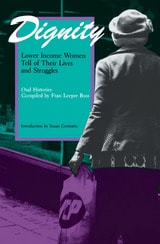
cover of Dignity: Lower Income Women Tell of Their Lives and Struggles

Dignity

Lower Income Women Tell of Their Lives and Struggles

Fran Leeper Buss

University of Michigan Press, 1985
Dignity brings together the stories of ten lower income American women whose backgrounds vary, but who share a struggle for survival and a quest for dignity in the face of hardship. Young or old, urban or rural, welfare recipient or union activist, each relates her life story with rich detail, poignant humor, and remarkable courage.
[more]
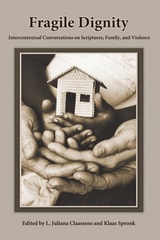
cover of Fragile Dignity: Intercontextual Conversations on Scriptures, Family, and Violence

Fragile Dignity

Intercontextual Conversations on Scriptures, Family, and Violence

L. Juliana Claassens

SBL Press, 2013

Human dignity insists that every human deserves respect and a safe place to live. For many, this is not a reality. The essays collected here analyze the background of this problem in contemporary family life and society at large, with special emphasis on the role of women and on the Bible as a source of inspiration and transformation. The collection is the product of a six-year conversation on family, violence, and human dignity between the Protestant Theological University in Kampen, The Netherlands, and the Faculty of Theology at Stellenbosch University, South Africa, a North-South dialogue that included annual conferences, a series of responsive letters, and additional external responses. The contributors are Cheryl B. Anderson, Hendrik Bosman, Gerrit Brand, Athalya Brenner, L. Juliana Claassens, Dorothea Erbele-Küster, Leo J. Koffeman, Frits de Lange, Monica Jyotsna Melanchthon, Magda Misset-van de Weg, Beverly Eileen Mitchell, Anne-Claire Mulder, Ian Nell, Mary-Anne Plaatjies-van Huffel, Jeremy Punt, Petruschka Schaafsma, D. Xolile Simon, Lee-Ann J. Simon, Gé Speelman, Klaas Spronk, Ciska Stark, Elsa Tamez, Charlene van der Walt, Robert Vosloo, and Yusef Waghid.
[more]
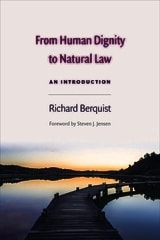
cover of From Human Dignity to Natural Law: An Introduction

From Human Dignity to Natural Law

An Introduction

Richard Berquist

Catholic University of America Press, 2019

From Human Dignity to Natural Law shows how the whole of the natural law, as understood in the Aristotelian Thomistic tradition, is contained implicitly in human dignity. Human dignity means existing for one’s own good (the common good as well as one’s individual good), and not as a mere means to an alien good. But what is the true human good? This question is answered with a careful analysis of Aristotle’s definition of happiness. The natural law can then be understood as the precepts that guide us in achieving happiness. To show that human dignity is a reality in the nature of things and not a mere human invention, it is necessary to show that human beings exist by nature for the achievement of the properly human good in which happiness is found. This implies finality in nature. Since contemporary natural science does not recognize final causality, the book explains why living things, as least, must exist for a purpose and why the scientific method, as currently understood, is not able to deal with this question. These reflections will also enable us to respond to a common criticism of natural law theory: that it attempts to derive statements of what ought to be from statements about what is. After defining the natural law and relating it to human or positive law, Richard Berquist considers Aquinas’s formulation of the first principle of the natural law. It then discusses the love commandments to love God above all things and to love one’s neighbor as oneself as the first precepts of the natural law. Subsequent chapters are devoted to clarifying and defending natural law precepts concerned with the life issues, with sexual morality and marriage, and with fundamental natural rights. From Human Dignity to Natural Law concludes with a discussion of alternatives to the natural law.
[more]
cover of Gangs, Politics and Dignity in Cape Town

Gangs, Politics and Dignity in Cape Town

Steffen Jensen

University of Chicago Press, 2008

After nearly fifty years of rigid segregation, the demise of the apartheid regime in South Africa and the African National Congress’s relatively peaceful assumption of power in 1994 were hailed as a miracle. But a few years into the transition, this miracle appeared increasingly threatened by crime and violence. In this compelling ethnography, Steffen Jensen focuses on a single township in Cape Town in order to explore how residents have negotiated the intersecting forces of political change and violent crime.

Jensen spent years closely observing the actions of residents both male and female, young and old, as well as gang members, police officers, and local government officials. The poisonous legacy of apartheid also comes under Jensen’s lens, as he examines the lasting effects that an official policy of racist stereotyping has had on the residents’ conceptions of themselves and their neighbors. While Gangs, Politics, and Dignity in Cape Town brims with insights into ongoing debates over policing, gangs, and local politics, Jensen also shows how people in the townships maintain their dignity in the face of hardship and danger.

[more]
cover of Homeless and at Home in America: Evidence for the Dignity of the Human Soul in Our Time and Place

Homeless and at Home in America

Evidence for the Dignity of the Human Soul in Our Time and Place

Peter Augustine Lawler

St. Augustine's Press, 2007

[more]
cover of Hope And Dignity: Older Black Women of the South

Hope And Dignity

Older Black Women of the South

Emily Wilson

Temple University Press, 1992
[more]
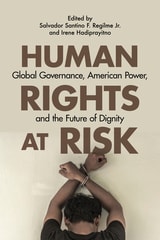
cover of Human Rights at Risk: Global Governance, American Power, and the Future of Dignity

Human Rights at Risk

Global Governance, American Power, and the Future of Dignity

Salvador Santino F. Regilme Jr. and Irene Hadiprayitno

Rutgers University Press, 2022
Human Rights at Risk brings together social scientists, legal scholars, and humanities scholars to analyze the policy challenges of human rights protection in the twenty-first century. The volume is organized based on three overarching themes that highlight the challenges and risks in international human rights: international institutions and global governance of human rights; thematic blind spots in human rights protection; and the human rights challenges of the United States as a global and domestic actor amidst the contemporary global shifts to authoritarianism and illiberal populism. One of the very few books that offer new perspectives that envision the future of transnational human rights norms and human dignity from a multidisciplinary perspective, Human Rights at Risk comprehensively examines the causes and consequences of the challenges faced by international human rights. Scholars, students, and policy practitioners who are interested in the challenges and reform prospects of the international human rights regime, United States foreign policy, and international institutions will find this multidisciplinary volume an invaluable guide to the state of global politics in the twenty-first century. 
[more]
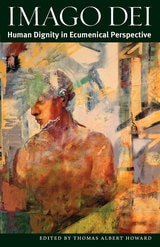
cover of Imago Dei

Imago Dei

Thomas Albert Howard

Catholic University of America Press, 2013
Imago Dei will serve as an indispensable resource for those wishing to deepen their grasp of the theological bases for Christian views of human dignity, as well as for those who believe that Christ's words "that they be one" (John 17:21) remain a theological imperative today
[more]
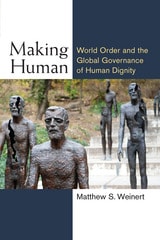
cover of Making Human: World Order and the Global Governance of Human Dignity

Making Human

World Order and the Global Governance of Human Dignity

Matthew S. Weinert

University of Michigan Press, 2015
Differences between human beings have long been used to justify a range of degrading, exclusionary, and murderous practices that strip people of their humanity and dignity. While considerable scholarship has been devoted to such dehumanization, Matthew S. Weinert asks how we might conceive its reverse—humanization, or what it means to “make human.”

Weinert proposes an account of making human centered on five mechanisms: reflection, recognition, resistance, replication of dominant mores, and responsibility. Examining cases such as the UN Security Council’s engagements with crises and the International Court of Justice’s grappling with Kosovo’s unilateral declaration of independence, he illustrates the distinct and contingent ways these mechanisms have been deployed. Theoretically, the cases evince a complex, evolving relationship between state-centric and human-centric views of society, ultimately revealing the normative potentialities of both.

Though the case studies concern specific human relations issues on an international level, Weinert argues in favor of starting from the shared problem of being human and of living in a world in which the humanity of countless groups has been demeaned or denied. Working outward from that point, he proposes, we obtain a more pragmatically grounded understanding of the social construction of the human being.
[more]
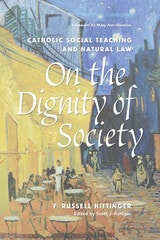
cover of On the Dignity of Society: Catholic Social Teaching and Natural Law

On the Dignity of Society

Catholic Social Teaching and Natural Law

F. Russell Hittinger

Catholic University of America Press, 2024
In this collection of essays, Francis Russell Hittinger shows that Catholic social teaching is not only an articulate defense of the dignity of the human person, but perhaps more fundamentally an elucidation of the dignity of society. Indeed, Hittinger enables us to see that one cannot properly defend the dignity of the person without also showing the dignity of societies in which human persons – as naturally familial, political, and ecclesial animals – seek their own perfection in communion with others. Hittinger has been a renowned scholar of Catholic social doctrine for some time now, and the essays presented here are the fruit of his mature thinking on the topic over the course of many years. As each chapter shows, Hittinger’s historically important body of work on Catholic moral and social philosophy and theology is rooted in natural law theory and Thomistic philosophy, but also animated by St. Augustine’s thought and thus consistently sensitive to historical contexts and arenas for moral and theological disputation. These magisterial essays therefore integrate historical studies of the development of Catholic social teaching with systematic exposition of the theological coherence of that tradition, while also articulating the essential role of philosophy and natural law within both. The volume is divided into three parts. The first part is comprised of six essays on Catholic social teaching, the second part is made up of six essays on natural law and its role in social doctrine, and the third part includes two essays discussing the first principles of the Church’s teaching on social issues. This collection will no doubt become a standard in the field of scholarship on Catholic social teaching.
[more]
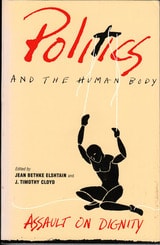
cover of Politics and the Human Body: Assault on Dignity

Politics and the Human Body

Assault on Dignity

Jean Bethke Elshtain

Vanderbilt University Press, 1995

Who or what determines the right to die? Do advancing reproductive technologies change reproductive rights? What forces influence cultural standards of beauty? How do discipline, punishment, and torture reflect our attitudes about the human body?

In this challenging new book, Jean Bethke Elshtain, a nationally recognized scholar in political science and philosophy, and J. Timothy Cloyd, a strong new voice in social and political science, have assembled a collection of thought-provoking essays on these issues written by some of the finest minds of our day.
[more]
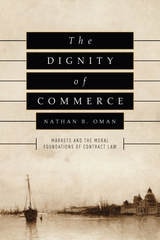
cover of The Dignity of Commerce: Markets and the Moral Foundations of Contract Law

The Dignity of Commerce

Markets and the Moral Foundations of Contract Law

Nathan B. Oman

University of Chicago Press, 2016

Why should the law care about enforcing contracts? We tend to think of a contract as the legal embodiment of a moral obligation to keep a promise. When two parties enter into a transaction, they are obligated as moral beings to play out the transaction in the way that both parties expect. But this overlooks a broader understanding of the moral possibilities of the market. Just as Shakespeare’s Shylock can stand on his contract with Antonio not because Antonio is bound by honor but because the enforcement of contracts is seen as important to maintaining a kind of social arrangement, today’s contracts serve a fundamental role in the functioning of society.

With The Dignity of Commerce, Nathan B. Oman argues persuasively that well-functioning markets are morally desirable in and of themselves and thus a fit object of protection through contract law. Markets, Oman shows, are about more than simple economic efficiency. To do business with others, we must demonstrate understanding of and satisfy their needs. This ability to see the world from another’s point of view inculcates key virtues that support a liberal society. Markets also provide a context in which people can peacefully cooperate in the absence of political, religious, or ideological agreement. Finally, the material prosperity generated by commerce has an ameliorative effect on a host of social ills, from racial discrimination to environmental destruction.

The first book to place the moral status of the market at the center of the justification for contract law, The Dignity of Commerce is sure to elicit serious discussion about this central area of legal studies.

 
[more]
cover of The Powers of Dignity: The Black Political Philosophy of Frederick Douglass

The Powers of Dignity

The Black Political Philosophy of Frederick Douglass

Nick Bromell

Duke University Press, 2021

In The Powers of Dignity Nick Bromell unpacks Frederick Douglass's 1867 claim that he had “elaborated a political philosophy” from his own “slave experience.” Bromell shows that Douglass devised his philosophy because he found that antebellum Americans' liberal-republican understanding of democracy did not provide a sufficient principled basis on which to fight anti-Black racism. To remedy this deficiency, Douglass deployed insights from his distinctively Black experience and developed a Black philosophy of democracy. He began by contesting the founders' racist assumptions about humanity and advancing instead a more robust theory of “the human” as a collection of human “powers.” He asserted further that the conscious exercise of those powers is what confirms human dignity and that human rights and democracy come into being as ways to affirm and protect that dignity. Thus, by emphasizing the powers and the dignity of all citizens, deriving democratic rights from these, and promoting a remarkably activist, power-oriented model of citizenship, Douglass's Black political philosophy aimed to rectify two major failings of US democracy in his time and ours: its complacence and its racism.
[more]
cover of The Right to Die with Dignity: An Argument in Ethics, Medicine, and Law

The Right to Die with Dignity

An Argument in Ethics, Medicine, and Law

Cohen-Almagor, Raphael

Rutgers University Press, 2001

There are few issues more divisive than what has become known as “the right to die.” One camp upholds “death with dignity,” regarding the terminally ill as autonomous beings capable of forming their own judgment on the timing and process of dying. The other camp advocates “sanctity of life,” regarding life as intrinsically valuable, and that should be sustained as long as possible. Is there a right answer?

Raphael Cohen-Almagor takes a balanced approach in analyzing this emotionally charged debate, viewing the dispute from public policy and international perspectives. He offers an interdisciplinary, compelling study in medicine, law, religion, and ethics. It is a comprehensive look at the troubling question of whether physician-assisted suicide should be allowed. Cohen-Almagor delineates a distinction between active and passive euthanasia and discusses legal measures that have been invoked in the United States and abroad. He outlines reasons non-blood relatives should be given a role in deciding a patient’s last wishes. As he examines euthanasia policies in the Netherlands and the 1994 Oregon Death with Dignity Act, the author suggests amendments and finally makes a circumscribed plea for voluntary physician-assisted suicide.
[more]
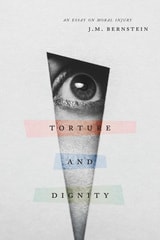
cover of Torture and Dignity: An Essay on Moral Injury

Torture and Dignity

An Essay on Moral Injury

J. M. Bernstein

University of Chicago Press, 2015

In this unflinching look at the experience of suffering and one of its greatest manifestations—torture—J. M. Bernstein critiques the repressions of traditional moral theory, showing that our morals are not immutable ideals but fragile constructions that depend on our experience of suffering itself. Morals, Bernstein argues, not only guide our conduct but also express the depth of mutual dependence that we share as vulnerable and injurable individuals.  
           
Beginning with the attempts to abolish torture in the eighteenth century, and then sensitively examining what is suffered in torture and related transgressions, such as rape, Bernstein elaborates a powerful new conception of moral injury. Crucially, he shows, moral injury always involves an injury to the status of an individual as a person—it is a violent assault against his or her dignity. Elaborating on this critical element of moral injury, he demonstrates that the mutual recognitions of trust form the invisible substance of our moral lives, that dignity is a fragile social possession, and that the perspective of ourselves as potential victims is an ineliminable feature of everyday moral experience. 
[more]
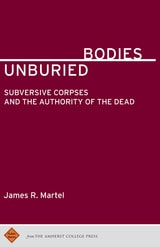
cover of Unburied Bodies: Subversive Corpses and the Authority of the Dead

Unburied Bodies

Subversive Corpses and the Authority of the Dead

James R. Martel

Amherst College Press, 2018

The human body is the locus of meaning, personhood, and our sense of the possibility of sanctity.  The desecration of the human corpse is a matter of universal revulsion, taboo in virtually all human cultures. Not least for this reason, the unburied corpse quickly becomes a focal point of political salience, on the one hand seeming to express the contempt of state power toward the basic claims of human dignity—while on the other hand simultaneously bringing into question the very legitimacy of that power. In Unburied Bodies: Subversive Corpses and the Authority of the Dead, James Martel surveys the power of the body left unburied to motivate resistance, to bring forth a radically new form of agency, and to undercut the authority claims made by state power. Ranging across time and space from the battlefields of ancient Thebes to the streets of Ferguson, Missouri, and taking in perspectives from such writers as Sophocles, Machiavelli, Walter Benjamin, Hannah Arendt, James Baldwin, Judith Butler, Thomas Lacqueur, and Bonnie Honig, Martel asks why the presence of the abandoned corpse can be seen by both authorities and protesters as a source of power, and how those who have been abandoned or marginalized by structures of authority can find in a lifeless body fellow accomplices  in their aspirations for dignity and humanity. 
[more]