Results by title
9 books match the query 'Disappeared persons'
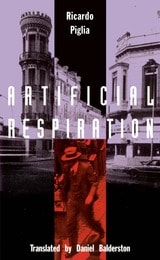
Artificial Respiration
Ricardo Piglia
Duke University Press, 1994
As a prize winning detective novel, Artificial Respiration reaches through many levels of mystery to explore the forces that have been at play in Argentina throughout its violent history. The narrator, a writer named Renzi, begins to look for an uncle who has vanished, a man he knows only through a web of contradictory family stories and an exchange of letters. Through these letters he learns about his uncle’s research into the life of Enrique Ossario, secretary to the 19th-century Argentine dictator Rosas and spy for the dictator’s enemy. As Renzi’s search leads further into his uncle’s work and to conversations with his literary and chess-playing friends, the reader is led by Piglia to consider the nature of Argentine identity, its literature and history, and its relation, for example, to Europe, exile, and democracy. Finally, and made most vividly appreciable by the retelling of a story in which Kafka meets Hitler, it is the encounter between literature and history that is explored.
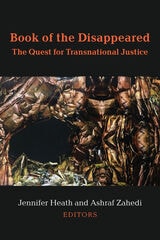
Book of the Disappeared
The Quest for Transnational JusticeJennifer Heath and Ashraf Zahedi, Editors
University of Michigan Press, 2023
Book of the Disappeared confronts worldwide human rights violations of enforced disappearance and genocide and explores the global quest for justice with forceful, outstanding contributions by respected scholars, expert practitioners, and provocative contemporary artists. This profoundly humane book spotlights our historic inhumanity while offering insights for survival and transformation.

Circle of Love Over Death
The Story of the Mothers of the Plaza de MayoMatilde Mellibovsky
Northwestern University Press, 1996

Digging for Hope
A Feminist Ethnography in the Land of Mass GravesR. Aída Hernández Castillo
University of Arizona Press, 2026
Through physical and spiritual practices such as exhumation, mourning, and poetic remembrance, these women reclaim dignity for the dead and challenge a society that has normalized disappearance. At the heart of this book is a profound exploration of what Hernández Castillo calls a “pedagogy of love”—a political and ethical framework rooted in care, solidarity, and the refusal to forget. These women are not only searching for bodies; they are building emotional communities, crafting new languages of justice, and offering a reimagining of what it means to resist violence. Their practices, often overlooked by traditional scholarship, restore humanity and dignify the disappeared.
Digging for Hope is essential reading for anyone seeking to understand the gendered dimensions of violence and the grassroots movements that rise in response. With clarity and compassion, Hernández Castillo brings readers into the intimate spaces of grief and resistance, offering a model for feminist ethnography that is both rigorous and deeply humane.

Disappearing Acts
Spectacles of Gender and Nationalism in Argentina's "Dirty War"Diana Taylor
Duke University Press, 1997
Taylor uses performance theory to explore how public spectacle both builds and dismantles a sense of national and gender identity. Here, nation is understood as a product of communal "imaginings" that are rehearsed, written, and staged—and spectacle is the desiring machine at work in those imaginings. Taylor argues that the founding scenario of Argentineness stages the struggle for national identity as a battle between men—fought on, over, and through the feminine body of the Motherland. She shows how the military’s representations of itself as the model of national authenticity established the parameters of the conflict in the 70s and 80s, feminized the enemy, and positioned the public—limiting its ability to respond. Those who challenged the dictatorship, from the Mothers of the Plaza de Mayo to progressive theater practitioners, found themselves in what Taylor describes as "bad scripts." Describing the images, myths, performances, and explanatory narratives that have informed Argentina’s national drama, Disappearing Acts offers a telling analysis of the aesthetics of violence and the disappearance of civil society during Argentina’s spectacle of terror.

I Remember Julia
Voices of the DisappearedEric Carlson
Temple University Press, 1996
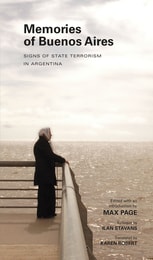
Memories of Buenos Aires
Signs of State Terrorism in ArgentinaMax Page
University of Massachusetts Press, 2013
In the 1970s, Argentina was the leader in the “Dirty War,” a violent campaign by authoritarian South American regimes to repress left-wing groups and any others who were deemed subversive. Over the course of a decade, Argentina's military rulers tortured and murdered upwards of 30,000 citizens. Even today, after thirty years of democratic rule, the horror of that time continues to roil Argentine society.
Argentina has also been in the vanguard in determining how to preserve sites of torture, how to remember the “disappeared,” and how to reflect on the causes of the Dirty War. Across the capital city of Buenos Aires are hundreds of grassroots memorials to the victims, documenting the scope of the state's reign of terror. Although many books have been written about this era in Argentina's history, the original Spanish-language edition of Memories of Buenos Aires was the first to identify and interpret all of these sites. It was published by the human rights organization Memoria Abierta, which used interviews with survivors to help unearth that painful history.
This translation brings this important work to an English-speaking audience, offering a comprehensive guidebook to clandestine sites of horror as well as innovative sites of memory. The book divides the 48 districts of the city into 9 sectors, and then proceeds neighborhood-by-neighborhood to offer descriptions of 202 known “sites of state terrorism” and 38 additional places where people were illegally detained, tortured, and killed by the government.
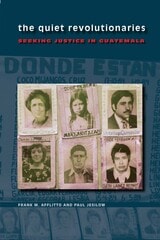
The Quiet Revolutionaries
Seeking Justice in GuatemalaBy Frank M. Afflitto and Paul Jesilow
University of Texas Press, 2007
The last three decades of the twentieth century brought relentless waves of death squads, political kidnappings, and other traumas to the people of Guatemala. Many people fled the country to escape the violence. Yet, at the same moment, a popular movement for justice brought together unlikely bands of behind-the-scenes heroes, blurring ethnic, geographic, and even class lines.
The Quiet Revolutionaries is drawn from interviews conducted by Frank Afflitto in the early 1990s with more than eighty survivors of the state-sanctioned violence. Gathered under frequently life-threatening circumstances, the observations and recollections of these inspiring men and women form a unique perspective on collective efforts to produce change in politics, law, and public consciousness. Examined from a variety of perspectives, from sociological to historical, their stories form a rich ethnography. While it is still too soon to tell whether stable, long-term democracy will prevail in Guatemala, the successes of these fascinating individuals provide a unique understanding of revolutionary resistance.
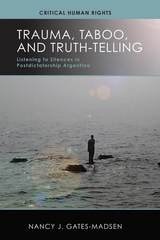
Trauma, Taboo, and Truth-Telling
Listening to Silences in Postdictatorship ArgentinaNancy J. Gates-Madsen
University of Wisconsin Press, 2018
Nancy J. Gates-Madsen reads between the lines of Argentine cultural texts (fiction, drama, testimonial narrative, telenovela, documentary film) to explore the fundamental role of silence—the unsaid—in the expression of trauma. Her careful examination of the interplay between textual and contextual silences illuminates public debate about the meaning of memory in Argentina—which stories are being told and, more important, which are being silenced. The imposition of silence is not limited to the military domain or its apologists, she shows; the human rights community also perpetuates and creates taboos.