Results by title
18 books match the query 'Discourse analysis, Literary'
Caribbean Literary Discourse
Voice and Cultural Identity in the Anglophone CaribbeanBarbara Lalla
University of Alabama Press, 2013
Caribbean Literary Discourse opens the challenging world of language choices and literary experiments characteristic of the multicultural and multilingual Caribbean. In these societies, the language of the master— English in Jamaica and Barbados—overlies the Creole languages of the majority. As literary critics and as creative writers, Barbara Lalla, Jean D’Costa, and Velma Pollard engage historical, linguistic, and literary perspectives to investigate the literature bred by this complex history. They trace the rise of local languages and literatures within the English speaking Caribbean, especially as reflected in the language choices of creative writers.
The study engages two problems: first, the historical reality that standard metropolitan English established by British colonialists dominates official economic, cultural, and political affairs in these former colonies, contesting the development of vernacular, Creole, and pidgin dialects even among the region’s indigenous population; and second, the fact that literary discourse developed under such conditions has received scant attention.
Caribbean Literary Discourse explores the language choices that preoccupy creative writers in whose work vernacular discourse displays its multiplicity of origins, its elusive boundaries, and its most vexing issues. The authors address the degree to which language choice highlights political loyalties and tensions; the politics of identity, self-representation, and nationalism; the implications of code-switching—the ability to alternate deliberately between different languages, accents, or dialects—for identity in postcolonial society; the rich rhetorical and literary effects enabled by code-switching and the difficulties of acknowledging or teaching those ranges in traditional education systems; the longstanding interplay between oral and scribal culture; and the predominance of intertextuality in postcolonial and diasporic literature.
Compelled to Write
Alternative Rhetoric in Theory and PracticeDavid L. Wallace
Utah State University Press, 2011
David Wallace argues that any understanding of writing studies must include the conception of discourse as an embodied force with real consequences for real people. Informed in important ways by queer theory, Wallace calls to account users of dominant discourses and at the same time articulates a theory base from which to interpret "alternative rhetoric."
To examine the practice of writing from varied margins of society, Compelled to Write offers careful readings of four exemplar American writers, each of whom felt compelled within their own time and place to write in response to systemic injustices in American society.
Sarah Grimké, a privileged white woman advocating for abolition, is forced to defend her right to speak as a woman; Frederick Douglass begins his public career almost as a curiosity (the articulate ex-slave) and ends it as one of the most important rhetors in American history; Gloria Anzaldúa writes not only in multiple languages and dialects but from marginalized positions related to gender, race, class, sexual identity, and physical abled-ness; David Sedaris uses his privileged position as a middle-class white male humorist to speak unabashedly of his sexuality, his addictions, and obsessive-compulsive personality disorder.
Through these writers, Wallace explores a range of strategies that comprise alternative rhetorical practice, and demonstrates how such practice is inflected by social constraints on rhetorical agency and by how writers employ alternative discourses to resist those constraints. Grounding and personalizing Compelled to Write with rich material from his own teaching and his own experience, Wallace considers a number of implications for teachers of writing.
Corporeal Words
Mikhail Bakhtins Theology DiscourseAlexandar Mihailovic
Northwestern University Press, 1997
Crime in Verse
The Poetics of Murder in the Victorian EraEllen L. O’Brien
The Ohio State University Press, 2008
Discourse and the Other
The Production of the Afro-American TextW. Lawrence Hogue
Duke University Press, 1986
Hogue presents an illuminating discussion of the publication and review history of "major" and neglected texts. He illustrates the acceptance of texts as exotica, as sociological documents, or as carriers of sufficient literary conventions to receive approbation. Although the sixties movement allowed the text to move to the periphery of the dominant ideology, providing some new myths about the Afro-American historical past, this marginal position was subsequently sabotaged, co-opted, or appropriated (Afros became a fad; presidents gave the soul handshake; the hip-talking black was dressing one style and talking another.)
This study includes extended discussion of four works; Ernest J. Gaines's The Autobiography of Miss Jane Pittman, Alice Walker's The Third Life of Grange Copeland, Albert Murray's Train Whistle Guitar, and Toni Morrison's Sula. Hogue assesses the informing worldviews of each and the extent and nature of their acceptance by the dominant American cultural apparatus.
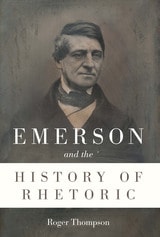
Emerson and the History of Rhetoric
Roger Thompson
Southern Illinois University Press, 2017
Moving beyond dominant literary critical thinking, Thompson argues that for Emerson, rhetoric was both imaginative and nonsystematic. This book covers the influences of rhetoricians from a range of periods on Emerson’s model of rhetoric. Drawing on Emerson’s manuscript notes, journal entries, and some of his rarely discussed essays and lectures as well as his more famous works, the author bridges the divide between literary and rhetorical studies, expanding our understanding of this iconic nineteenth-century man of letters.
Genre Fission
A New Discourse Practice for Culture StudiesMarleen S. Barr
University of Iowa Press, 2000
Barr expands postmodern assumptions about cultural studies by suggesting that "genre fission" is occurring among discrete literary and cultural "types" of events--mainstream novels, science fiction, historical narratives, film, paintings, and museum displays. For her literary insights, Barr turns her attention to such mainstream authors as Saul Bellow, John Updike, Marge Piercy, and John Barth as well as science fiction writers Ursula Le Guin and Octavia Butler and Hispanic American writers Julia Alvarez, Ana Castillo, and Cristina García, among others.
Barr moves from literary to culture studies by addressing such phenomena from contemporary mass culture as the urban landscapes of New York and Los Angeles, Jackie Kennedy, the Star Trek industry, Lynn Redgrave, Amsterdam's red light district, Lorena Bobbitt, and the Apollo astronauts--to provide only a few of the relevant examples. Thus Genre Fission attains what Barr herself designates (in describing the art of Judy Chicago and Lee Bontecou) as "utopian interweavings of difference," crossing numerous boundaries in order to frame a larger territory for exploration.
Interruptions
The Fragmentary Aesthetic in Modern LiteratureGerald L. Bruns
University of Alabama Press, 2018
A history of fragmentary—or interrupted—writing in avant-garde poetry and prose by a renowned literary critic.
In Interruptions: The Fragmentary Aesthetic in Modern Literature, Gerald L. Bruns explores the effects of parataxis, or fragmentary writing as a device in modern literature. Bruns focuses on texts that refuse to follow the traditional logic of sequential narrative. He explores numerous examples of self-interrupting composition, starting with Friedrich Schlegel's inaugural theory and practice of the fragment as an assertion of the autonomy of words, and their freedom from rule-governed hierarchies.
Bruns opens the book with a short history of the fragment as a distinctive feature of literary modernism in works from Gertrude Stein to Paul Celan to present-day authors. The study progresses to the later work of Maurice Blanchot and Samuel Beckett, and argues, controversially, that Blanchot's writings on the fragment during the 1950s and early 1960s helped to inspire Beckett’s turn toward paratactic prose.
The study also extends to works of poetry, examining the radically paratactic arrangements of two contemporary British poets, J. H. Prynne and John Wilkinson, focusing chiefly on their most recent, and arguably most abstruse, works. Bruns also offers a close study of the poetry and poetics of Charles Bernstein.
Interruptions concludes with two chapters about James Joyce. First, Bruns tackles the language of Finnegans Wake, namely the break-up of words themselves, its reassembly into puns, neologisms, nonsense, and even random strings of letters. Second, Bruns highlights the experience of mirrors in Joyce’s fiction, particularly in Dubliners, Portrait of the Artist as a Young Man, and Ulysses, where mirrored reflections invariably serve as interruptions, discontinuities, or metaphorical displacements and proliferations of self-identity.
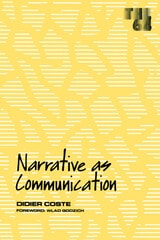
Narrative As Communication
Didier Coste
University of Minnesota Press, 1989
Narrative as Communication is the first major treatise on narrative and narrative theory to make use of all the analytic tools developed in the twenty years. Intended as an up-to-date introduction, it carefully defines narrative discourse, distinguishing it from other discourses, and analyzes what it entails by referring to numerous examples spanning a wide range of media and literary works. At the same time, it orients narrative theory in the current debates surrounding the “New Historicism” and postmodern ideology, showing that theories of narrative are necessarily central to any understanding of history.
Not restricted to any single genre, Coste’s text emphasizes the production of narrative meaning in diverse contexts: The Epic of Gilgamesh, a John Ford film classic, French American, and Spanish new fiction, Dante, Shakespeare, the pastoral, the fairy tale, The Communist Manifesto, Prescott’s History of the Conquest of Peru, a painting by Gustave Moreau. Coste thoroughly and critically examines the usual concepts of voice, character, point of view and narrative syntax, and he develops radical revisions in the notion of fictionality, character, narrative economy and the function of narrative meaning itself. The book is a remarkable synthesis that will likely become a reference for future studies in narratology.
Poetic Voices
Discourse Linguistics and the Poetic TextTimothy R. Austin
University of Alabama Press, 1994
Poems written in the first person, poems that contain passages of conversation or dialogue, and narrative poems all rely on their readers’ capacity to process discourse. Discourse features in the texts of those poems—features such as temporal and spatial reference, narrative “framing”, and the strategic use of direct speech—inevitably affect the way readers receive the central themes. Recent developments in linguistic theory, including developments that address discourse structure, thus offer literary scholars new tools for approaching a richer understanding of those poems.
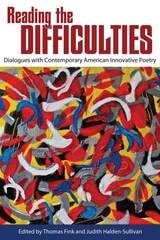
Reading the Difficulties
Dialogues with Contemporary American Innovative PoetryThomas Fink
University of Alabama Press, 2013
New Strategies for Reading the Most Innovative Poetry of Our Time.
Definitions of what constitutes innovative poetry are innumerable and are offered from every quarter. Some critics and poets argue that innovative poetry concerns free association (John Ashbery), others that experimental poetry is a “re-staging” of language (Bruce Andrews) or a syntactic and cognitive break with the past (Ron Silliman and Lyn Hejinian). The tenets of new poetry abound.
But what of the new reading that such poetry demands? Essays in Reading the Difficulties ask what kinds of stances allow readers to interact with verse that deliberately removes many of the comfortable cues to comprehension—poetry that is frequently nonnarrative, nonrepresentational, and indeterminate in subject, theme, or message.
Some essays in Thomas Fink and Judith Halden-Sullivan’s collection address issues of reader reception and the way specific stances toward reading support or complement the aesthetic of each poet. Others suggest how we can be open readers, how innovative poetic texts change the very nature of reader and reading, and how critical language can capture this metamorphosis. Some contributors consider how the reader changes innovative poetry, what language reveals about this interaction, which new reading strategies unfold for the audiences of innovative verse, and what questions readers should ask of innovative verse and of events and experiences that we might bring to reading it.
Tense and Narrativity
From Medieval Performance to Modern FictionBy Suzanne Fleischman
University of Texas Press, 1990
In this pathfinding study, Suzanne Fleischman brings together theory and methodology from various quarters to shed important new light on the linguistic structure of narrative, a primary and universal device for translating our experiences into language.
Fleischman sees linguistics as laying the foundation for all narratological study, since it offers insight into how narratives are constructed in their most primary context: everyday speech. She uses a linguistic model designed for "natural" narrative to explicate the organizational structure of "artificial" narrative texts, primarily from the Middle Ages and the postmodern period, whose seemingly idiosyncratic use of tenses has long perplexed those who study them. Fleischman develops a functional theory of tense and aspect in narrative that accounts for the wide variety of functions—pragmatic as well as grammatical—that these two categories of grammar are called upon to perform in the linguistic economy of a narration.
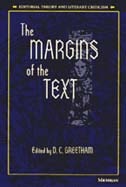
The Margins of the Text
D. C. Greetham, Editor
University of Michigan Press, 1997
The Margins of the Text is the first attempt to collect a body of essays concerned with specific aspects of the marginal as they relate to text. The volume is divided into two sections. The first part assembles essays concerned with the margins of textual discourse and explores the function of discourses not previously recognized as significant to scholarly editing, such as those of class, race, gender, and sexual orientation. The second section attends to the textual margins in the bibliographical sense--the margins of the book, in which there has been so much recent interest. The two parts of the collection are clearly interrelated, since both study the effects of margins as a form of cultural discourse.
As a whole, the collection spans several periods (medieval, Renaissance, eighteenth-century to modern), several disciplines (drama, literature, art history, politics, and philosophy), and offers a wide-ranging consideration of a single topic as it is manifested in various genres, formats, and media. The contributors are among the most respected textual/critical theorists in their fields.
The Margins of the Text will become a standard reference in the field, and will be read profitably by culture critics and social historians as well as textual critics and editors.
D. C. Greetham is Professor of English and Medieval Studies, City University of New York Graduate School.
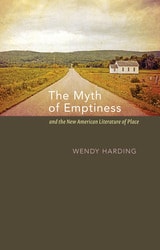
The Myth of Emptiness and the New American Literature of Place
Wendy Harding
University of Iowa Press, 2014
In The Myth of Emptiness and the New American Literature of Place, Wendy Harding identifies an important recent development in the literature of place that corrects the misperceptions resulting from these tropes. Works by Rick Bass, Charles Bowden, Ellen Meloy, Jonathan Raban, Rebecca Solnit, and Robert Sullivan move away from the tradition of nature writing, with its emphasis on the solitary individual communing with nature in uninhabited places, to recognize the interactions of human and other-than-human presences in the land. In different ways, all six writers reveal a more historically complex relationship between Americans and their environments. In this new literature of place, writers revisit abandoned, threatened, or damaged sites that were once represented as devoid of human presence and dig deeper to reveal that they are in fact full of the signs of human activity. These writers are interested in the role of social, political, and cultural relationships and the traces they leave on the landscape.
Throughout her exploration, Harding adopts a transdisciplinary perspective that draws on the theories of geographers, historians, sociologists, and philosophers to understand the reasons for the enduring perception of emptiness in the American landscape and how this new literature of place works with and against these ideas. She reminds us that by understanding and integrating human impacts into accounts of the landscape, we are better equipped to fully reckon with the natural and cultural crisis that engulfs all landscapes today.
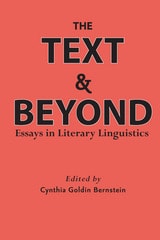
The Text and Beyond
Essays in Literary LinguisticsCynthia Bernstein
University of Alabama Press, 1997
A groundbreaking collection that bridges linguistics and literature, offering powerful tools to uncover how language shapes meaning, identity, and power in literary texts.
The Text and Beyond: Essays in Literary Linguistics, edited by Cynthia Bernstein, presents a groundbreaking collection of essays that demonstrate how linguistic tools can enrich literary analysis. The volume brings together scholars who explore the intersections of language, literature, and culture—examining how syntax, discourse, gender, power, and regional dialects shape meaning in texts. From Tennessee Williams to Harry Crews, from Dickens to immigrant literature, the essays offer models for integrating linguistic theory with literary interpretation. This book is essential for scholars of stylistics, discourse analysis, and anyone interested in the evolving relationship between language and literature.
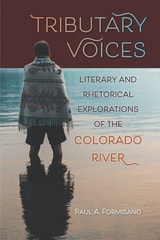
Tributary Voices
Literary and Rhetorical Exploration of the Colorado RiverPaul A. Formisano
University of Nevada Press, 2022
Through literary, rhetorical, and historical analysis of some of the Colorado River’s lesser-known stakeholders, Tributary Voices considers a more comprehensive approach to river management on the eve of the one-hundredth anniversary of the signing of the Colorado River Compact, which governs the allocation of water rights to the seven states in the region. Ranging from the early twentieth century to the present, Tributary Voices examines nature writing, women’s narratives, critiques of dam development, the Latina/o communities’ appeals for river restoration, American Indian authors’ and tribal nations’ claims of water sovereignty, and teachings about environmental stewardship and provident living. This innovative study models an interdisciplinary approach to water governance and reinvigorates our imagination in achieving a more sustainable water ethic.
Women and Discourse in the Fiction of Marguerite Duras
Love, Legends, LanguageSusan D. Cohen
University of Massachusetts Press, 1993
One of the most famous living French writers, Marguerite Duras is renowned for her provocative and hauntingly beautiful works of fiction, drama, and cinema. This book offers the first comprehensive study of the narrative and stylistic characteristics of Duras's fiction. Susan D. Cohen examines the entire range of Duras's works, combining close textual analyses with a more general discussion of narrativity and its connections with gender, class, and race. The focus throughout is on language, representation, and difference, which Duras explores on every structural level.
Cohen shows how Duras's writings, even the controversial “erotic” works, expose and subvert the repression of women in traditional, dominant discourse and at the same time present an alternative, nonrepressive discursive model. She formulates a concept of creative “ignorance,” which she identifies as the generative principle of Duras's textual production and the approach to language it proposes. Cohen also explores the distinctive features of Duras's prose, describing how the writer achieves the ritual, legendary aura that characterizes her work.
Writing the Caribbean in Magazine Time
Katerina Gonzalez Seligmann
Rutgers University Press, 2021