Results by title
2 books match the query 'Discourse markers'
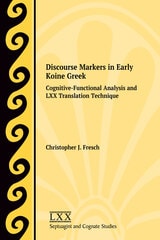
Discourse Markers in Early Koine Greek
Cognitive-Functional Analysis and LXX Translation TechniqueChristopher J. Fresch
SBL Press, 2023
Using a cognitive-functional linguistic framework and cross-linguistic research on discourse markers, Christopher J. Fresch investigates the use of five discourse markers in the documentary papyri of the third to first centuries BCE and the Greek translations of the Hebrew Bible. Through this analysis, Fresch proposes linguistically grounded descriptions for how each discourse marker uniquely functions to guide readers in how they process and comprehend the text. Based on these descriptions, he examines the instances of these discourse markers in the Greek translation of the Minor Prophets and how the translator used them to render the Hebrew text. Fresch presents a picture of a translator who selected discourse markers based on their own understanding of the structure, flow, and meaning of the underlying Hebrew text. Their use attests to a translator who was contextually aware and who desired to produce a translation in idiomatic Koine.
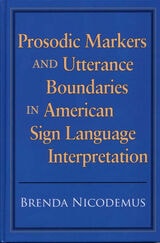
Prosodic Markers and Utterance Boundaries in American Sign Language Interpretation
Brenda Nicodemus
Gallaudet University Press, 2009
The Fifth Volume in the Studies in Interpretation Series
In interpreting, professionals must be able to convey to their clients the rhythm, stress, and length of phrases used by the communicating parties to indicate their respective emotional states. Such subtleties, which can signal sarcasm and irony or whether a statement is a question or a command, are defined in linguistics as prosody. Brenda Nicodemus’s new volume, the fifth in the Studies in Interpretation series, discusses the prosodic features of spoken and signed languages, and reports the findings of her groundbreaking research on prosodic markers in ASL interpretation.
In her study, Nicodemus videotaped five highly skilled interpreters as they interpreted a spoken English lecture into ASL. Fifty Deaf individuals viewed the videotaped interpretations and indicated perceived boundaries in the interpreted discourse. These identified points were then examined for the presence of prosodic markers that might be responsible for the perception of a boundary. Prosodic Markers and Utterance Boundaries reports on the characteristics of the ASL markers, including their frequency, number, duration, and timing. Among other findings, the results show that interpreters produce an average of seven prosodic markers at each boundary point. The markers are produced both sequentially and simultaneously and under conditions of highly precise timing. Further, the results suggest that the type of prosodic markers used by interpreters are both systematic and stylistic.