Results by title
32 books match the query 'Discrimination in criminal justice administration'
Arresting Citizenship
The Democratic Consequences of American Crime ControlAmy E. Lerman and Vesla M. Weaver
University of Chicago Press, 2014
Break the System
Criminalized Black Mothers and the Reproductive Politics of AbolitionSusila Gurusami
University of Chicago Press, 2026
Upends the “broken systems” myth and reveals how the law deliberately criminalizes and punishes Black women, inflicting lasting harm on Black communities in the process.
The United States has one of the highest rates of incarceration in the world, with Black Americans representing a disproportionate share of theimprisoned. Many view this statistic as evidence of a broken system. But sociologist Susila Gurusami argues that the carceral system that so disproportionately harms Black families is not broken at all. In fact, it works just as it was intended. Looking closely at the lives of formerly incarcerated Black mothers, Gurusami shows how state institutions—the criminal-legal, child welfare, and healthcare systems—keep Black mothers from their families, harming Black communities in the process. She also shows how Black women work towards conditions that seem impossible—and even utopian—as part of their everyday mothering labor, but find themselves criminalized for these same actions.
Drawing on ethnographic data and interviews with formerly incarcerated Black women in South Los Angeles, Gurusami challenges dominant assumptions about mothering and criminal justice reform. Gurusami finds that criminalized Black women endure multigenerational political, social, and embodied assaults–what she calls “reproductive warfare”— and still, they build networks, practices, and theories of radical care that protect Black maternal life, legacies, and futures. With incarcerated, formerly incarcerated, and system-impacted Black mothers at the forefront of the growing movement to abolish prisons and jails, Gurusami demonstrates how their everyday mothering work—what she calls “abolitionist motherwork”—is essential to imagining the end of incarceration and ultimately achieving it.
Written with a tender and honest voice, Break the System shares moving vignettes that underscore why we must break the system, rather than reform it, and why we must imagine a future that is radically different than the one we’re told we must accept or salvage.
Captivating Technology
Race, Carceral Technoscience, and Liberatory Imagination in Everyday LifeRuha Benjamin, editor
Duke University Press, 2019
Colored Amazons
Crime, Violence, and Black Women in the City of Brotherly Love, 1880–1910Kali N. Gross
Duke University Press, 2006
Gross draws on prison records, trial transcripts, news accounts, and rare mug shot photographs. Providing an overview of Philadelphia’s black women criminals, she describes the women’s work, housing, and leisure activities and their social position in relation to the city’s native-born whites, European immigrants, and elite and middle-class African Americans. She relates how news accounts exaggerated black female crime, trading in sensationalistic portraits of threatening “colored Amazons,” and she considers criminologists’ interpretations of the women’s criminal acts, interpretations largely based on notions of hereditary criminality. Ultimately, Gross contends that the history of black female criminals is in many ways a history of the rift between the political rhetoric of democracy and the legal and social realities of those marginalized by its shortcomings.
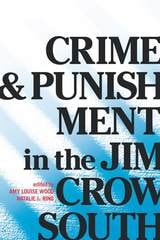
Crime and Punishment in the Jim Crow South
Edited by Amy Louise Wood and Natalie J. Ring
University of Illinois Press, 2019
In this collection, Amy Louise Wood and Natalie J. Ring present nine groundbreaking essays about the carceral system and its development over time. Topics range from activism against police brutality to the peculiar path of southern prison reform to the fraught introduction of the electric chair. The essays tell nuanced stories of rapidly changing state institutions, political leaders who sought to manage them, and African Americans who appealed to the regulatory state to protect their rights.
Contributors: Pippa Holloway, Tammy Ingram, Brandon T. Jett, Seth Kotch, Talitha L. LeFlouria, Vivien Miller, Silvan Niedermeier, K. Stephen Prince, and Amy Louise Wood
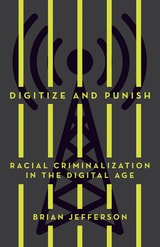
Digitize and Punish
Racial Criminalization in the Digital AgeBrian Jefferson
University of Minnesota Press, 2020
Tracing the rise of digital computing in policing and punishment and its harmful impact on criminalized communities of color
The U.S. Bureau of Justice Statistics estimates that law enforcement agencies have access to more than 100 million names stored in criminal history databases. In some cities, 80 percent of the black male population is registered in these databases. Digitize and Punish explores the long history of digital computing and criminal justice, revealing how big tech, computer scientists, university researchers, and state actors have digitized carceral governance over the past forty years—with devastating impact on poor communities of color.
Providing a comprehensive study of the use of digital technology in American criminal justice, Brian Jefferson shows how the technology has expanded the wars on crime and drugs, enabling our current state of mass incarceration and further entrenching the nation’s racialized policing and punishment. After examining how the criminal justice system conceptualized the benefits of computers to surveil criminalized populations, Jefferson focuses on New York City and Chicago to provide a grounded account of the deployment of digital computing in urban police departments.
By highlighting the intersection of policing and punishment with big data and web technology—resulting in the development of the criminal justice system’s latest tool, crime data centers—Digitize and Punish makes clear the extent to which digital technologies have transformed and intensified the nature of carceral power.
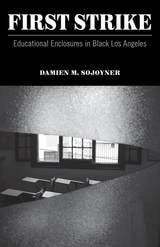
First Strike
Educational Enclosures in Black Los AngelesDamien M. Sojoyner
University of Minnesota Press, 2016
California is a state of immense contradictions. Home to colossal wealth and long portrayed as a bastion of opportunity, it also has one of the largest prison populations in the United States and consistently ranks on the bottom of education indexes. Taking a unique, multifaceted insider’s perspective, First Strike delves into the root causes of its ever-expansive prison system and disastrous educational policy.
Recentering analysis of Black masculinity beyond public rhetoric, First Strike critiques the trope of the “school-to-prison pipeline” and instead explores the realm of public school as a form of “enclosure” that has influenced the schooling (and denial of schooling) and imprisonment of Black people in California. Through a fascinating ethnography of a public school in Los Angeles County, and a “day in the life tour” of the effect of prisons on the education of Black youth, Damien M. Sojoyner looks at the contestation over education in the Black community from Reconstruction to the civil rights and Black liberation movements of the past three decades.
Policy makers, school districts, and local governments have long known that there is a relationship between high incarceration rates and school failure. First Strike is the first book that demonstrates why that connection exists and shows how school districts, cities and states have been complicit and can reverse a disturbing and needless trend. Rather than rely upon state-sponsored ideological or policy-driven models that do nothing more than to maintain structures of hierarchal domination, it allows us to resituate our framework of understanding and begin looking for solutions in spaces that are readily available and are immersed in radically democratic social visions of the future.
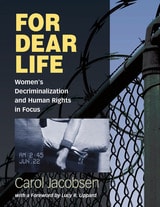
For Dear Life
Women's Decriminalization and Human Rights in FocusCarol Jacobsen
University of Michigan Press, 2019
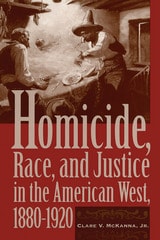
Homicide, Race, and Justice in the American West, 1880-1920
Clare V. McKanna
University of Arizona Press, 1997
This scenario dramatically brings home to the viewer what historians have long debated and hundreds of other films and books suggest: the turn-of-the-century West was a violent time and place. Ranchers, miners, deputy sheriffs, teenagers and old men, occasionally even housewives and mothers found themselves at the business end of a shotgun or a .38 revolver. Yet, since western historians tend to portray violence as essentially episodic--frontier gunfights, range wars, vigilante movements, and the like--solid data has been hard to come by.
As a beginning point for actually measuring lethal violence and assessing the administration of justice, here at last is a detailed and well-documented study of homicide in the American West. Comparing data from representative areas--Douglas County, Nebraska; Las Animas County, Colorado; and Gila County, Arizona--this book reveals a level of violence far greater than many historians have believed, even surpassing eastern cities like New York and Boston.
Clashing cultures and transient populations, a boomtown mentality, easy availability of alcohol and firearms: these and many other factors come under scrutiny as catalysts in the violence that permeated the region. By comparing homicide data, including coroner's inquests, indictments, plea bargains, and sentences across both racial and regional lines, the book also offers persuasive evidence that criminal justice systems of the Old West were weighted heavily in favor of defendants who were white and against those who were African American, Native American, or Mexican.
Packed with information, this is a book for students and scholars of western history, social history, criminology, and justice studies. Western history buffs will be captivated by colorful anecdotes about the real West, where guns could and did blaze over anything from love trysts to vendettas to too much foam on the beer. From whatever perspective, all readers are sure to find here a well-constructed framework for understanding the West as it was and for interpreting the region as it moves into the future.

Implicating the System
Judicial Discourses in Sentencing of Indigenous WomenElspeth Kaiser-Derrick
University of Manitoba Press, 2019
Invisible Men
Mass Incarceration and the Myth of Black ProgressBecky Pettit
Russell Sage Foundation, 2012

Jurors' Stories of Death
How America's Death Penalty Invests in InequalityBenjamin Fleury-Steiner
University of Michigan Press, 2004
-David Cole, from the Foreword
"Perhaps the most powerful, routinely enacted civic ritual in American public life is that of capital punishment. This state-sanctioned extirpation of human life in the collective pursuit of justice is a searing act of civic pedagogy, made legitimate only by the deliberative endorsement of a small group of ordinary citizens-the jury. In Jurors' Stories of Death, Benjamin Fleury-Steiner has taken a cold, hard look at how these ordinary citizens come to terms with their extraordinary role, and how they rationalize their irreversible decisions. The result is a chilling portrait of how we---that is, all of us Americans---constitute ourselves as a political community."
-Glenn Loury, Director, Institute on Race and Social Division
"This illuminating and insightful examination of jury deliberations makes a terrific contribution to the study of capital punishment. Fleury-Steiner's synthesis of sociological, legal and theoretical concepts with vivid juror narratives and statistical data, thoughtfully animates and details how race and class consciousness continue to shape America's death penalty."
---Bryan Stevenson, Professor of Clinical Law, NYU School of Law, Executive Director, Equal Justice Initiative of Alabama
Jurors' Stories of Death is more than just another book on the death penalty; it is the first systematic survey of how death penalty decisions are made.
Benjamin Fleury-Steiner draws on real-life accounts of white and black jurors in capital punishment trials to discuss the effect of race on the sentencing process. He finds that race is invariably a factor in sentencing, with jurors relying on accounts that deny the often marginalized defendants their individuality and complexity, while reinforcing the jurors' own identities as superior, moral, and law-abiding citizens-a system that punishes in the name of dominance. This biased story of "us versus them" continues to infuse political rhetoric on crime and punishment in the United States even today.
Jurors' Stories of Death concludes with an original argument for abolition of the death penalty: If America values multiculturalism and cultural diversity, it must do away with institutions such as state-sanctioned capital punishment in order to begin to free itself from the racism and classicism that so insidiously plague social relations today.
Legal Plunder
The Predatory Dimensions of Criminal JusticeJoshua Page and Joe Soss
University of Chicago Press, 2025
A searing, historically rich account of how US policing and punishment have been retrofitted over the last four decades to extract public and private revenues from America’s poorest and most vulnerable communities.
Alongside the rise of mass incarceration, a second profound and equally disturbing development has transpired. Since the 1980s, US policing and punishment have been remade into tools for stripping resources from the nation’s most oppressed communities and turning them into public and private revenues. Legal Plunder analyzes this development’s origins, operations, consequences, and the political struggles that it has created.
Drawing on historical and contemporary evidence, including original ethnographic research, Joshua Page and Joe Soss examine the predatory dimensions of criminal legal governance to show how practices that criminalize, police, and punish have been retrofitted to siphon resources from subordinated groups, subsidize governments, and generate corporate profits. As tax burdens have declined for the affluent, this financial extraction—now a core function of the country’s sprawling criminal legal apparatus—further compounds race, class, and gender inequalities and injustices. Legal Plunder shows that we can no longer afford to overlook legal plunder or the efforts to dismantle it.
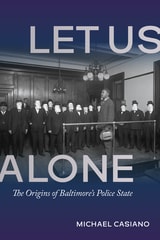
Let Us Alone
The Origins of Baltimore's Police StateMichael Casiano
University of Illinois Press, 2025
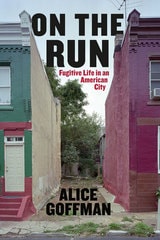
On the Run
Fugitive Life in an American CityAlice Goffman
University of Chicago Press, 2014
Alice Goffman spent six years living in one such neighborhood in Philadelphia, and her close observations and often harrowing stories reveal the pernicious effects of this pervasive policing. Goffman introduces us to an unforgettable cast of young African American men who are caught up in this web of warrants and surveillance—some of them small-time drug dealers, others just ordinary guys dealing with limited choices. All find the web of presumed criminality, built as it is on the very associations and friendships that make up a life, nearly impossible to escape. We watch as the pleasures of summer-evening stoop-sitting are shattered by the arrival of a carful of cops looking to serve a warrant; we watch—and can’t help but be shocked—as teenagers teach their younger siblings and cousins how to run from the police (and, crucially, to keep away from friends and family so they can stay hidden); and we see, over and over, the relentless toll that the presumption of criminality takes on families—and futures.
While not denying the problems of the drug trade, and the violence that often accompanies it, through her gripping accounts of daily life in the forgotten neighborhoods of America's cities, Goffman makes it impossible for us to ignore the very real human costs of our failed response—the blighting of entire neighborhoods, and the needless sacrifice of whole generations.
Pobre Raza!
Violence, Justice, and Mobilization among México Lindo Immigrants, 1900-1936By F. Arturo Rosales
University of Texas Press, 1999
Fleeing the social and political turmoil spawned by the Mexican Revolution, massive numbers of Mexican immigrants entered the southwestern United States in the early decades of the twentieth century. But instead of finding refuge, many encountered harsh, anti-Mexican attitudes and violence from an Anglo population frightened by the influx of foreigners and angered by anti-American sentiments in Mexico.
This book examines the response of Mexican immigrants to Anglo American prejudice and violence early in the twentieth century. Drawing on archival sources from both sides of the border, Arturo Rosales traces the rise of "México Lindo" nationalism and the efforts of Mexican consuls to help poor Mexican immigrants defend themselves against abuses and flagrant civil rights violations by Anglo citizens, police, and the U.S. judicial system. This research illuminates a dark era in which civilian and police brutality, prejudice in the courtroom, and disproportionate arrest, conviction, and capital punishment rates too often characterized justice for Mexican Americans.
Private Prisons in America
A Critical Race PerspectiveMichael A. Hallett
University of Illinois Press, 2006
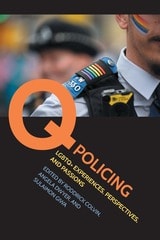
Q Policing
LGBTQ+ Experiences, Perspectives, and PassionsEdited by Roddrick Colvin, Angela Dwyer, and Sulaimon Giwa
Southern Illinois University Press, 2024
Global perspectives on policing within LGBTQ+ communities
Relationships between law enforcement and lesbian, gay, bisexual, transgender, and queer (LGBTQ+) communities have always been varied and complex. On one hand, history is filled with incidents of police harassment: raids that sparked famous uprisings and rebellions; shoddy police investigations into the murders of LGBTQ+ community members; a corrosive organizational culture marked by heteronormativity and misogyny. Yet positive changes are being made, such as the creation of LGBTQ+ police associations, participation by police officers in Pride Parades around the world, and formal apologies for past actions. To some LGBTQ+ community members, police are the physical manifestations of state-sanctioned oppression and abuse. To others, they are guardians who have become partners in public safety.
Q Policing features eighteen contributors from around the world who explore the nature of the relationship between LGBTQ+ communities and the police. Part 1 of the book offers insights on policing and racial and ethnic constructions, including efforts to build collaborative models of community-building within groups and with law enforcement. Part 2 highlights the experiences of individuals who may be marginalized due to various social constructions such as transgender, unhoused, southern, or kink-involved. Finally, Part 3 shares perspectives of queer folks inside policing.
The contributors—scholars, social workers, police officers, and other community leaders—cover diverse topics, including queer experiences of policing in southern India, clinical implications for mental health professionals working with Latinx LGBTQ+ people, transgender and nonbinary peoples’ presentation management during encounters with law enforcement, discriminatory policies in place in the southern United States, the pathologization of kink, and more. Essays analyze interviews with the “Pride Defenders” in Hamilton, Canada, as well as British and American police officers transitioning while in uniform. They explore the experiences of gay, lesbian, and genderqueer police officers, map principal findings and central concerns that structure extant scholarship on gay police officers in the UK, use queer theory to explore the effectiveness of LGBTQ+ liaisons, and more.
The volume editors adopt an inclusive global perspective to account for contextually located experiences of queer people within and outside of the United States. The book incorporates a variety of voices, data sources, and methodologies, but contributors share an intentional focus on race, age, sex, gender, and other identities that helps explain and contextualize queer people’s experiences around and in policing. The diverse, international group of contributors—whose voices are not often heard in traditional outlets and mainstream media—demonstrates that despite discrimination, harassment, and violence, LGBTQ+ communities continue to thrive.
Race, Gender, and Punishment
From Colonialism to the War on TerrorEdited by Mary Bosworth and Jeanne Flavin
Rutgers University Press, 2006
In Race, Gender, and Punishment, Mary Bosworth and Jeanne Flavin bring together twelve original essays by prominent scholars to examine not only the discrimination that is evident, but also the structural and cultural forces that have influenced and continue to perpetuate the current situation. Contributors point to four major factors that have impacted public sentiment and criminal justice policy: colonialism, slavery, immigration, and globalization. In doing so they reveal how practices of punishment not only need particular ideas about race to exist, but they also legitimate them.
The essays unearth troubling evidence that testifies to the nation's brutally racist past, and to white Americans' continued fear of and suspicion about racial and ethnic minorities. The legacy of slavery on punishment is considered, but also subjects that have received far less attention such as how colonizers' notions of cultural superiority shaped penal practices, the criminalization of reproductive rights, the link between citizenship and punishment, and the global export of crime control strategies.
Uncomfortable but necessary reading, this book provides an original critique of why and how the criminal justice system has emerged as such a racist institution.
Raced to Death in 1920s Hawai i
Injustice and Revenge in the Fukunaga CaseJonathan Y. Okamura
University of Illinois Press, 2019

Rape in Chicago
Race, Myth, and the CourtsDawn Rae Flood
University of Illinois Press, 2018

Roots of Disorder
Race and Criminal Justice in the American South, 1817-80Christopher Waldrep
University of Illinois Press, 1998
"Delivers what no other study has yet attempted. . . . Waldrep's book is one of the first systematically to use local trial data to explore questions of society and culture." -- Vernon Burton, author of "A Gentleman and an Officer": A Social and Military History of James B. Griffin's Civil War
Savage Portrayals
Race, Media and the Central Park Jogger StoryNatalie Byfield
Temple University Press, 2014
Slaves of the State
Black Incarceration from the Chain Gang to the PenitentiaryDennis Childs
University of Minnesota Press, 2015
The Thirteenth Amendment to the United States Constitution, passed in 1865, has long been viewed as a definitive break with the nation’s past by abolishing slavery and ushering in an inexorable march toward black freedom. Slaves of the State presents a stunning counterhistory to this linear narrative of racial, social, and legal progress in America.
Dennis Childs argues that the incarceration of black people and other historically repressed groups in chain gangs, peon camps, prison plantations, and penitentiaries represents a ghostly perpetuation of chattel slavery. He exposes how the Thirteenth Amendment’s exception clause—allowing for enslavement as “punishment for a crime”—has inaugurated forms of racial capitalist misogynist incarceration that serve as haunting returns of conditions Africans endured in the barracoons and slave ship holds of the Middle Passage, on plantations, and in chattel slavery.
Childs seeks out the historically muted voices of those entombed within terrorizing spaces such as the chain gang rolling cage and the modern solitary confinement cell, engaging the writings of Toni Morrison and Chester Himes as well as a broad range of archival materials, including landmark court cases, prison songs, and testimonies, reaching back to the birth of modern slave plantations such as Louisiana’s “Angola” penitentiary.
Slaves of the State paves the way for a new understanding of chattel slavery as a continuing social reality of U.S. empire—one resting at the very foundation of today’s prison industrial complex that now holds more than 2.3 million people within the country’s jails, prisons, and immigrant detention centers.
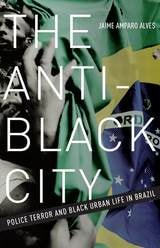
The Anti-Black City
Police Terror and Black Urban Life in BrazilJaime Amparo Alves
University of Minnesota Press, 2018
An important new ethnographic study of São Paulo’s favelas revealing the widespread use of race-based police repression in Brazil
While Black Lives Matter still resonates in the United States, the movement has also become a potent rallying call worldwide, with harsh police tactics and repressive state policies often breaking racial lines. In The Anti-Black City, Jaime Amparo Alves delves into the dynamics of racial violence in Brazil, where poverty, unemployment, residential segregation, and a biased criminal justice system create urban conditions of racial precarity.
The Anti-Black City provocatively offers race as a vital new lens through which to view violence and marginalization in the supposedly “raceless” São Paulo. Ironically, in a context in which racial ambiguity makes it difficult to identify who is black and who is white, racialized access to opportunities and violent police tactics establish hard racial boundaries through subjugation and death. Drawing on two years of ethnographic research in prisons and neighborhoods on the periphery of this mega-city, Alves documents the brutality of police tactics and the complexity of responses deployed by black residents, including self-help initiatives, public campaigns against police violence, ruthless gangs, and self-policing of communities.
The Anti-Black City reveals the violent and racist ideologies that underlie state fantasies of order and urban peace in modern Brazil. Illustrating how “governing through death” has become the dominant means for managing and controlling ethnic populations in the neoliberal state, Alves shows that these tactics only lead to more marginalization, criminality, and violence. Ultimately, Alves’s work points to a need for a new approach to an intractable problem: how to govern populations and territories historically seen as “ungovernable.”
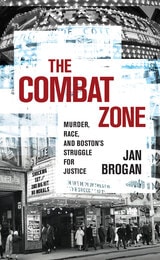
The Combat Zone
Murder, Race, and Boston's Struggle for JusticeJan Brogan
University of Massachusetts Press, 2021
At the end of the 1976 football season, more than forty Harvard athletes went to Boston's Combat Zone to celebrate. In the city's adult entertainment district, drugs and prostitution ran rampant, violent crime was commonplace, and corrupt police turned the other way. At the end of the night, Italian American star athlete Andy Puopolo, raised in the city's North End, was murdered in a stabbing. Three African American men were accused of the crime. His murder made national news and led to the eventual demise of the city's red-light district.
Starting with this brutal murder, The Combat Zone tells the story of the Puopolo family's struggle with both a devastating loss and a criminal justice system that produced two trials with opposing verdicts, all within the context of a racially divided Boston. Brogan traces the contentious relationship between Boston’s segregated neighborhoods during the busing crisis; shines a light on a court system that allowed lawyers to strike potential jurors based purely on their racial or ethnic identity; and lays bare the deep-seated corruption within the police department and throughout the Combat Zone. What emerges is a fascinating snapshot of the city at a transitional moment in its recent past.
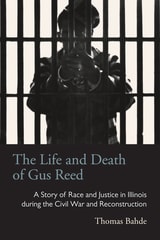
The Life and Death of Gus Reed
A Story of Race and Justice in Illinois during the Civil War and ReconstructionThomas Bahde
Ohio University Press, 2014
Gus Reed was a freed slave who traveled north as Sherman’s March was sweeping through Georgia in 1864. His journey ended in Springfield, Illinois, a city undergoing fundamental changes as its white citizens struggled to understand the political, legal, and cultural consequences of emancipation and black citizenship. Reed became known as a petty thief, appearing time and again in the records of the state’s courts and prisons. In late 1877, he burglarized the home of a well-known Springfield attorney—and brother of Abraham Lincoln’s former law partner—a crime for which he was convicted and sentenced to the Illinois State Penitentiary.
Reed died at the penitentiary in 1878, shackled to the door of his cell for days with a gag strapped in his mouth. An investigation established that two guards were responsible for the prisoner’s death, but neither they nor the prison warden suffered any penalty. The guards were dismissed, the investigation was closed, and Reed was forgotten.
Gus Reed’s story connects the political and legal cultures of white supremacy, black migration and black communities, the Midwest’s experience with the Civil War and Reconstruction, and the resurgence of nationwide opposition to African American civil rights in the late nineteenth century. These experiences shaped a nation with deep and unresolved misgivings about race, as well as distinctive and conflicting ideas about justice and how to achieve it.
The Long Walk to Equality
Perspectives on Racial Inequality, Injustice and the LawAvis Whyte, Patricia Tuitt and Judith Bourne
University of Westminster Press, 2024
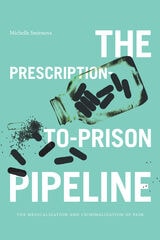
The Prescription-to-Prison Pipeline
The Medicalization and Criminalization of PainMichelle Smirnova
Duke University Press, 2023
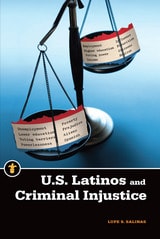
U.S. Latinos and Criminal Injustice
Lupe S. Salinas
Michigan State University Press, 2015
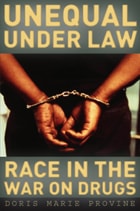
Unequal under Law
Race in the War on DrugsDoris Marie Provine
University of Chicago Press, 2007
Doris Marie Provine’s engaging analysis traces the history of race in anti-drug efforts from the temperance movement of the early 1900s to the crack scare of the late twentieth century, showing how campaigns to criminalize drug use have always conjured images of feared minorities. Explaining how alarm over a threatening black drug trade fueled support in the 1980s for a mandatory minimum sentencing scheme of unprecedented severity, Provine contends that while our drug laws may no longer be racist by design, they remain racist in design. Moreover, their racial origins have long been ignored by every branch of government. This dangerous denial threatens our constitutional guarantee of equal protection of law and mutes a much-needed national discussion about institutionalized racism—a discussion that Unequal under Law promises to initiate.
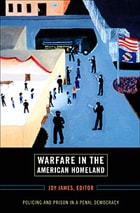
Warfare in the American Homeland
Policing and Prison in a Penal DemocracyJoy James, ed.
Duke University Press, 2007
Contributors consider the interning or policing of citizens of color, the activism of radicals, structural racism, destruction and death in New Orleans following Hurricane Katrina, and the FBI Counterintelligence Program designed to quash domestic dissent. Among the first-person accounts are an interview with Dhoruba Bin Wahad, a Black Panther and former political prisoner; a portrayal of life in prison by a Plowshares nun jailed for her antinuclear and antiwar activism; a discussion of the Puerto Rican Independence Movement by one of its members, now serving a seventy-year prison sentence for sedition; and an excerpt from a 1970 letter by the Black Panther George Jackson chronicling the abuses of inmates in California’s Soledad Prison. Warfare in the American Homeland also includes the first English translation of an excerpt from a pamphlet by Michel Foucault and others. They argue that the 1971 shooting of George Jackson by prison guards was a murder premeditated in response to human-rights and justice organizing by black and brown prisoners and their supporters.
Contributors. Hishaam Aidi, Dhoruba Bin Wahad (Richard Moore), Marilyn Buck, Marshall Eddie Conway, Susie Day, Daniel Defert, Madeleine Dwertman, Michel Foucault, Carol Gilbert, Sirène Harb, Rose Heyer, George Jackson, Joy James, Manning Marable, William F. Pinar, Oscar Lòpez Rivera, Dylan Rodríguez, Jared Sexton, Catherine vön Bulow, Laura Whitehorn, Frank B. Wilderson III