Results by title

15 books match the query 'Displacement'
cover of A World of Words: Language and Displacement in the Fiction of Edgar Allan Poe

A World of Words

Language and Displacement in the Fiction of Edgar Allan Poe

Michael J. S. Williams

Duke University Press, 1988
A World of Words offers a new look at the degree to which language itself is a topic of Poe's texts. Stressing the ways his fiction reflects on the nature of its own signifying practices, Williams sheds new light on such issues as Poe's characterization of the relationship between author and reader as a struggle for authority, on his awareness of the displacement of an "authorial writing self" by a "self as it is written," and on his debunking of the redemptive properties of the romantic symbol.
[more]
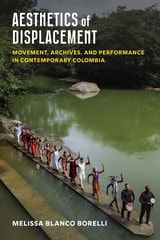
cover of Aesthetics of Displacement: Movement, Archives, and Performance in Contemporary Colombia

Aesthetics of Displacement

Movement, Archives, and Performance in Contemporary Colombia

Melissa Blanco Borelli

University of Michigan Press, 2026

Aesthetics of Displacement centers the embodied aesthetic practices of Afro-Colombian people and their experiences, asking readers to reassess Colombian national history, legacies of colonialism and racism, politics of memory, and the inheritances of violence related to the Colombian armed conflict. Through a theoretical frame of destierro or “displacement” and an examination of the Afro-Colombian philosophy vivir sabroso or “to live harmoniously,” Aesthetics of Displacement focuses on how theatre-makers, choreographers, filmmakers, activist groups, and photojournalists create an embodied Colombian perspective informed by decolonial practices and thinking that rely on movement as a strategy for existence and that counter European hegemonic aesthetics as the major foundations of taste and value. This approach not only enhances our understanding of contemporary Colombian culture, but also highlights the importance of performance as a means of resistance and identity formation.
[more]
cover of American Diaspora: Poetry of Displacement

American Diaspora

Poetry of Displacement

Virgil Suarez

University of Iowa Press, 2001

Diaspora constitutes a powerful descriptor for the modern condition of the contemporary poet, the spokesperson for the psyche of America. The poems in American Diaspora: Poetry of Displacement focus on the struggles and pleasures of creating a home-physical and mental-out of displacement, exile, migration, and alienation.

To fully explore the concept of diaspora, the editors have broadened the scope of their definition to include not only the physical act of moving and immigration but also the spiritual and emotional dislocations that can occur-as for Emily Dickinson and other poets-even in a life spent entirely in one location.

v
[more]
cover of Crossing Cultures: Essays in the Displacement of Western Civilization

Crossing Cultures

Essays in the Displacement of Western Civilization

Daniel Segal

University of Arizona Press, 1992
Through re-examination of colonial and post-colonial encounters, this collection of essays makes a strategic intervention into the current debate over the study of "Western Civilization." Together they question whether, at least since Columbus, "the West" has existed independent of its relations with those deemed Other.
[more]
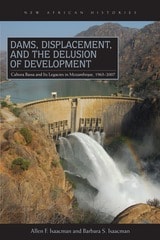
cover of Dams, Displacement, and the Delusion of Development: Cahora Bassa and Its Legacies in Mozambique, 1965–2007

Dams, Displacement, and the Delusion of Development

Cahora Bassa and Its Legacies in Mozambique, 1965–2007

Allen F. Isaacman

Ohio University Press, 2013

Cahora Bassa Dam on the Zambezi River, built in the early 1970s during the final years of Portuguese rule, was the last major infrastructure project constructed in Africa during the turbulent era of decolonization. Engineers and hydrologists praised the dam for its technical complexity and the skills required to construct what was then the world’s fifth-largest mega-dam. Portuguese colonial officials cited benefits they expected from the dam—from expansion of irrigated farming and European settlement, to improved transportation throughout the Zambezi River Valley, to reduced flooding in this area of unpredictable rainfall. “The project, however, actually resulted in cascading layers of human displacement, violence, and environmental destruction. Its electricity benefited few Mozambicans, even after the former guerrillas of FRELIMO (Frente de Libertação de Moçambique) came to power; instead, it fed industrialization in apartheid South Africa.” (Richard Roberts)

This in-depth study of the region examines the dominant developmentalist narrative that has surrounded the dam, chronicles the continual violence that has accompanied its existence, and gives voice to previously unheard narratives of forced labor, displacement, and historical and contemporary life in the dam’s shadow.

[more]
cover of Destroy Them Gradually: Displacement as Atrocity

Destroy Them Gradually

Displacement as Atrocity

Andrew R. Basso

Rutgers University Press, 2024
Perpetrators of mass atrocities have used displacement to transport victims to killing sites or extermination camps to transfer victims to sites of forced labor and attrition, to ethnically homogenize regions by moving victims out of their homes and lands, and to destroy populations by depriving them of vital daily needs. Displacement has been treated as a corollary practice to crimes committed, not a central aspect of their perpetration. Destroying Them Gradually examines four cases that illuminate why perpetrators have destroyed populations using displacement policies: Germany’s genocide of the Herero (1904–1908); Ottoman genocides of Christian minorities (1914–1925); expulsions of Germans from East/Central Europe (1943–1952); and climate violence (twenty-first century). Because displacement has been typically framed as a secondary aspect of mass atrocities, existing scholarship overlooks how perpetrators use it as a means of executing destruction rather than a vehicle for moving people to a specific location to commit atrocities.
 
[more]
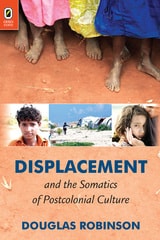
cover of Displacement and the Somatics of Postcolonial Culture

Displacement and the Somatics of Postcolonial Culture

Douglas Robinson

The Ohio State University Press, 2013
Displacement and the Somatics of Postcolonial Culture is Douglas Robinson’s study of postcolonial affect—specifically, of the breakdown of the normative (regulatory) circulation of affect in the refugee experience and the colonial encounter, the restructuring of that regulatory circulation in colonization, and the persistence of that restructuring in decolonization and intergenerational trauma. Robinson defines “somatics” as a cultural construction of “reality” and “identity” through the regulatory circulation of evaluative affect. This book is divided into three essays covering the refugee experience, colonization and decolonization, and intergenerational trauma. Each essay contains a review of empirical studies of its main topic, a study of literary representations of that topic, and a study of postcolonial theoretical spins. The literary representations in the refugee essay are a novel and short story by the Haitian writer Edwidge Danticat; in the colonization essay a short film by Javier Fesser and a novella by Mahasweta Devi (translated by Gayatri Chakravorty Spivak); and in the intergenerational trauma essay novels by James Welch and Toni Morrison and a short story by Percival Everett. The first essay’s theoretical spins include Deleuze and Guattari on nomad thought and Iain Chambers on migrancy; the second’s, Nietzsche’s Genealogy of Morals and theories of postcolonial affect in Bhabha and Spivak; the third’s, work on historical trauma by Cathy Caruth and Dominic LaCapra.
[more]
cover of Displacement, Diaspora, and Geographies of Identity

Displacement, Diaspora, and Geographies of Identity

Smadar Lavie and Ted Swedenburg, eds.

Duke University Press, 1996

Displacement, Diaspora, and Geographies of Identity challenges conventional understandings of identity based on notions of nation and culture as bounded or discrete. Through careful examinations of various transnational, hybrid, border, and diasporic forces and practices, these essays push at the edge of cultural studies, postmodernism, and postcolonial theory and raise crucial questions about ethnographic methodology.
This volume exemplifies a cross-disciplinary cultural studies and a concept of culture rooted in lived experience as well as textual readings. Anthropologists and scholars from related fields deploy a range of methodologies and styles of writing to blur and complicate conventional dualisms between authors and subjects of research, home and away, center and periphery, and first and third world. Essays discuss topics such as Rai, a North African pop music viewed as westernized in Algeria and as Arab music in France; the place of Sephardic and Palestinian writers within Israel’s Ashkenazic-dominated arts community; and the use and misuse of the concept “postcolonial” as it is applied in various regional contexts.
In exploring histories of displacement and geographies of identity, these essays call for the reconceptualization of theoretical binarisms such as modern and postmodern, colonial and postcolonial. It will be of interest to a broad spectrum of scholars and students concerned with postmodern and postcolonial theory, ethnography, anthropology, and cultural studies.

Contributors. Norma Alarcón, Edward M. Bruner, Nahum D. Chandler, Ruth Frankenberg, Joan Gross, Dorinne Kondo, Kristin Koptiuch, Smadar Lavie, Lata Mani, David McMurray, Kirin Narayan, Greg Sarris, Ted Swedenburg

[more]
cover of Frontera Freeways: Highway Building and Displacement in El Paso, Texas

Frontera Freeways

Highway Building and Displacement in El Paso, Texas

Miguel Juarez

University of North Texas Press, 2025
[more]
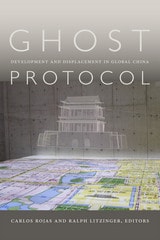
cover of Ghost Protocol: Development and Displacement in Global China

Ghost Protocol

Development and Displacement in Global China

Carlos Rojas and Ralph A. Litzinger, editors

Duke University Press, 2016

Even as China is central to the contemporary global economy, its socialist past continues to shape its capitalist present. This volume's contributors see contemporary China as haunted by the promises of capitalism, the institutional legacy of the Maoist regime, and the spirit of Marxist resistance. China's development does not result from historical imperatives or deliberate economic strategies, but from the effects of discrete practices the contributors call protocols, which stem from an overlapping mix of socialist and capitalist institutional strategies, political procedures, legal regulations, religious rituals, and everyday practices. Analyzing the process of urbanization and the ways marginalized communities and migrant workers are positioned in relation to the transforming social landscape, the contributors show how these protocols constitute the Chinese national imaginary while opening spaces for new emancipatory possibilities. Offering a nuanced theory of contemporary China's hybrid political economy, Ghost Protocol situates China's development at the juncture between the world as experienced and the world as imagined.

Contributors. Yomi Braester, Alexander Des Forges, Kabzung, Rachel Leng, Ralph A. Litzinger, Lisa Rofel, Carlos Rojas, Bryan Tilt, Robin Visser, Biao Xiang, Emily T. Yeh
[more]
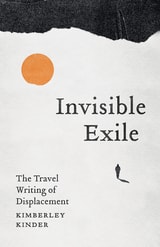
cover of Invisible Exile: The Travel Writing of Displacement

Invisible Exile

The Travel Writing of Displacement

Kimberley Kinder

University of Minnesota Press, 2025

Mapping the transformative personal journeys of the displaced

The travel writing genre has long been associated with a certain kind of privileged and autonomous journey, encouraged by society and geared toward individual growth. Presenting an important counterpoint to this tradition, Invisible Exile considers a diverse set of narratives that explore travel undertaken as a result of displacement. In this creative work of cultural geography, Kimberley Kinder sheds light on the transformative accounts of those who must navigate across and within spatial boundaries due to marginalization and violence.

Unfolding as an extended trip, with each chapter marking out the next phase of one imaginatively constructed itinerary, Invisible Exile analyzes forty works in which the authors grapple with themes of loss and alienation. Kinder emphasizes the aspect of travel writing that posits spatial movement as a means of reinventing oneself, showcasing the personal insight and renewal these travelers find on their paths into, through, and partially out of exile.

By foregrounding the experiences of forced and reluctant migrants and refugees, Invisible Exile poses a critical challenge to the existing genre of travel literature, expanding its scope. Examining a vast range of twenty-first-century writings, Kinder crafts a moving, episodic journey that carries readers through displacement, transformation, and redemption.

Retail e-book files for this title are screen-reader friendly.
[more]
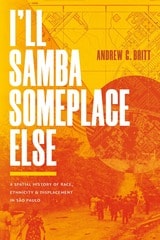
cover of I’ll Samba Someplace Else: A Spatial History of Race, Ethnicity, and Displacement in São Paulo

I’ll Samba Someplace Else

A Spatial History of Race, Ethnicity, and Displacement in São Paulo

Andrew G. Britt

Duke University Press, 2026
In I’ll Samba Someplace Else, Andrew G. Britt maps the interwoven histories of three of the city of São Paulo’s most iconic ethnoracialized neighborhoods, popularly known as “African” Brasilândia, “Japanese” Liberdade, and “Italian” Bexiga. Following these spaces over the mid-twentieth century through inventive methods of spatial history, archival research, and sustained engagement with African-descendent cultural organizations, Britt shows that these ethnoracialized neighborhoods did not accrue naturally over time. Instead, they were planned, produced, and contested by an array of individuals, from powerful urbanist-politicians and neighborhood businessowners to celebrated samba composers and historic preservationists. The ethnoracialization of these neighborhoods, Britt argues, served paradoxical ends: it reproduced consequential racialized inequities while, simultaneously, bolstering discourses of multicultural harmony. By untangling the paradoxes of ethnoracial space in Brazil’s most populous, diverse, and unequal city, I’ll Samba Someplace Else elucidates how popular ideologies of multiculturalism endure despite persistently high levels of racialized inequity and anti-Black violence in both Brazil and beyond.
[more]
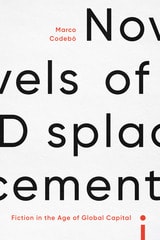
cover of Novels of Displacement: Fiction in the Age of Global Capital

Novels of Displacement

Fiction in the Age of Global Capital

Marco Codebò

The Ohio State University Press, 2020

In Novels of Displacement: Fiction in the Age of Global Capital, Marco Codebò assesses the state of fiction in our time, an age defined by the combined hegemony of global capital and software. Codebò argues that present-day displacement originates in the dualism of power that pervades our polarized society and in the sweeping deterritorialization that is affecting people, objects, and signs. As the ties between subjectivity and territory break, being in the world means being displaced. Rather than narrating how subjectivity can mark a place, novels of displacement convey the crisis of subjectivity’s connection to place.

Using four works as case studies—Bernardo Carvalho’s Nove noites, Daniel Sada’s Porque parece mentira la verdad nunca se sabe, Zadie Smith’s White Teeth, and Mathias Énard’s Zone—Codebò investigates how globalization, displacement, and technology inform our understanding of subjectivity and one’s place in the world. Coming from different literary traditions––Brazilian-Portuguese, Spanish, English, and French–– Novels of Displacement traces the development of displacement caused by organized crime, migration, and war. Ultimately what emerges from this study is evidence of how cultures of untruth damage but do not destroy human agency.
[more]
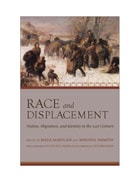
cover of Race and Displacement: Nation, Migration, and Identity in the Twenty-First Century

Race and Displacement

Nation, Migration, and Identity in the Twenty-First Century

Edited by Maha Marouan and Merinda Simmons

University of Alabama Press, 2013

Race and Displacement captures a timely set of discussions about the roles of race in displacement, forced migrations, nation and nationhood, and the way continuous movements of people challenge fixed racial definitions.
 
The multifaceted approach of the essays in Race and Displacement allows for nuanced discussions of race and displacement in expansive ways, exploring those issues in transnational and global terms. The contributors not only raise questions about race and displacement as signifying tropes and lived experiences; they also offer compelling approaches to conversations about race, displacement, and migration both inside and outside the academy. Taken together, these essays become a case study in dialogues across disciplines, providing insight from scholars in diaspora studies, postcolonial studies, literary theory, race theory, gender studies, and migration studies.
 
The contributors to this volume use a variety of analytical and disciplinary methodologies to track multiple articulations of how race is encountered and defined. The book is divided by editors Maha Marouan and Merinda Simmons into four sections: “Race and Nation” considers the relationships between race and corporality in transnational histories of migration using literary and oral narratives. Essays in “Race and Place” explore the ways spatial mobility in the twentieth century influences and transforms notions of racial and cultural identity.  Essays in “Race and Nationality” address race and its configuration in national policy, such as racial labeling, federal regulations, and immigration law. In the last section, “Race and the Imagination” contributors explore the role imaginative projections play in shaping understandings of race.
 
Together, these essays tackle the question of how we might productively engage race and place in new sociopolitical contexts.  Tracing the roles of "race" from the corporeal and material to the imaginative, the essays chart new ways that concepts of origin, region, migration, displacement, and diasporic memory create understandings of race in literature, social performance, and national policy.
 
Contributors: Regina N. Barnett, Walter Bosse, Ashon T. Crawley, Matthew Dischinger, Melanie Fritsh, Jonathan Glover, Delia Hagen, Deborah Katz, Kathrin Kottemann, Abigail G.H. Manzella, Yumi Pak, Cassander L. Smith,  Lauren Vedal
 
[more]
cover of The Briny South: Displacement and Sentiment in the Indian Ocean World

The Briny South

Displacement and Sentiment in the Indian Ocean World

Nienke Boer

Duke University Press, 2023

In The Briny South Nienke Boer examines the legal and literary narratives of enslaved, indentured, and imprisoned individuals crossing the Indian Ocean to analyze the formation of racialized identities in the imperial world. Drawing on court records, ledgers, pamphlets, censors’ reports, newsletters, folk songs, memoirs, and South African and South Asian works of fiction and autobiography, Boer theorizes the role of sentiment and the depiction of emotions in the construction of identities of displaced peoples across the Indian Ocean. From Dutch East India Company rule in the seventeenth and eighteenth centuries to early apartheid South Africa, Boer shows how colonial powers and settler states mediated and manipulated subaltern expressions of emotion as a way to silence racialized subjects and portray them as inarticulately suffering. In this way, sentiment operated in favor of the powerful rather than as an oppositional weapon of the subaltern. By tracing the entwinement of displacement, race, and sentiment, Boer frames the Indian Ocean as a site of subjectification with a long history of transnational connection—and exploitation.
[more]