Results by title
11 books match the query 'Doctrine'
Becoming God
The Doctrine of Theosis in Nicholas of CusaNancy J. Hudson
Catholic University of America Press, 2007
Constructing Antichrist
Paul, Biblical Commentary, and the Development of Doctrine in the Early Middle AgesKevin L. Hughes
Catholic University of America Press, 2005
Continuing Revelation
Essays on DoctrineBryan Buchanan
Signature Books, 2021
Determining what is and what is not Mormon doctrine is a difficult endeavor. The Church of Jesus Christ of Latter-day Saints embraces four books of scripture as its canon, but also believes the church is led by a living prophet. Additions to the canon have been rare since the death of church founder Joseph Smith. Joseph Fielding Smith, tenth church president, said that if the prophet ever contradicts canon, canon prevails. On the other hand, Ezra Taft Benson, the church’s thirteenth president, said that the living prophet’s words are more important than cannon. Such messages create no shortage of confusion among church members.
The question “What is doctrine?” opens the door for theologians and historians to wrestle over the answer, and to do so thoughtfully and insightfully. In Continuing Revelation, editor Bryan Buchanan has compiled essays that seek greater understanding about what doctrine is and why it matters.
The Challenge of Defining LDS Doctrine, by Loyd Isao Ericson • LDS Theology and the Omnis: The Dangers of Theological Speculation, by David H. Bailey • Crawling out of the Primordial Soup: A Step toward the Emergence of an LDS Theology Compatible with Organic Evolution, by Steven L. Peck • “To Destroy the Agency of Man”: The War in Heaven in LDS Thought, by Boyd Petersen • Three Sub-Degrees in the Celestial Kingdom?, by Shannon P. Flynn • Heavenly Mother: The Mother of All Women, by Blaire Ostler • Mormonism and the Problem of Heterodoxy, by Kelli D. Potter • Women at the Gates of Mortality: Relief Society Birth and Death Rituals, by Susanna Morrill • “Shake Off the Dust of Thy Feet”: The Rise and Fall of Mormon Ritual Cursing, by Samuel R. Weber • “Satan Mourns Naked Upon the Earth: Locating Mormon Possession and Exorcism Rituals in the American Religious Landscape, 1830–1977, by Stephen C. Taysom

DOCTRINE OF SIGNATURES
A DEFENSE OF THEORY IN MEDICINEScott Buchanan
University of Illinois Press, 1991
is one of the first and most significant works in our time to show how closely
connected the liberal arts are to clinical medicine. It is the seminal work
in the recent history of the philosophy of medicine, a field that is enjoying
a renaissance throughout the world today."
-- Edmund D. Pellegrino, M.D.
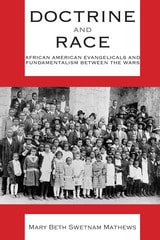
Doctrine and Race
African American Evangelicals and Fundamentalism between the WarsMary Beth Swetnam Mathews
University of Alabama Press, 2017
Doctrine and Race examines the history of African American Baptists and Methodists of the early twentieth century and their struggle for equality in the context of white Protestant fundamentalism.
By presenting African American Protestantism in the context of white Protestant fundamentalism, Doctrine and Race: African American Evangelicals and Fundamentalism between the Wars demonstrates that African American Protestants were acutely aware of the manner in which white Christianity operated and how they could use that knowledge to justify social change. Mary Beth Swetnam Mathews’s study scrutinizes how white fundamentalists wrote blacks out of their definition of fundamentalism and how blacks constructed a definition of Christianity that had, at its core, an intrinsic belief in racial equality. In doing so, this volume challenges the prevailing scholarly argument that fundamentalism was either a doctrinal debate or an antimodernist force. Instead, it was a constantly shifting set of priorities for different groups at different times.
A number of African American theologians and clergy identified with many of the doctrinal tenets of the fundamentalism of their white counterparts, but African Americans were excluded from full fellowship with the fundamentalists because of their race. Moreover, these scholars and pastors did not limit themselves to traditional evangelical doctrine but embraced progressive theological concepts, such as the Social Gospel, to help them achieve racial equality. Nonetheless, they identified other forward-looking theological views, such as modernism, as threats to “true” Christianity.
Mathews demonstrates that, although traditional portraits of “the black church” have provided the illusion of a singular unified organization, black evangelical leaders debated passionately among themselves as they sought to preserve select aspects of the culture around them while rejecting others. The picture that emerges from this research creates a richer, more profound understanding of African American denominations as they struggled to contend with a white American society that saw them as inferior.
Doctrine and Race melds American religious history and race studies in innovative and compelling ways, highlighting the remarkable and rich complexity that attended to the development of African American Protestant movements.
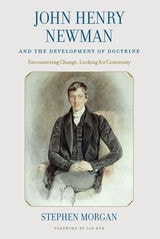
John Henry Newman and the Development of Doctrine
Encountering Change, Looking for ContinuityStephen Morgan
Catholic University of America Press, 2022
Kant’s Critical Philosophy
The Doctrine of the FacultiesGilles Deleuze
University of Minnesota Press, 1985
The Philosophy of Hegel as a Doctrine of the Concreteness of God and Humanity
Volume One: The Doctrine of GodI. A. Il’in, Translated by Philip T. Grier
Northwestern University Press, 2010
This landmark two-volume translation from Russian of The Philosophy of Hegel as a Doctrine of the Concreteness of God and Humanity marks the first appearance in English of any of the works of Russian philosopher Ivan Aleksandrovich Il’in (Ilyin). Originally published in 1918, on the eve of the Russian civil war, Il'in's commentary on Hegel marked both an apogee of Russian Silver Age philosophy and a significant manifestation of the resurgence of interest in Hegel that began in the early twentieth century.
A. F. Losev accurately observed in the same year it appeared: “Neither the study of Hegel nor the study of contemporary Russian philosophical thought is any longer thinkable without this book of I. A. Il’in’s.” Some Hegel scholars may know this work through the abridged translation into German that Il’in produced himself in 1946. However, that edition omitted most of the original volume two. Noted Hegel scholar Philip T. Grier’s edition—with an introduction setting Il’in’s work in its proper historical, cultural, and philosophical contexts and annotation throughout—represents the first opportunity for non-Russian-speaking readers to acquaint themselves with the full scope of Il’in’s still provocative interpretation of Hegel.
Volume 1 is "The Doctrine of God." Volume 2 is "The Doctrine of Humanity."
The Philosophy of Hegel as a Doctrine of the Concreteness of God and Humanity
Volume Two: The Doctrine of HumanityI. A. Il’in, Translated by Philip T. Grier
Northwestern University Press, 2011
The publication of volume 2 of Philip T. Grier’s translation of The Philosophy of Hegel as a Doctrine of the Concreteness of God and Humanity completes the first appearance in English of any of the works of Russian philosopher I. A. Il’in (Ilyin).
Most of the contents of volume 2 will be unknown even to those who have read the 1946 German version prepared by Il’in, because in that version he omitted eight of the original ten chapters. These omitted chapters provide an extended reflection on the central categories of Hegel’s moral, legal, and political philosophies, as well as of the philosophy of history. The topics examined are, in order: freedom, humanity, will, right, morality, ethical life, personhood and its virtue, and the state. Contained within these chapters are some notably insightful expositions of core doctrines in Hegel’s philosophy.
Il’in’s colleague A. F. Losev accurately observed in the same year the text first appeared: “Neither the study of Hegel nor the study of contemporary Russian philosophical thought is any longer thinkable without this book of I. A. Il’in’s.”
Torts
Doctrine and ProcessDonald H. Beskind and Doriane Lambelet Coleman
Duke University Press, 2018
Walking Away from Nuremberg
Just War and the Doctrine of Command ResponsibilityLawrence P. Rockwood
University of Massachusetts Press, 2007
In September 1994, Lawrence P. Rockwood, then a counterintelligence officer with the U.S. Army's Tenth Mountain Division, was deployed to Haiti as part of Operation Restore Democracy, the American-led mission to oust the regime of Raoul Cedras and reinstall President Jean-Bertrand Aristide. Shortly after arriving in-country, Captain Rockwood began receiving reports of human rights abuses at the local jails, including the murder of political prisoners. He appealed to his superiors for permission to take action but was repeatedly turned down. Eventually, after filing a formal complaint with an army inspector general, he set off to inspect the jails on his own. The next day, Captain Rockwood found himself on a plane headed back to the United States, where he was tried by court-martial, convicted on several counts, and discharged from military service.
In this book, Rockwood places his own experience within the broader context of the American military doctrine of “command responsibility”—the set of rules that holds individual officers directly responsible for the commission of war crimes under their authority. He traces the evolution of this doctrine from the Civil War, where its principles were first articulated as the “Lieber Code,” through the Nuremberg trials following World War II, where they were reaffirmed and applied, to the present. Rockwood shows how in the past half-century the United States has gradually abandoned its commitment to these standards, culminating in recent Bush administration initiatives that in effect would shield American commanders and officials from prosecution for many war crimes. The Abu Ghraib and Guantánamo prison abuse scandals, the recently disclosed illegal CIA detention centers, the unprecedented policy of tolerating acts considered as torture by both international standards and U.S. military doctrine, and the recent cover-ups of such combat-related war crimes as the Haditha massacre of November 2005, all reflect an “official anti-humanitarian” trend, Rockwood argues, that is at odds with our nation's traditions and principles.