Results by title
13 books match the query 'Domestic relations'
Butterfly, the Bride
Essays on Law, Narrative, and the FamilyCarol Weisbrod
University of Michigan Press, 2004
Butterfly, the Bride looks at law from the outside, using narrative to provide a fresh perspective on the issues of law and social structure---and individual responses to law. This book thoroughly explores relationships between inner and public lives by examining what is ordinarily classified as the sphere of private life---the world of family relationships.

Drawing on Anger
Portraits of U.S. HypocrisyEric J. García
The Ohio State University Press, 2018
For over a decade García has been serving up inked visuals with the sharpest of political critiques through a Chicano lens. If you’re looking for funny punch lines, these aren’t the cartoons for you. But if you want to pull down Uncle Sam’s pants and see what’s really going on, this is your book.

Edwardian Stories of Divorce
Janice Hubbard Harris
Rutgers University Press, 1996
Much as abortion in the United States today is a contentious issue used for scripting women's roles and potential into the national agenda, divorce was an issue dividing England in the Edwardian era. According to Janice Harris, anything and everything, from illicit sex and family values to the Garden of Eden, wrath of children, poverty of women, nature of cruelty, scandal of America, threat of Germany, and future of England were part of the debate over divorce. Living under marriage laws far more restrictive than those of their Protestant neighbors, Edwardian women and men campaigned for reform with a barrage of compelling stories. Organizing her analysis around three major sources of narrative on divorce––the Sunday papers, the Report of the Royal Commission on Divorce and Matrimonial causes, and the novel––Harris uncovers a war of words and a competition of tales. In raising questions about the winners, losers, and spoils, Harris expands our understanding of the history of divorce, the wars between the sexes, and the political import of those wars.
In the end, she presents a complex and lively story herself, one that illuminates battles over marriage and divorce taking place in our own era as well. This humane book on a long-neglected subject marks an important contribution to narrative studies and Edwardian history.

Family Law Matters
Katherine O'Donovan
Pluto Press, 1993

Family, Law, and Community
Supporting the CovenantMargaret F. Brinig
University of Chicago Press, 2010
In the wake of vast social and economic changes, the nuclear family has lost its dominance, both as an ideal and in practice. Some welcome this shift, while others see civilization itself in peril—but few move beyond ideology to develop a nuanced understanding of how families function in society. In this provocative book, Margaret F. Brinig draws on research from a variety of disciplines to offer a distinctive study of family dynamics and social policy.
Concentrating on legal reform, Brinig examines a range of subjects, including cohabitation, custody, grandparent visitation, and domestic violence. She concludes that conventional legal reforms and the social programs they engender ignore social capital: the trust and support given to families by a community. Traditional families generate much more social capital than nontraditional ones, Brinig concludes, which leads to clear rewards for the children. Firmly grounded in empirical research, Family, Law, and Community argues that family policy can only be effective if it is guided by an understanding of the importance of social capital and the advantages held by families that accrue it.
Gender, Religion, and Family Law
Theorizing Conflicts between Women’s Rights and Cultural TraditionsEdited by Lisa Fishbayn Joffe and Sylvia Neil
Brandeis University Press, 2012
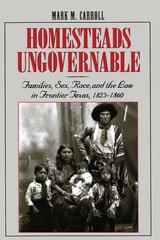
Homesteads Ungovernable
Families, Sex, Race, and the Law in Frontier Texas, 1823-1860By Mark M. Carroll
University of Texas Press, 2001
When he settled in Mexican Texas in 1832 and began courting Anna Raguet, Sam Houston had been separated from his Tennessee wife Eliza Allen for three years, while having already married and divorced his Cherokee wife Tiana and at least two other Indian "wives" during the interval. Houston's political enemies derided these marital irregularities, but in fact Houston's legal and extralegal marriages hardly set him apart from many other Texas men at a time when illicit and unstable unions were common in the yet-to-be-formed Lone Star State.
In this book, Mark Carroll draws on legal and social history to trace the evolution of sexual, family, and racial-caste relations in the most turbulent polity on the southern frontier during the antebellum period (1823-1860). He finds that the marriages of settlers in Texas were typically born of economic necessity and that, with few white women available, Anglo men frequently partnered with Native American, Tejano, and black women. While identifying a multicultural array of gender roles that combined with law and frontier disorder to destabilize the marriages of homesteaders, he also reveals how harsh living conditions, land policies, and property rules prompted settling spouses to cooperate for survival and mutual economic gain. Of equal importance, he reveals how evolving Texas law reinforced the substantial autonomy of Anglo women and provided them material rewards, even as it ensured that cross-racial sexual relationships and their reproductive consequences comported with slavery and a regime that dispossessed and subordinated free blacks, Native Americans, and Tejanos.
Intimate Associations
The Law and Culture of American FamiliesJ. Herbie DiFonzo and Ruth C. Stern
University of Michigan Press, 2013
The rise in divorce, cohabitation, single parenthood, and same-sex partnerships, along with an increase in surrogacy, adoption, and assisted reproductive technologies, has led to many diverse configurations of families, or intimate associations. J. Herbie DiFonzo and Ruth C. Stern chart these trends over the past several decades and investigate their social, legal, and economic implications.
Drawing upon a wealth of social science data, they show that, by a number of measures, children of married parents fare better than children in a household formed by cohabiting adults. This is not to condemn nontraditional families, but to point out that society and the law do not yet adequately provide for their needs. The authors applaud the ways in which courts and legislatures are beginning to replace rigid concepts of marriage and parenthood with the more flexible concept of “functional” family roles. In the conclusion, they call for a legal system that can adapt to the continually changing reality of family life.
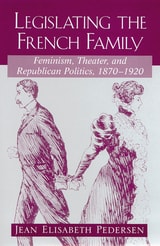
Legislating the French Family
Feminism, Theater, and Republican Politics: 1870-1920Jean Elisabeth Pedersen
Rutgers University Press, 2003
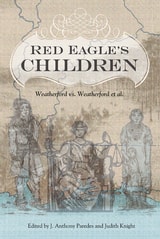
Red Eagle's Children
Weatherford vs. Weatherford et al.Edited by J. Anthony Paredes and Judith Knight
University of Alabama Press, 2012
Tracing identity, law, and legacy in an inheritance dispute that reveals the intersection of two cultural and legal systems: Creek Indian and Euro-American.
In 1846, in the Chancery Court of Mobile, Alabama, William “Red Eagle” Weatherford’s son, by the Indian woman Supalamy, sued his half siblings fathered by Weatherford with two other Creek women, Polly Moniac and Mary Stiggins, for a greater share of Weatherford’s estate. While the court recognized William Jr. as the son of William Sr., he nevertheless lost his petition for inheritance due to the lack of legal evidence concerning the marriage of his biological mother to William Sr. The case, which went to the Alabama Supreme Court in 1851, provides a record of an attempt to interrelate and, perhaps, manipulate differences in cultures as they played out within the ritualized, arcane world of antebellum Alabama jurisprudence.
Although the case has value in the classic mold of salvage ethnography of Creek Indian culture, Red Eagle’s Children, edited by J. Anthony Paredes and Judith Knight, shows that its more enduring value lies in being a source for historical ethnography—that is, for anthropological analyses of cultural dynamics of the past events that complement the narratives of professional historians.
CONTRIBUTORS: David I. Durham / Robbie Ethridge / Judith Knight / J. Anthony Paredes / Paul M. Pruitt Jr. / Nina Gail Thrower / Robert Thrower / Gregory A. Waselkov
The Fall and Rise of Freedom of Contract
F. H. Buckley, ed.
Duke University Press, 1999
The 1970s was a decade of regulatory triumphalism in North America, marked by a surge in consumer, securities, and environmental regulation. Legal scholars predicted the “death of contract” and its replacement by regulation and reliance-based theories of liability. Instead, we have witnessed the reemergence of free bargaining norms. This revival can be attributed to the rise of law-and-economics, which laid bare the intellectual failure of anticontractarian theories. Scholars in this school note that consumers are not as helpless as they have been made out to be, and that intrusive legal rules meant ostensibly to help them often leave them worse off. Contract law principles have also been very robust in areas far afield from traditional contract law, and the essays in this volume consider how free bargaining rights might reasonably be extended in tort, property, land-use planning, bankruptcy, and divorce and family law.
This book will be of particular interest to legal scholars and specialists in contract law. Economics and public policy planners will also be challenged by its novel arguments.
Contributors. Gregory S. Alexander, Margaret F. Brinig, F. H. Buckley, Robert Cooter, Steven J. Eagle, Robert C. Ellickson, Richard A. Epstein, William A. Fischel, Michael Klausner, Bruce H. Kobayashi, Geoffrey P. Miller, Timothy J. Muris, Robert H. Nelson, Eric A. Posner, Robert K. Rasmussen, Larry E. Ribstein, Roberta Romano, Paul H. Rubin, Alan Schwartz, Elizabeth S. Scott, Robert E. Scott, Michael J. Trebilcock
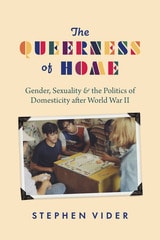
The Queerness of Home
Gender, Sexuality, and the Politics of Domesticity after World War IIStephen Vider
University of Chicago Press, 2021
From the Stonewall riots to the protests of ACT UP, histories of queer and trans politics have almost exclusively centered on public activism. In The Queerness of Home, Stephen Vider turns the focus inward, showing that the intimacy of domestic space has been equally crucial to the history of postwar LGBTQ life.
Beginning in the 1940s, LGBTQ activists looked increasingly to the home as a site of connection, care, and cultural inclusion. They struggled against the conventions of marriage, challenged the gendered codes of everyday labor, reimagined domestic architecture, and contested the racial and class boundaries of kinship and belonging. Retelling LGBTQ history from the inside out, Vider reveals the surprising ways that the home became, and remains, a charged space in battles for social and economic justice, making it clear that LGBTQ people not only realized new forms of community and culture for themselves—they remade the possibilities of home life for everyone.
The Transformation of Family Law
State, Law, and Family in the United States and Western EuropeMary Ann Glendon
University of Chicago Press, 1989
"Glendon is generally acknowledged to be the premier comparative law scholar in the area of family law. This volume, which offers an analytical survey of the changes in family law over the past twenty-five years, will burnish that reputation. Essential reading for anyone interested in evaluating the major changes that occurred in the law of the family. . . . [And] of serious interest to those in the social sciences as well."—James B. Boskey, Law Books in Review
"Poses important questions and supplies rich detail."—Barbara Bennett Woodhouse, Texas Law Review
"An impressive scholarly documentation of the legal changes that comprise the development of a conjugally-centered family system."—Debra Friedman, Contemporary Sociology
"She has painted a portrait of the family in which we recognize not only ourselves but also unremembered ideological forefathers. . . . It sends our thoughts out into unexpected adventures."—Inga Markovits, Michigan Law Review