Results by title
7 books match the query 'Dorson, Richard M.'
American Folklore
Richard M. Dorson
University of Chicago Press, 1961
Here, grounded firmly in American history, is a skilled folklorist's survey of the entire field of America's folklore—from colonization to mass culture.
Tracing the forms and content of American folklore, Mr. Dorson reveals the richness, pathos, and humor of genuine folklore, which he distinguishes from the "fakelore" of popularizers and chauvinists. At the same time, however, he shows what the creation of spurious folklore (the Paul Bunyan legends, for instance) discloses about our national character. Based upon authentic field collections and research, the examples cited include folkways, jests, boasts, tall tales, ballads, folk and legendary heroes.
"His volume enlarges our understanding of the American past and present through an empirical survey of the extant folk traditions and it also provides us with the means for appreciating what is valuable in these folk traditions."—Virginia Quarterly Review
[more]
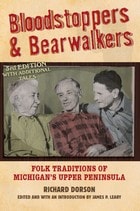
Bloodstoppers and Bearwalkers
Folk Traditions of Michigan’s Upper PeninsulaRichard M. Dorson
University of Wisconsin Press, 2008
Remote and rugged, Michigan’s Upper Peninsula (fondly known as “the U.P.”) has been home to a rich variety of indigenous peoples and Old World immigrants—a heritage deeply embedded in today’s “Yooper” culture. Ojibwes, French Canadians, Finns, Cornish, Poles, Italians, Slovenians, and others have all lived here, attracted to the area by its timber, mineral ore, and fishing grounds. Mixing local happenings with supernatural tales and creatively adapting traditional stories to suit changing audiences, the diverse inhabitants of the U.P. have created a wealth of lore populated with tricksters, outlaws, cunning trappers and poachers, eccentric bosses of the mines and lumber camps, “bloodstoppers” gifted with the lifesaving power to stop the flow of blood, “bearwalkers” able to assume the shape of bears, and more.
For folklorist Richard M. Dorson, who ventured into the region in the late 1940s, the U.P. was a living laboratory, a storyteller’s paradise. Bloodstoppers and Bearwalkers, based on his extensive fieldwork in the area, is his richest and most enduring work. This new edition, with a critical introduction and an appendix of additional tales selected by James P. Leary, restores and expands Dorson’s classic contribution to American folklore. Engaging and well informed, the book presents and ponders the folk narratives of the region’s loggers, miners, lake sailors, trappers, and townsfolk. Unfolding the variously peculiar and raucous tales of the U.P., Bloodstoppers and Bearwalkers reveals a vital component of Upper Midwest culture and a fascinating cross-section of American society.
[more]
Buying the Wind
Regional Folklore in the United StatesRichard M. Dorson
University of Chicago Press, 1964
This anthology of regional folklore displays the abundance, humor, and continuing vigor of the American oral tradition. The collection explores rich and distinctive lore of Maine Down-Easters, Pennsylvania Dutchmen, Southern mountaineers, Louisiana Cajuns, Illinois Egyptians, Southwest Mexicans, and Utah Mormons.
Their tales, songs, riddles, proverbs, games, superstitions, and customs provide a wealth of living folklore presented here as it was recorded in the field. And this unvarnished folklore fact—retains the spicy flavor of authentic narrative, told in the vernacular of the skillful folk storyteller.
Their tales, songs, riddles, proverbs, games, superstitions, and customs provide a wealth of living folklore presented here as it was recorded in the field. And this unvarnished folklore fact—retains the spicy flavor of authentic narrative, told in the vernacular of the skillful folk storyteller.
[more]
Folklore and Folklife
An IntroductionRichard M. Dorson
University of Chicago Press, 1982
"This introduction to the study of folklore and folklife contains an inspiring and spirited mixture of essays, theoretical contributions, practical instructions, and pure encyclopedia articles. It is a very well put together book, written by eighteen researchers who have something to say. One can see here that it is competent educators who have come forward and are narrating. . . . All in all it is a very use-oriented handbook with attractive typography and layout."—Iorn Pio, Journal of American Folklore
[more]
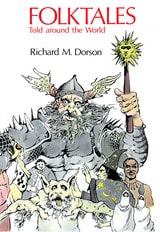
Folktales Told Around the World
Richard M. Dorson
University of Chicago Press, 1978
All the selections in Richard M. Dorson's Folktales Told around the World were recorded by expert collectors, and the majority of them are published here for the first time. The tales presented are told in Africa, Asia, the Middle East, Europe, North and South America, and Oceania. Unlike other collections derived in large part from literary texts, this volume meets the criteria of professional folklorists in assembling only authentic examples of folktales as they were orally told. Background information, notes on the narrators, and scholarly commentaries are provided to establish the folkloric character of the tales.
[more]
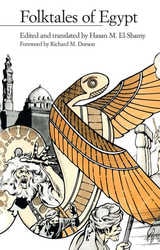
Folktales of Egypt
Hasan M. El-Shamy
University of Chicago Press, 1982
A fascinating collection of modern folk tales from Egypt
In this book Hasan M. El-Shamy has gathered the first authentic new collection of modern Egyptian folk narratives to appear in nearly a century. El-Shamy's English translations of these orally presented stories not only preserve their spirit, but give Middle Eastern lore the scholarly attention it has long deserved. Ranging from the fantastic to the religious to the philosophical and beyond, these stories offer insights into the folk culture of one of the oldest societies in the world.
[more]
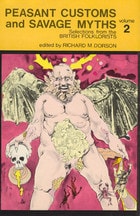
Peasant Customs and Savage Myths
Selections from the British FolkloristsEdited by Richard M. Dorson
University of Chicago Press, 1969
The word "folklore" was coined in 1846 by an English antiquary, William John Thoms, although Professor Dorson's intellectual history of the folklore movement shows that the study of folklore had its origins in an earlier period. Educated men and women in many fields, especially in Victorian times, succumbed to the fascination of noting curious tales and odd rituals both at home and abroad. The British Folklorists describes how the influence of folklore extended into many fields such as literature, history, the classics, archaeology, philology, psychical research, legal and medical antiquities, Scandinavian, Germanic, and Celtic studies, and the history of religions. Interest in the collection of folklore was carried to the far corners of the British Empire by colonial administrators, missionaries, and military officers, who found that a knowledge of local folklore helped them understand the strangers they lived among.
Professor Dorson traces the historical development of folklore as a field of learning, beginning with sixteenth-century antiquarians whose studies encompassed the preservation of local customs and reaching its climax with the "Great Team" of Andrew Lang and his co-workers from the 1870's to the First World War.
Professor Dorson traces the historical development of folklore as a field of learning, beginning with sixteenth-century antiquarians whose studies encompassed the preservation of local customs and reaching its climax with the "Great Team" of Andrew Lang and his co-workers from the 1870's to the First World War.
[more]