Results by title
8 books match the query 'Douglass, Frederick'
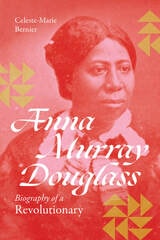
Anna Murray Douglass
Biography of a RevolutionaryCeleste-Marie Bernier
Duke University Press, 2026
Working with family descendants and based on thirty years of research digging through public and private archives, Celeste-Marie Bernier presents the first standalone biography of Anna Murray Douglass, wife and co-revolutionary of Frederick Douglass, honoring her history-making role as a campaigner, liberator, and freedom-fighter.
Anna Murray Douglass was born legally free in Maryland to Mary and Bambarra Murray. From working with her future husband, Frederick Douglass, to secure his self-liberation from enslavement to converting her family homes to command centers for the Underground Railroad, she dedicated her entire life to the fight for all freedoms and to supporting loved ones and strangers alike in their fight for equal, independent lives. Her deeds have long gone unsung until now.
In this first-ever standalone biography of the wife and co-revolutionary of Frederick Douglass, Celeste-Marie Bernier provides a detailed and illustrated history of Anna Murray Douglass’s leadership roles in fighting against the injustices of enslavement, racism, and white supremacy, as well as how she laid the foundation for her family to follow in her and her husband’s footsteps. After over three decades of archival research, Bernier presents a wide-ranging collection of stories, writings, letters, and photographs in a comprehensive and illuminating biography of Anna Murray Douglass’s life and work as an educator, activist, intellectual, orator, political thinker, artist, philosopher, and strategist. Ultimately, Bernier aims to combat the widespread misrepresentation that the liberation movement bearing the Douglass name was the work of one individual when it was, in reality, a family institution. Anna Murray Douglass is the first book in a ten-volume collection detailing the life and work of the entire Douglass family including their children, Rosetta, Lewis Henry, Frederick, Jr., Charles Remond and Annie Douglass, all freedom-fighters in their own right.
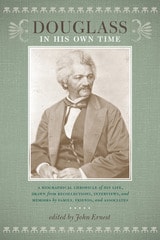
Douglass in His Own Time
A Biographical Chronicle of His Life, Drawn from Recollections, Interviews, and Memoirs by Family, Friends, and AssociatesJohn Ernest
University of Iowa Press, 2014
As valuable as these writings are in illuminating the man, the story Douglass told in 1845 has become rather too easy to tell, obscuring as much as it reveals. Less a living presence than an inspiring tale, Frederick Douglass remains relatively unknown even to many of those who celebrate his achievements. Douglass in His Own Time offers an introduction to Douglass the man by those who knew him. The book includes a broad range of writings, some intended for public viewing and some private correspondence, all of which contend with the force of Douglass’s tremendous power over the written and spoken word, his amazing presence before crowds, his ability to improvise, to entertain, to instruct, to inspire—indeed, to change lives through his eloquent appeals to righteous self-awareness and social justice. In approaching Douglass through the biographical sketches, memoirs, letters, editorials, and other articles about him, readers will encounter the complexity of a life lived on a very public stage, the story of an extraordinary black man in an insistently white world.
Frederick Douglass
Freedom's Voice, 1818-1845Gregory P. Lampe
Michigan State University Press, 1998
This work in the MSU Press Rhetoric and Public Affairs Series chronicles Frederick Douglass's preparation for a career in oratory, his emergence as an abolitionist lecturer in 1841, and his development and activities as a public speaker and reformer from 1841 to 1845. Lampe's meticulous scholarship overturns much of the conventional wisdom about this phase of Douglass's life and career uncovering new information about his experiences as a slave and as a fugitive; it provokes a deeper and richer understanding of this renowned orator's emergence as an important voice in the crusade to end slavery.
Contrary to conventional wisdom, Douglass was well prepared to become a full-time lecturer for the Massachusetts Anti-Slavery Society in 1841. His emergence as an eloquent voice from slavery was not as miraculous as scholars have led us to believe. Lampe begins by tracing Douglass's life as slave in Maryland and as fugitive in New Bedford, showing that experiences gained at this time in his life contributed powerfully to his understanding of rhetoric and to his development as an orator. An examination of his daily oratorical activities from the time of his emergence in Nantucket in 1841 until his departure for England in 1845 dispels many conventional beliefs surrounding this period, especially the belief that Douglass was under the wing of William Lloyd Garrison. Lampe's research shows that Douglass was much more outspoken and independent than previously thought and that at times he was in conflict with white abolitionists.
Included in this work is a complete itinerary of Douglass's oratorical activities, correcting errors and omissions in previously published works, as well as two newly discovered complete speech texts, never before published.
Knowing Him by Heart
African Americans on Abraham LincolnEdited by Frederick Hord and Matthew D. Norman
University of Illinois Press, 2023
Winner of an Abraham Lincoln Institute Book Award
Though not blind to Abraham Lincoln's imperfections, Black Americans long ago laid a heartfelt claim to his legacy. At the same time, they have consciously reshaped the sixteenth president's image for their own social and political ends. Frederick Hord and Matthew D. Norman's anthology explores the complex nature of views on Lincoln through the writings and thought of Frederick Douglass, Ida B. Wells-Barnett, Mary McLeod Bethune, Thurgood Marshall, Malcolm X, Gwendolyn Brooks, Barbara Jeanne Fields, Barack Obama, and dozens of others. The selections move from speeches to letters to book excerpts, mapping the changing contours of the bond--emotional and intellectual--between Lincoln and Black Americans over the span of one hundred and fifty years.
A comprehensive and valuable reader, Knowing Him by Heart examines Lincoln’s still-evolving place in Black American thought.
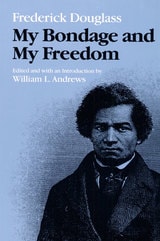
My Bondage and My Freedom
Frederick Douglass
University of Illinois Press, 1988
Shaping Words to Fit the Soul
The Southern Ritual Grounds of Afro-ModernismJürgen E. Grandt
The Ohio State University Press, 2009
The Powers of Dignity
The Black Political Philosophy of Frederick DouglassNick Bromell
Duke University Press, 2021
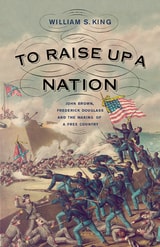
To Raise Up a Nation
John Brown, Frederick Douglass, and the Making of a Free CountryWilliam S. King
Westholme Publishing, 2013
Drawing on decades of research, and demonstrating remarkable command of a great range of primary sources, William S. King has written an important history of African Americans’ own contributions and points of crossracial cooperation to end slavery in America. Beginning with the civil war along the border of Kansas and Missouri, the author traces the life of John Brown and the personal support for his ideas from elite New England businessmen, intellectuals such as Emerson and Thoreau, and African Americans, including his confidant, Frederick Douglass, and Harriet Tubman. Throughout, King links events that contributed to the growing antipathy in the North toward slavery and the South’s concerns for its future, including Nat Turner’s insurrection, the Amistad affair, the Fugitive Slave law, the Kansas-Nebraska Act, and the Dred Scott decision. The author also effectively describes the debate within the African American community as to whether the U.S. Constitution was colorblind or if emigration was the right course for the future of blacks in America.
Following Brown’s execution after the failed raid on Harper’s Ferry in 1859, King shows how Brown’s vision that only a clash of arms would eradicate slavery was set into motion after the election of Abraham Lincoln. Once the Civil War erupted on the heels of Brown’s raid, the author relates how black leaders, white legislators, and military officers vigorously discussed the use of black manpower for the Union effort as well as plans for the liberation of the “veritable Africa” within the southern United States. Following the Emancipation Proclamation of January 1863, recruitment of black soldiers increased and by war’s end they made up nearly ten percent of the Union army, and contributed to many important victories.
To Raise Up a Nation: John Brown, Frederick Douglass, and the Making of a Free Country is a sweeping history that explains how the destruction of American slavery was not directed primarily from the counsels of local and national government and military men, but rather through the grassroots efforts of extraordinary men and women. As King notes, the Lincoln administration ultimately armed black Americans, as John Brown had attempted to do, and their role was a vital part in the defeat of slavery.