Results by title
18 books match the query 'Down'

DOWN ON PARCHMAN FARM
THE GREAT PRISON IN THE MISSISSIPPI DELTAWILLIAM BANKS TAYLOR
The Ohio State University Press, 1999

Down The Jersey Shore
Russell Roberts and Rich Youmans
Rutgers University Press, 1993
Summer visitors and year-round residents alike are sure to discover Jersey Shore lore that captures their fancy in this entertaining account of the people, places, and events that have shaped New Jersey’s famous shoreline.
From ghost stories and the comic misadventures of the early Miss America Pageant to the dynamics of the changing coastline and poignant portraits of traditional crafts workers, Russell Roberts and Rich Youmans have chronicled the fascinating history and heritage of the New Jersey Shore. In this book you’ll meet the luminaries who’ve frequented the Shore—from President Ulysses Grant strolling through Long Branch to Grace Kelly learning to surf at Ocean City. You’ll find out why the boardwalk was invented, and also why early ones were removable. Join the authors as they pay tribute to the Shore’s forgotten inventors, including Simon Lake, who some consider the true father of the modern submarine. Relive the Jersey Shore’s role in wartime and learn the story of the mysterious Nazi submarine sunken off of Point Pleasant Beach. Read about Lucy the Margate Elephant, as a well as her two long-gone “cousins.”
Discover all this and more as Roberts and Youmans explore the vast uncharted heritage of the New Jersey Shore.

Down and Dirty Down South
Politics and the Art of RevengeRoger Glasgow
Butler Center for Arkansas Studies, 2016
While pursuing a race for district prosecutor in the 1970s, Glasgow had run afoul of the local political machine. The machine later decided to teach Glasgow a lesson even though he’d lost the race. Down and Dirty Down South is Glasgow’s story of how he attempted to clear his name and also track down the people who had set him up for charges of smuggling illegal drugs into the United States.

Down and Dirty
Toward a Sucialogy of Queer Chicane LifeDeborah R. Vargas
Duke University Press, 2027
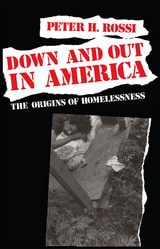
Down and Out in America
The Origins of HomelessnessPeter H. Rossi
University of Chicago Press, 1990
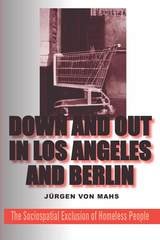
Down and Out in Los Angeles and Berlin
The Sociospatial Exclusion of Homeless PeopleJurgen von Mahs
Temple University Press, 2015
Drawing on fascinating ethnographic insights, von Mahs shows how homeless people in both cities face sociospatial exclusion-legal displacement for criminal activities, poor shelters in impoverished neighborhoods, as well as market barriers that restrict reintegration. Providing a necessary wake-up call, Down and Out in Los Angeles and Berlin addresses the critical public policy issues that can produce effective services to improve homeless people's chances for a lasting exit.
Down and Out in the New Economy
How People Find (or Don’t Find) Work TodayIlana Gershon
University of Chicago Press, 2017
Finding a job used to be simple. Now . . . well, it’s complicated. In today’s economy, you can’t just be an employee looking to get hired—you have to market yourself as a business, one that can help another business achieve its goals.
That’s a radical transformation in how we think about work and employment, says Ilana Gershon. And with Down and Out in the New Economy, she digs deep into that change and what it means, not just for job seekers, but for businesses and our very culture. In telling this story, Gershon covers all parts of the employment spectrum: she interviews hiring managers about how they assess candidates; attends personal branding seminars; talks with managers at companies around the United States to suss out regional differences—like how Silicon Valley firms look askance at the lengthier employment tenures of applicants from the Midwest. And she finds that not everything has changed: though the technological trappings may be glitzier, in a lot of cases, who you know remains more important than what you know.
Rich in the voices of people deeply involved with all parts of the employment process, Down and Out in the New Economy offers a snapshot of the quest for work today—and a pointed analysis of its larger meaning.
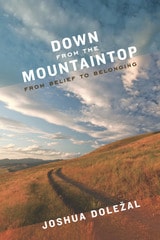
Down from the Mountaintop
From Belief to BelongingJoshua Dolezal
University of Iowa Press, 2014
For more than a decade, Doležal taught in the Midwest throughout the school year but returned to Montana and Idaho in the summers to work as a firefighter and wilderness ranger. He reveled in the life of the body and the purifying effects of isolation and nature, believing he had found transcendence. Yet his summers tied him even more to the mountain landscape, fueling his sense of exile on the plains.
It took falling in love, marrying, and starting a family in Iowa to allow Doležal to fully examine his desire for a spiritual mountaintop from which to view the world. In doing so, he undergoes a fundamental redefinition of the nature of home and belonging. He learns to accept the plains on their own terms, moving from condemnation to acceptance and from isolation to community. Coming down from the mountaintop means opening himself to relationships, grounding himself as a husband, father, and gardener who learns that where things grow, the grower also takes root.
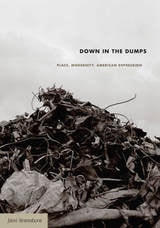
Down in the Dumps
Place, Modernity, American DepressionJani Scandura
Duke University Press, 2007
An interpretive bricolage that draws on an unlikely archive of 1930s detritus—office memos, scribbled manuscripts, scrapbooks, ruined photographs, newspaper clippings, glass eyes, incinerated stage sets, pulp novels, and junk washed ashore—Down in the Dumps escorts its readers through Reno’s divorce factory of the 1930s, where couples from across the United States came to quickly dissolve matrimonial bonds; Key West’s multilingual salvage economy and its status as the island that became the center of an ideological tug-of-war between the American New Deal government and a politically fraught Caribbean; post-Renaissance Harlem, in the process of memorializing, remembering, grieving, and rewriting a modernity that had already passed; and Studio-era Hollywood, Nathanael West’s “dump of dreams,” in which the introduction of sound in film and shifts in art direction began to transform how Americans understood place-making and even being itself. A coda on Alcatraz and the Pentagon brings the book into the present, exploring how American Depression comes to bear on post-9/11 America.
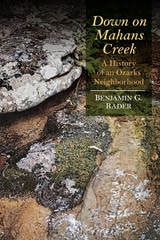
Down on Mahans Creek
A History of an Ozarks NeighborhoodBenjamin G. Rader
University of Arkansas Press, 2017
In Down on Mahans Creek, Benjamin Rader provides a fascinating look at a neighborhood in the Missouri Ozarks from the early nineteenth to the mid-twentieth century. He explores the many ways in which Mahans Creek, though remote, was never completely isolated or self-sufficient. The residents were deeply affected by the Civil War, and the arrival of the railroad and the timber boom in the 1890s propelled the community into modern times, creating a more fast-paced and consumer-oriented way of life and a new moral sensibility. During the Great Depression the creek’s residents returned to some of the older values for survival. After World War II, modern technology changed their lives again, causing a movement away from the countryside and to the nearby small towns.
Down on Mahans Creek tells the dynamic story of this distinctive neighborhood navigating the push and pull of the old and new ways of life.

Down on the Killing Floor
Black and White Workers in Chicago's Packinghouses, 1904-54Rick Halpern
University of Illinois Press, 1997

Down the River
or Practical Lessons Under The Code DuelloGeorge W Hooper
University of Alabama Press, 2007

Down to Earth
Satellite Technologies, Industries, and CulturesParks, Lisa
Rutgers University Press, 2012
Down to Earth presents the first comprehensive overview of the geopolitical maneuvers, financial investments, technological innovations, and ideological struggles that take place behind the scenes of the satellite industry. Satellite projects that have not received extensive coverage—microsatellites in China, WorldSpace in South Africa, SiriusXM, the failures of USA 193 and Cosmos 954, and Iridium—are explored. This collection takes readers on a voyage through a truly global industry, from the sites where satellites are launched to the corporate clean rooms where they are designed, and along the orbits and paths that satellites traverse. Combining a practical introduction to the mechanics of the satellite industry, a history of how its practices and technologies have evolved, and a sophisticated theoretical analysis of satellite cultures, Down to Earth opens up a new space for global media studies.

Down to the River
Portraits of Iowa MusiciansSandra Louise Dyas
University of Iowa Press, 2007
Dyas’s photographs present both the sweaty intensity of live performances and the more contemplative moments of individual portraits. They are complemented by Chris Offutt’s empathetic essay, which also encapsulates the experience of connecting with a new home through its music. A companion CD with eighteen tracks by Iowa’s finest singer/songwriters, including Dave Moore, Greg Brown, Bo Ramsey, David Zollo, and Pieta Brown, add up to an unmatched perspective on Iowa music and musicians.
CD Tracks
1. Iowa Crawl, Joe Price
2. Poor Back Slider, Greg Brown
3. Parnell, David Zollo
4. #807, Pieta Brown
5. Wheels of Steel, Radoslav Lorkovic
6. Down to the River, Dave Moore
7. Lucy and Andy Drive to Arkansas, Kevin Gordon
8. Chuck Brown, Mike and Amy Finders
9. Nobody But You, Joe Price
10. Earleton, BeJae Fleming
11. Ceremonial Child, High and Lonesome
12. Sidetrack Lounge, Bo Ramsey
13. On the Edge, Pieta Brown
14. One Wrong Turn, Greg Brown
15. Not in Iowa, Kelly Pardekooper
16. Living in a Cornfield, Bo Ramsey
17. ’57 Chevy, Tom Jessen’s Dimestore Outfit
18. Roll on John, the Pines
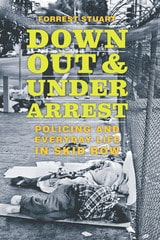
Down, Out, and Under Arrest
Policing and Everyday Life in Skid RowForrest Stuart
University of Chicago Press, 2016
Juliette, a woman he met during that time, has been stopped by police well over one hundred times, arrested upward of sixty times, and has given up more than a year of her life serving week-long jail sentences. Her most common crime? Simply sitting on the sidewalk—an arrestable offense in LA.
Why? What purpose did those arrests serve, for society or for Juliette? How did we reach a point where we’ve cut support for our poorest citizens, yet are spending ever more on policing and prisons? That’s the complicated, maddening story that Stuart tells in Down, Out and Under Arrest, a close-up look at the hows and whys of policing poverty in the contemporary United States. What emerges from Stuart’s years of fieldwork—not only with Skid Row residents, but with the police charged with managing them—is a tragedy built on mistakes and misplaced priorities more than on heroes and villains. He reveals a situation where a lot of people on both sides of this issue are genuinely trying to do the right thing, yet often come up short. Sometimes, in ways that do serious harm.
At a time when distrust between police and the residents of disadvantaged neighborhoods has never been higher, Stuart’s book helps us see where we’ve gone wrong, and what steps we could take to begin to change the lives of our poorest citizens—and ultimately our society itself—for the better.

Europe
or Up and Down with Schreiber and BaggishRichard Stern
Northwestern University Press, 2007
Originally published in 1961, this shrewd, smartly written novel follows two American men traveling in Europe. Though both have struck out for the same continent, each man’s methods of and motives for travel lead him to have a very different experience than the other. Underlying it all is the premise that Europe--the contrast, the otherness of it--can be a refiner’s fire, deeply affecting a person’s character. Europe represents a crucial step in Stern’s development as a writer and stands as a witty, sharp point of entry into his writings and the writings of novelists who rose to prominence in the 1960s.

Old South, New South, or Down South?
Florida and the Modern Civil Rights MovementEdited by Irvin D. S. Winsboro
West Virginia University Press, 2009
How does a state, tarnished with a racist, violent history, emerge from the modern civil rights movement with a reputation for tolerance and progression? Old South, New South, or Down South?: Florida and the Modern Civil Rights Movement exposes the image, illusion, and reality behind Florida’s hidden story of racial discrimination and violence. By exploring multiple perspectives on racially motivated events, such as black agency, political stonewalling, and racist assaults, this collection of nine essays reconceptualizes the civil rights legacy of the Sunshine State. Its dissection of local, isolated acts of rebellion reveals a strategic, political concealment of the once dominant, often overlooked, old south attitude towards race in Florida.

Siberian Journey
Down the Amur to the Pacific, 1856–1857Perry McDonough Collins
University of Wisconsin Press, 2011
Perry McDonough Collins was the first American to journey through Siberia and down the 2,690-mile Amur River to the Pacific Ocean. In 1860 he wrote A Voyage Down the Amoor, an account of his adventures, and his book proved so popular that it was reissued in 1864. Siberian Journey consists of Collins’s original text framed by an interpretive introduction and explanatory notes by Charles Vevier, providing an extensive, first-hand account of Russia’s land and its people in the mid–nineteenth century.