Results by title
11 books match the query 'Drug addicts'
A House on Stilts
Mothering in the Age of Opioid AddictionPaula Becker
University of Iowa Press, 2019
More than 2.5 million Americans are addicted to opioids, some half-million of these to heroin. For many of them, their drug addiction leads to lives of demoralization, homelessness, and constant peril. For parents, a child’s addiction upends family life, catapulting them onto a path no longer prescribed by Dr. Spock, but by Dante’s Inferno. Within this ten-year crucible, Paula is transformed by an excruciating, inescapable truth: the difference between what she can do and what she cannot do.
Addicted to Rehab
Race, Gender, and Drugs in the Era of Mass IncarcerationMcKim, Allison
Rutgers University Press, 2017
Winner of the 2018 Book of the Year Award from the American Society of Criminology's Division on Women and Crime
After decades of the American “war on drugs” and relentless prison expansion, political officials are finally challenging mass incarceration. Many point to an apparently promising solution to reduce the prison population: addiction treatment.
In Addicted to Rehab, Bard College sociologist Allison McKim gives an in-depth and innovative ethnographic account of two such rehab programs for women, one located in the criminal justice system and one located in the private healthcare system—two very different ways of defining and treating addiction. McKim’s book shows how addiction rehab reflects the race, class, and gender politics of the punitive turn. As a result, addiction has become a racialized category that has reorganized the link between punishment and welfare provision. While reformers hope that treatment will offer an alternative to punishment and help women, McKim argues that the framework of addiction further stigmatizes criminalized women and undermines our capacity to challenge gendered subordination. Her study ultimately reveals a two-tiered system, bifurcated by race and class.
Border Junkies
Addiction and Survival on the Streets of Juárez and El PasoBy Scott Comar
University of Texas Press, 2011
The drug war that has turned Juárez, Mexico, into a killing field that has claimed more than 7,000 lives since 2008 captures headlines almost daily. But few accounts go all the way down to the streets to investigate the lives of individual drug users. One of those users, Scott Comar, survived years of heroin addiction and failed attempts at detox and finally cleaned up in 2003. Now a graduate student at the University of Texas at El Paso in the history department's borderlands doctoral program, Comar has written Border Junkies, a searingly honest account of his spiraling descent into heroin addiction, surrender, change, and recovery on the U.S.-Mexico border.
Border Junkies is the first book ever written about the lifestyle of active addiction on the streets of Juárez. Comar vividly describes living between the disparate Mexican and American cultures and among the fellow junkies, drug dealers, hookers, coyote smugglers, thieves, and killers who were his friends and neighbors in addiction—and the social workers, missionaries, shelter workers, and doctors who tried to help him escape. With the perspective of his anthropological training, he shows how homelessness, poverty, and addiction all fuel the use of narcotics and the rise in their consumption on the streets of Juárez and contribute to the societal decay of this Mexican urban landscape. Comar also offers significant insights into the U.S.-Mexico borderland's underground and peripheral economy and the ways in which the region's inhabitants adapt to the local economic terrain.
Doin’ Drugs
Patterns of African American AddictionBy William H. James and Stephen L. Johnson
University of Texas Press, 1996
Throughout the African American community, individuals and organizations ranging from churches to schools to drug treatment centers are fighting the widespread use of crack cocaine. To put that fight in a larger cultural context, Doin' Drugs explores historical patterns of alcohol and drug use from pre-slavery Africa to present-day urban America.
William Henry James and Stephen Lloyd Johnson document the role of alcohol and other drugs in traditional African cultures, among African slaves before the American Civil War, and in contemporary African American society, which has experienced the epidemics of marijuana, heroin, crack cocaine, and gangs since the beginning of this century. The authors zero in on the interplay of addiction and race to uncover the social and psychological factors that underlie addiction.
James and Johnson also highlight many culturally informed programs, particularly those sponsored by African American churches, that are successfully breaking the patterns of addiction. The authors hope that the information in this book will be used to train a new generation of counselors, ministers, social workers, nurses, and physicians to be better prepared to face the epidemic of drug addiction in African American communities.
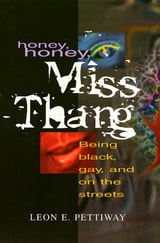
Honey, Honey, Miss Thang
Being Black, Gay, and on the StreetsLeon E. Pettiway
Temple University Press, 1996
Many straight Americans would never embrace homosexuals as neighbors, co-workers, or friends. Still less would they accept as equals those transgendered individuals who work the streets to provide themselves with drug money.
This book seeks to change that perception. It celebrates the lives of Shontae, China, Keisha, Detra, and Monique, five Afro-American gay hustlers who struggle to survive and to maintain a life of dignity and value in the face of their drug use and criminal activity. As individuals they vary in terms of background, the manner in which they entered the transgendered world, and the nature of their initiation into the drug subculture. None of them has escaped the ravages of urban decline, crime, drugs, and poverty that accompany life in an inner city, but by the same token, none of them has capitulated to the stresses with which they live.
It is impossible to read these accounts and not come away emotionally drained. As Monique explains, their lives take place in a world of chances. "You take a chance on living or dying, on being hurt or not being hurt, a chance on finding a friend or finding an enemy." It is from this world that their voices speak so eloquently about their families, hustling, sexuality, sexual abuse, friendship, and intimacy.
By letting these women speak, Leon E. Pettiway evokes questions and encourages discussion and a re-evaluation of those who are labeled as deviant. Pettiway reaches beyond academic convention to offer a view with depth and emotion that mere statistics could never provide. While the poverty and often destructive lifestyle of these women may be gut-wrenching, their experiences reveal joy, pain, and the profound strength of the human spirit with which we can all identify. These lives have much to teach us about ourselves and those we label as "other."
Hunted
Predation and Pentecostalism in GuatemalaKevin Lewis O'Neill
University of Chicago Press, 2019
Hunted is based on more than ten years of fieldwork among these centers and the drug users that populate them. Over time, as Kevin Lewis O’Neill engaged both those in treatment and those who surveilled them, he grew increasingly concerned that he, too, had become a hunter, albeit one snatching up information. This thoughtful, intense book will reframe the arc of redemption we so often associate with drug rehabilitation, painting instead a seemingly endless cycle of hunt, capture, and release.
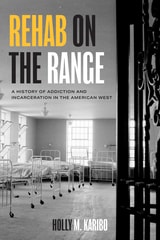
Rehab on the Range
A History of Addiction and Incarceration in the American WestHolly M. Karibo
University of Texas Press, 2024
2026 Texas Christian University (TCU) Texas Book Award Winner
2025 Coral Horton Tullis Memorial Prize, Texas State Historical Association
2025 Outstanding Academic Title, CHOICE
The first study of the Fort Worth Narcotic Farm, an institution that played a critical role in fusing the War on Drugs, mass incarceration, and public health in the American West.
In 1929, the United States government approved two ground-breaking and controversial drug addiction treatment programs. At a time when fears about a supposed rise in drug use reached a fevered pitch, the emergence of the nation’s first “narcotic farms” in Fort Worth, Texas, and Lexington, Kentucky, marked a watershed moment in the treatment of addiction. Rehab on the Range is the first in-depth history of the Fort Worth Narcotic Farm and its impacts on the American West. Throughout its operation from the 1930s to the 1970s, the institution was the only federally funded drug treatment center west of the Mississippi River. Designed to blend psychiatric treatment, physical rehabilitation, and vocational training, the Narcotic Farm, its proponents argued, would transform American treatment policies for the better. The reality was decidedly more complicated.
Holly M. Karibo tells the story of how this institution—once framed as revolutionary for addiction care—ultimately contributed to the turn towards incarceration as the solution to the nation’s drug problem. Blending an intellectual history of addiction and imprisonment with a social history of addicts’ experiences, Rehab on the Range provides a nuanced picture of the Narcotic Farm and its cultural impacts. In doing so, it offers crucial historical context that can help us better understand our current debates over addiction, drug policy, and the rise of mass incarceration.
Speed Trap
eighty robberies and fifty yearsWilliam W. Allen
Parkhurst Brothers, Inc., 2012
Allen describes the exhilaration of his youthful rule-breaking behavior
as well as the crushing reality that followed.”
– William Stephens, Ph.D.
Street Addicts in the Political Economy
Alisse Waterston
Temple University Press, 1997
The Alchemy of Meth
A DecompositionJason Pine
University of Minnesota Press, 2019
Meth cooks practice late industrial alchemy—transforming base materials, like lithium batteries and camping fuel, into gold
Meth alchemists all over the United States tap the occulted potencies of industrial chemical and big pharma products to try to cure the ills of precarious living: underemployment, insecurity, and the feeling of idleness. Meth fires up your attention and makes repetitive tasks pleasurable, whether it’s factory work or tinkering at home. Users are awake for days and feel exuberant and invincible. In one person’s words, they “get more life.”
The Alchemy of Meth is a nonfiction storybook about St. Jude County, Missouri, a place in decomposition, where the toxic inheritance of deindustrialization meets the violent hope of this drug-making cottage industry. Jason Pine bases the book on fieldwork among meth cooks, recovery professionals, pastors, public defenders, narcotics agents, and pharmaceutical executives. Here, St. Jude is not reduced to its meth problem but Pine looks at meth through materials, landscapes, and institutions: the sprawling context that makes methlabs possible. The Alchemy of Meth connects DIY methlabs to big pharma’s superlabs, illicit speed to the legalized speed sold as ADHD medication, uniquely implicating the author’s own story in the narrative.
By the end of the book, the backdrop of St. Jude becomes the foreground. It could be a story about life and work anywhere in the United States, where it seems no one is truly clean and all are complicit in the exploitation of their precious resources in exchange for a livable present—or even the hope of a future.
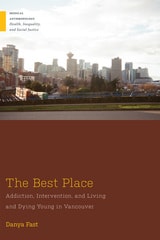
The Best Place
Addiction, Intervention, and Living and Dying Young in VancouverDanya Fast
Rutgers University Press, 2024
Winner of the CASCA Labrecque-Lee Book Prize
In both local and international imaginations, Vancouver, Canada, is often celebrated as one of the world’s most beautiful, cosmopolitan, and livable cities. Simultaneously, the city continues to be ground zero for successive waves of public health emergency and intervention, including a recent and unprecedented drug overdose crisis driven by the proliferation of illicitly manufactured fentanyl and related analogs in the local drug supply. In The Best Place: Addiction, Intervention, and Living and Dying Young in Vancouver, Danya Fast explores these politics of place from the perspectives of young people who use drugs. Those who are the subject of this book were in many ways relegated to the social, spatial, and economic margins of the city. Yet, they were also often at the very center of city life and state projects, including the project of protecting life in the context of the current overdose crisis.