Results by title

8 books match the query 'Drum'
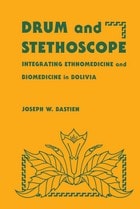
cover of Drum and stethoscope: integrating ethnomedicine and biomedicine in Bolivia

Drum and stethoscope

integrating ethnomedicine and biomedicine in Bolivia

Joseph William Bastien

University of Utah Press, 1992
[more]
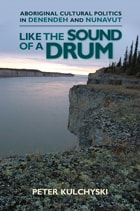
cover of Like the Sound of a Drum: Aboriginal Cultural Politics in Denendeh and Nunavut

Like the Sound of a Drum

Aboriginal Cultural Politics in Denendeh and Nunavut

Peter Kulchyski

University of Manitoba Press, 2005
[more]
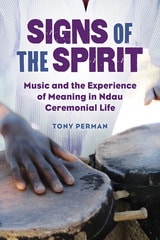
cover of Signs of the Spirit: Music and the Experience of Meaning in Ndau Ceremonial Life

Signs of the Spirit

Music and the Experience of Meaning in Ndau Ceremonial Life

Tony Perman

University of Illinois Press, 2020

In 2005, Tony Perman attended a ceremony alongside the living and the dead. His visit to a Zimbabwe farm brought him into contact with the madhlozi, outsider spirits that Ndau people rely upon for guidance, protection, and their collective prosperity.

Perman's encounters with the spirits, the mediums who bring them back, and the accompanying rituals form the heart of his ethnographic account of how the Ndau experience ceremonial musicking. As Perman witnessed other ceremonies, he discovered that music and dancing shape the emotional lives of Ndau individuals by inviting them to experience life's milestones or cope with its misfortunes as a group. Signs of the Spirit explores the historical, spiritual, and social roots of ceremonial action and details how that action influences the Ndau's collective approach to their future. The result is a vivid ethnomusicological journey that delves into the immediacy of musical experience and the forces that transform ceremonial performance into emotions and community.
[more]
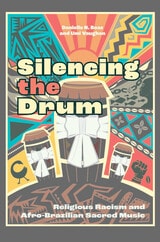
cover of Silencing the Drum: Religious Racism and Afro-Brazilian Sacred Music

Silencing the Drum

Religious Racism and Afro-Brazilian Sacred Music

Danielle N. Boaz and Umi Vaughan

Amherst College Press, 2024

Silencing the Drum exposes the profound struggle of Afro-Brazilian sacred music against escalating intolerance. Danielle N. Boaz and Umi Vaughan blend legal scholarship with ethnomusicology, offering a compelling narrative rooted in interviews with religious leaders, musicians, and activists across Brazil. This multidisciplinary exploration examines the relentless attacks against the practitioners of Afro-Brazilian religions—from discriminatory noise complaints in Bahia to vigilante violence in Rio de Janeiro.

The volume integrates multimedia elements including musical samples to vividly illustrate the struggles and resilience of Afro-Brazilian communities in the face of discrimination. As Silencing the Drum confronts the larger global issues of racism and religious freedom, it provides essential insights for scholars, activists, and anyone passionate about human rights and cultural preservation.
[more]
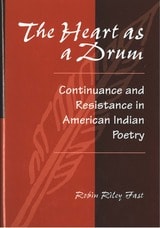
cover of The Heart as a Drum: Continuance and Resistance in American Indian Poetry

The Heart as a Drum

Continuance and Resistance in American Indian Poetry

Robin Riley Fast

University of Michigan Press, 2000
The Heart as a Drum celebrates poetry by a range of contemporary Native American writers, illuminating the poets' shared commitments and distinctive approaches to political resistance and cultural survival. The poetry reflects an awareness of the divisions and conflicts inherited from colonization and a commitment to traditional beliefs about the relatedness of all beings. This double perception engenders poetry that emphasizes resistance and continuance and poetry that makes creative and unique use of language. The book elucidates these aspects of the work through cultural and historical readings of poetry written by both urban- and reservation-identified Indians from varied geographic and tribal origins.
 
The book's focus is on the major themes in contemporary Native American literature: community and audience, the meanings of place and history, spiritual experiences, the nature of language, and the roles and varieties of storytelling. The poets whose works are discussed include Sherman Alexie, Joy Harjo, Maurice Kenny, Simon J. Ortiz, Wendy Rose, Elizabeth Woody, and Ray Young Bear.
 
The first critical book dedicated to contemporary Native American poetry, The Heart as a Drum will be useful to students, teachers, and critics of American Indian cultures and literatures, and to all readers of contemporary American poetry.
[more]
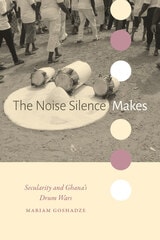
cover of The Noise Silence Makes: Secularity and Ghana's Drum Wars

The Noise Silence Makes

Secularity and Ghana's Drum Wars

Mariam Goshadze

Duke University Press, 2025
For generations, the Ga community in Accra, Ghana, has enforced an annual citywide ban on noisemaking during an important religious festival. In the 1990s and 2000s, this “ban on drumming” became a point of conflict between the Ga people and the newly popular Pentecostal/Charismatic churches, which refused to subdue their loud worship during the ban. Although the Ghanaian state constitutionally and institutionally grants superior status to Christianity and Islam, it ruled in favor of the Ga community, which emphasized its “cultural” rather than religious rights. In The Noise Silence Makes, Mariam Goshadze traces the history of noise regulation in Accra, showing how the Ga people have adopted colonial mechanisms of noise control to counter Pentecostal/Charismatic dominance over Accra’s soundscape. Goshadze shows how the drumming ban represents a reversal of the top-down model of noise regulation and illuminates the reality of Ghanaian secularity, in which the state unofficially collaborates with indigenous religious authorities to control sound. In so doing, Goshadze counters the tendency to push African “traditional religions” to the margins, demonstrating that they are instrumental players in contemporary African urbanity.
[more]
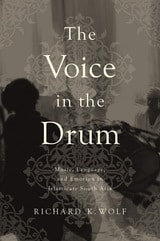
cover of The Voice in the Drum: Music, Language, and Emotion in Islamicate South Asia

The Voice in the Drum

Music, Language, and Emotion in Islamicate South Asia

Richard K. Wolf

University of Illinois Press, 2014
Based on extensive field research in India and Pakistan, this new study examines the ways drumming and voices interconnect over vast areas of South Asia and considers what it means for instruments to be voice-like and carry textual messages in particular contexts. Richard K. Wolf employs a hybrid, novelistic form of presentation, in which a fictional protagonist interacts with Wolf's field consultants, to communicate ethnographic and historical realities that transcend the local details of any one person's life. The narrative explores how the themes of South Asian Muslims and their neighbors coming together, moving apart, and relating to God and spiritual intermediaries resonate across ritual and expressive forms such as drumming and dancing. Wolf weaves in the story of a family led by Ahmed Ali Khan, a North Indian ruler who revels in the glories of 19th century life, when many religious communities joined together harmoniously in grand processions. His journalist son Muharram Ali obsessively scours the subcontinent in pursuit of a music he naively hopes will dissolve religious and political barriers. The story charts the breakdown of this naiveté. A daring narrative of music, religion and politics in late twentieth century South Asia, The Voice in the Drum delves into the social and religious principles around which Muslims, Hindus, and others bond, create distinctions, reflect upon one another, or decline to acknowledge differences.
[more]
cover of Voice in the Drum: Music, Language, and Emotion in Islamicate South Asia

Voice in the Drum

Music, Language, and Emotion in Islamicate South Asia

Richard Wolf

University of Illinois Press, 2017

Based on extensive research in India and Pakistan, this new study examines the ways drumming and voices interconnect over vast areas of South Asia and considers what it means for instruments to be voice-like and carry textual messages in particular contexts. Richard K. Wolf employs a hybrid, novelistic form of presentation in which the fictional protagonist Muharram Ali, a man obsessed with finding music he believes will dissolve religious and political barriers, interacts with Wolf's field consultants, to communicate ethnographic and historical realities that transcend the local details of any one person's life. The result is a daring narrative that follows Muharram Ali on a journey that explores how the themes of South Asian Muslims and their neighbors coming together, moving apart, and relating to God and spiritual intermediaries resonate across ritual and expressive forms such as drumming and dancing.
[more]