Results by title

5 books match the query 'Principle'
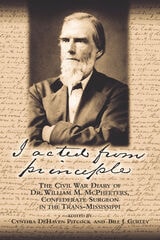
cover of I Acted from Principle: The Civil War Diary of Dr. William M. McPheeters, Confederate Surgeon in the Trans-Mississippi

I Acted from Principle

The Civil War Diary of Dr. William M. McPheeters, Confederate Surgeon in the Trans-Mississippi

Cynthia DeHaven Pitcock

University of Arkansas Press, 2000
At the start of the Civil War, Dr. William McPheeters was a distinguished physician in St. Louis, conducting unprecedented public-health research, forging new medical standards, and organizing the state's first professional associations. But Missouri was a volatile border state. Under martial law, Union authorities kept close watch on known Confederate sympathizers. McPheeters was followed, arrested, threatened, and finally, in 1862, given an ultimatum: sign an oath of allegiance to the Union or go to federal prison. McPheeters "acted from principle" instead, fleeing by night to Confederate territory. He served as a surgeon under Gen. Sterling Price and his Missouri forces west of the Mississippi River, treating soldiers' diseases, malnutrition, and terrible battle wounds. From almost the moment of his departure, the doctor kept a diary. It was a pocket-size notebook which he made by folding sheets of pale blue writing paper in half and in which he wrote in miniature with his steel pen. It is the first known daily account by a Confederate medical officer in the Trans-Mississippi Department. It also tells his wife's story, which included harassment by Federal military officials, imprisonment in St. Louis, and banishment from Missouri with the couple's two small children. The journal appears here in its complete and original form, exactly as the doctor first wrote it, with the addition of the editors' full annotation and vivid introductions to each section.
[more]
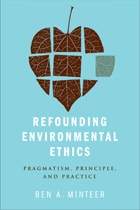
cover of Refounding Environmental Ethics: Pragmatism, Principle, and Practice

Refounding Environmental Ethics

Pragmatism, Principle, and Practice

Ben Minteer

Temple University Press, 2011

Providing a bold and original rethinking of environmental ethics, Ben Minteer's Refounding Environmental Ethics will help ethicists and their allies resolve critical debates in environmental policy and conservation practice.

Minteer considers the implications of John Dewey's pragmatist philosophy for environmental ethics, politics, and practice. He provides a new and compelling intellectual foundation for the field—one that supports a more activist, collaborative and problem-solving philosophical enterprise.

Combining environmental ethics, democratic theory, philosophical pragmatism, and the environmental social sciences, Minteer makes the case for a more experimental, interdisciplinary, and democratic style of environmental ethics—one that stands as an alternative to the field's historically dominant “nature-centered” outlook.

Minteer also provides examples of his pragmatic approach in action, considering a wide range of application and issues, including invasive species, ecological research, biodiversity loss, protected area management, and conservation under global climate change.
[more]
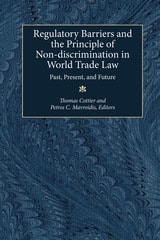
cover of Regulatory Barriers and the Principle of Non-discrimination in World Trade Law: Past, Present, and Future

Regulatory Barriers and the Principle of Non-discrimination in World Trade Law

Past, Present, and Future

Thomas Cottier and Petros C. Mavroidis, Editors

University of Michigan Press, 2000
The University of Michigan Press is pleased to announce the second volume in an annual series, the World Trade Forum. The Forum's members include scholars, lawyers, and government and business practitioners working in the area of international trade, law, and policy. They meet annually to discuss integration issues in international economic relations, focusing on a new theme each year.
The World Trade Forum 1998 deals with the issue of regulatory barriers. Contributors focus their attention on the implications that government intervention has on the principle of nondiscrimination, the cornerstone of the World Trade Organization. The chapters, which cover both the positive and the normative level, deal in particular with the issue of "like product" definition, and with mutual recognition agreements. The relevant WTO case law is presented and analyzed, and the roundtable discussions are primarily aimed at clarifying to what extent a constitutional function should be assigned to the WTO organs, if at all.
Contributors include: Christoph Bail, Jacques Bourgeois, Marco Bronckers, Thomas Cottier, William Davey, Paul Demaret, Piet Eeckhout, Crawford Falconer, Olivier Guillod, Meinhard Hilf, Gary Horlick, Robert Howse, Robert Hudec, Patrick Low, Aaditya Mattoo, Petros C. Mavroidis, Patrick Messerlin, Damien Neven, Kalypso Nicolaidis, David Palmeter, Ernst Ulrich Petresmann, Andre Sapir, and Michel Waelbroeck.
Thomas Cottier is Professor of Law, Institute of European and International Economic Law, University of Bern Law School. Petros C. Mavroidis is Professor of Law, University of Neuchâtel.
[more]
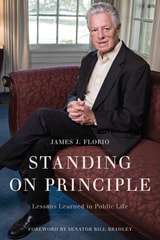
cover of Standing on Principle: Lessons Learned in Public Life

Standing on Principle

Lessons Learned in Public Life

Florio, James J

Rutgers University Press, 2018

James J. Florio is best known as governor of New Jersey from 1990 to 1994. But his career in local, state, and national government is far more varied, and his achievements as a progressive reformer are more substantial than most realize. 

This political memoir tells the remarkable story of how Florio, a high school dropout who left to join the Navy as a teenager, went on to become an attorney, a state assemblyman, a congressman, and a governor. A passionate defender of the environment, Florio played a crucial role in the enactment of 1980s-era Superfund laws, which helped to clean up toxic waste sites in New Jersey and around the country. As governor, he fought for the groundbreaking Clean Water Enforcement Act. But his reforms quite literally came at a cost, as he raised New Jersey sales taxes and income taxes to balance the state budget. Florio reflects upon the challenges of meeting the state’s budgetary needs while keeping his tax-averse constituents happy.  

Standing on Principle reveals a politician who has never been afraid to take a progressive stand—including a firm stance against semiautomatic weapons that led gun lobbyists to bankroll his opponent. His story is sure to inspire readers from New Jersey and across the nation.

Published in cooperation with the Center on the American Governor, Eagleton Institute of Politics, Rutgers University
[more]
cover of Strategy or Principle?: The Choice Between Regulation and Taxation

Strategy or Principle?

The Choice Between Regulation and Taxation

Mark Kelman

University of Michigan Press, 1999

Governments may choose to meet perceived social problems either through regulatory mandates or the public provision of a good that is funded by broad-based taxes. Contrary to an emerging conservative consensus in the "property rights" movement, Strategy or Principle? argues, first, that the constitution permits broad use of regulations and, second, that the use of regulation may be the better policy choice. Strategy or Principle? addresses a critical issue in law, public administration, and public finance: When is it both prudent and constitutionally permissible to meet social aims by requiring that private parties take certain steps to meet that aim? Alternately, when is it appropriate for the government to use the money it raises through general taxation to fund programs that meet these aims? Regulations have been criticized in "property rights" literature on the grounds that it violates the constitution by limiting the ability of property owners to use their property without compensation. These theorists argue that the government must directly fund these programs. Kelman argues for regulations and "regulatory taxes" in some situations. However, he criticizes an undue reliance among certain political progressives on regulation, arguing that the allocation of social benefits may be irrational if those who are benefited by regulation are thought to have some sort of moral priority to the money implicitly spent on improving their condition over those who receive funds through tax-and-spend programs. Strategy or Principle? will be of interest to students and scholars of constitutional law, public finance, political science, and legislation and administration.
[more]