Results by title
8 books match the query 'Duby, Georges'

History Continues
Georges Duby
University of Chicago Press, 1994
In this engaging intellectual autobiography, Georges Duby looks back on a career that has led him to be called one of the most distinguished historians in the Western world.
Since its beginning in the 1940s, Duby's career has been rich and varied, encompassing economic history, social history, the history of mentalites, art history, microhistory, urban history, the history of women and sexuality, and, most recently, the Church's influence on feudal society. In retracing this singular career path, Duby candidly remembers his life's most formative influences, including the legendary historians Marc Bloch and Lucien Febvre, the Annales School so closely associated with them, and the College de France.
Duby also offers insights about the proper methods of gathering and using archival data and on constructing penetrating interpretations of the documents. Indeed, his discussion of how he chose his subjects, collected his materials, developed the arguments, erected the scaffolding and constructed his theses offers the best introduction to the craft available to aspiring historians.
Candid and charming, this book is both a memoir of one of this century's great scholars and a history of the French historical school since the mid-twentieth century. It will be required reading for anyone interested in the French academic milieu, medieval history, French history, or the recording of history in general.
Georges Duby, a member of the Academie francaise, for many years held the distinguished chair in medieval history at the College de France. His numerous books include The Age of Cathedrals; The Knight, the Lady, and the Priest; Love and Marriage in the Middle Ages; and The Three Orders—all published by the University of Chicago Press.
[more]
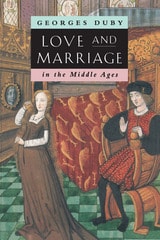
Love and Marriage in the Middle Ages
Georges Duby
University of Chicago Press, 1993
Preeminent medieval scholar Georges Duby argues that the structure of sexual relationships took its cue from the family and from feudalism—both bastions of masculinity—as he reveals the role of women, what they represented, and what they were in the Middle Ages.
Beautifully written in Duby's characteristically nuanced and powerful style, this collection is an ideal entree into Duby's thinking about marriage and the diversities of love, spousal decorum, family structure, and their cultural context in bodily and spiritual values. Love and Marriage in the Middle Ages will be of great interest to students in social and cultural history, medieval and early modern history, and women's studies, as well as those interested in the nature of social life in the Middle Ages.
Georges Duby (1919-1996) was a member of the Académie française and for many years held the distinguished chair in medieval history at the Collège de France. His books include The Three Orders; The Age of Cathedrals; The Knight, the Lady, and the Priest; Love and Marriage in the Middle Ages; and History Continues, all published by the University of Chicago Press.
[more]
The Age of the Cathedrals
Art and Society, 980-1420Georges Duby
University of Chicago Press, 1981
Recognizing that a work of art is the product of a particular time and place as much as it is the creation of an individual, Duby provides a sweeping survey of the changing mentalities of the Middle Ages as reflected in the art and architecture of the period.
"If Age of the Cathedrals has a fault, it is that Professor Duby knows too much, has too many new ideas and takes such a delight in setting them out. . . insights whiz to and fro like meteorites."—John Russell, New York Times Book Review
"If Age of the Cathedrals has a fault, it is that Professor Duby knows too much, has too many new ideas and takes such a delight in setting them out. . . insights whiz to and fro like meteorites."—John Russell, New York Times Book Review
[more]
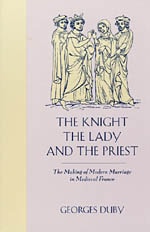
The Knight, the Lady and the Priest
The Making of Modern Marriage in Medieval FranceGeorges Duby
University of Chicago Press, 1993
This ambitious study sets out to discover what marriage meant in the daily lives of the nobles of the tenth, eleventh, and twelfth centuries. Through entertaining anecdotes, family dramas, and striking quotations, Duby succeeds in bringing his subjects to life, making us feel as if we understand the motives and conflicts of those who inhabited the distant past.
"It is typical of Duby's modest spirit and his book-long concern with the ancient status of beleaguered wives that he ends his study with a plea: 'We must not forget the women. Much has already been said about them. But how much do we really know?' Not everything, certainly, but far more than we did before the author began these charmingly erudite investigations."—Ken Turan, Time
"It is refreshing to find a historian who is always conscious that we simply do not know what or how people thought 1000 years ago. . . . Duby explains the complicated machinations of the medieval churchman and the paterfamilias in a scholarly but lively style."—Sarah Lawson, New Statesman
"Duby has written an extraordinarily rich book—a panoramic view of medieval marriage and the relations between men and women, full of arresting insights and human detail. . . . It is the work of a master historian at the peak of his powers on a subject of central relevance, compulsive and essential reading."—P. Stafford, British History
Georges Duby (1919-1996) was a member of the Académie française and for many years held the distinguished chair in medieval history at the Collège de France. His books include The Three Orders; The Age of Cathedrals; The Knight, the Lady, and the Priest; Love and Marriage in the Middle Ages; and History Continues, all published by the University of Chicago Press.
[more]
The Three Orders
Feudal Society ImaginedGeorges Duby
University of Chicago Press, 1980
[more]
Women of the Twelfth Century, Volume 1
Eleanor of Aquitaine and Six OthersGeorges Duby
University of Chicago Press, 1997
In this volume, Georges Duby examines the lives of prominent twelfth-century French women as well as popular female literary figures of that time. Focusing on medieval notions of women and love, Duby looks for the ideological motivations for the representation of the female sex. He analyzes the ways in which women's biographies were written and how female characters were treated in fable and legend, pointing to the social and political forces at work in these representations.
The historical personages include Eleanor of Aquitaine whose several marriages brought her wealth and autonomy; the virtuous Héloïse; and the visionary recluse Juette. Duby also studies the literary figures of St. Marie-Madeleine, a composite figure who personified the essential female traits of frailty, ardent love, and evangelicalism; Iseut, literary beloved of Tristan; and two other emblematic figures, Dorée d'Amour and Phénix—women who became ladies through chivalrous love.
Provocative, informative, and entertaining, this book offers new insight on courtly love and the representations of women under medieval patriarchy.
[more]
Women of the Twelfth Century, Volume 2
Remembering the DeadGeorges Duby
University of Chicago Press, 1997
In this volume, one of the greatest medieval historians of our time continues his rich and illuminating inquiry into the lives of twelfth-century women. Georges Duby bases his account on a twelfth-century genre that commemorated the virtues of noblewomen who had died and the roles they came to play in the history of their lineage. From these genealogical works a vivid picture emerges of the lives these women led, the values they held, and the way in which they were viewed by the ecclesiastical and chivalric writers who immortalized them.
The first section outlines the ways in which the dead—in both memory and legend—served to bond noble society in the twelfth century. Drawing on the Gesta by Dudo of Saint Quentin, the second section reflects on the roles that wives, concubines, and other women played during times of war and in the great exchanges of power that established the grand lineages of the Middle Ages. The third section reconstructs women as wives, mothers, and widows through the work of Lambert, Priest of Ardres.
The first section outlines the ways in which the dead—in both memory and legend—served to bond noble society in the twelfth century. Drawing on the Gesta by Dudo of Saint Quentin, the second section reflects on the roles that wives, concubines, and other women played during times of war and in the great exchanges of power that established the grand lineages of the Middle Ages. The third section reconstructs women as wives, mothers, and widows through the work of Lambert, Priest of Ardres.
[more]
Women of the Twelfth Century, Volume 3
Eve and the ChurchGeorges Duby
University of Chicago Press, 1998
In this volume, Georges Duby studies the relationship between the Church and women in twelfth-century Europe. By that time, the Church had begun to see the evolving roles and expectations of women as serious matters, resulting in a wide range of clerical writings addressing "the woman question."
Drawing on these writings, Duby describes how women were thought to embody particular sins, such as sorcery, disobedience, and licentiousness. He evaluates Eve's role in man's fall from grace in the Garden of Eden and analyzes the reasoning behind the view that women are unstable, curious, frivolous creatures. He also notes that these charges are leveled against women, even as praise is heaped upon them for the conventional virtues they exhibit in their roles as wives and mothers.
As the final installment in Duby's three-volume study of French noblewomen of the twelfth century, Eve and the Church is the last work of this superb historian. It will be of interest to scholars of medieval history and women's history as well as to anyone interested in current debates about women and religion.
Georges Duby (1919-1996) was a member of the Académie française and for many years held the distinguished chair in medieval history at the Collège de France. His books include The Three Orders; The Age of Cathedrals; The Knight, the Lady, and the Priest; Love and Marriage in the Middle Ages; and History Continues, all published by the University of Chicago Press.
[more]