Results by title
3 books match the query 'Duchess'
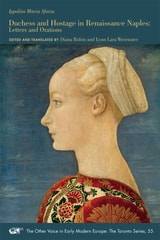
Duchess and Hostage in Renaissance Naples
Letters and OrationsIppolita Maria Sforza
Iter Press, 2017

Duchess of Palms
A MemoirBy Nadine Eckhardt
University of Texas Press, 2009
A “fifties girl” tells the fascinating story of her marriages to novelist Billy Lee Brammer and Congressman Bob Eckhardt, and how these relationships propelled her into the multifaceted life she led on her own terms.
Child of the Great Depression, teenage "Duchess of Palms" beauty queen, wife of an acclaimed novelist and later of a brilliant U.S. congressman, and ultimately a successful single working woman and mother, Nadine Eckhardt has lived a fascinating life. In this unique, funny, and honest memoir, she recounts her journey from being a "fifties girl" who lived through the men in her life to becoming a woman in her own right, working toward her own goals.
Eckhardt's first marriage to writer Billy Lee Brammer gave her entrée to liberal political and literary circles in Austin and Washington, where she and Brammer both worked for Senator Lyndon B. Johnson. She describes the heady excitement of LBJ's world—a milieu that Brammer vividly captured in his novel The Gay Place. She next recalls her second marriage to Bob Eckhardt, whom she helped get elected to the U.S. House of Representatives, as well as her growing involvement with the counterculture of social protest, sexual revolution, and drug use. Eckhardt honestly recounts how the changing times changed her perception of herself, recalling that "I didn't know how to achieve for myself, only for others, and I felt ripped off and empty." This painful realization opened the door to a new life for Eckhardt. Her memoir concludes with a joyful description of her multifaceted later life as a restaurateur, assistant to Molly Ivins, writer, and center of a wide circle of friends.
The Duchess of Suffolk
Thomas Drue. Edited and with an Introduction by Richard Dutton and Steven K. Galbraith
The Ohio State University Press, 2015
With this volume, Dutton and Galbraith provide a critical apparatus that situates The Duchess of Suffolk in historical context and suggests an explanation for its continued resonance. They account for the play’s censorship in 1624 by detailing how it evoked contemporary parallels to the controversial foreign policy of King James I. More specifically, the editors offer an introduction that includes a historical overview of the author, staging, printing, and reception. Facing facsimiles of the original are pages with the updated text, complete with annotations to clarify language and staging details. This edition of The Duchess of Suffolk will have something to offer to early modern drama scholars as well as scholars of book history.