Results by title
13 books match the query 'Duplessis, Rachel Blau'
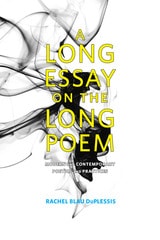
A Long Essay on the Long Poem
Modern and Contemporary Poetics and PracticesRachel Blau DuPlessis
University of Alabama Press, 2023
A masterful meditation on our most mercurial and abiding of poetic forms—the long poem
For decades, Rachel Blau DuPlessis has shown readers how genres, forms, and the literal acts of writing and reception can be understood as sites of struggle. In her own words, “writing is . . . a praxis . . . in which the author disappears into a process, into a community, into discontinuities, and into a desire for discovery.” It is cause for celebration, then, that we have another work of warm, incisive, exploratory writing from DuPlessis in A Long Essay on the Long Poem.
Long poems, DuPlessis notes, are elusive, particularly in the slippery forms that have emerged in the postmodern mode. She cites both Nathaniel Mackey and Anne Waldman in thinking of the poem as a “box,” both in the sense of a vessel that contains and as a machine that processes, an instrument on which language is played. This study’s central attention is on the long poem as a sociocultural Book, distinctively envisioned by a range of authors.
To reckon with these shifting and evolving forms, DuPlessis works in a polyvalent mode, a hybrid of critical analysis and speculative essay. She divides the long poem and the long poets into three genres: epics, quests, and a composite she terms “assemblages.” The poets she surveys include T. S. Eliot, Ezra Pound, H.D., Louis Zukofsky, Gwendolyn Brooks, Charles Olson, Alice Notley, Nathaniel Mackey, Ron Silliman, Robert Duncan, Kamau Brathwaite, and, finally, Mallarmé and Dante. Instead of a traditional lineage, she deliberately seeks intersecting patterns of connection between poems and projects, a nexus rather than a family tree. In doing so she navigates both some challenges of long poems and her own attempt to “essay” them. The result is a fascinating and generous work that defies categorization as anything other than essential.
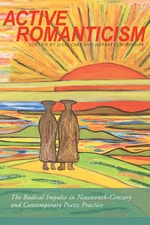
Active Romanticism
The Radical Impulse in Nineteenth-Century and Contemporary Poetic PracticeEdited by Julie Carr and Jeffrey C. Robinson
University of Alabama Press, 2015
A collection of essays highlighting the pervasive, yet often unacknowledged, role of Romantic poetry and poetics on modern and contemporary innovative poetry.
Literary history generally locates the primary movement toward poetic innovation in twentieth-century modernism, an impulse carried out against a supposedly enervated “late-Romantic” poetry of the nineteenth century. The original essays in Active Romanticism challenge this interpretation by tracing the fundamental continuities between Romanticism’s poetic and political radicalism and the experimental movements in poetry from the late nineteenth century to the present day.
According to editors July Carr and Jeffrey C. Robinson, “active romanticism” is a poetic response, direct or indirect, to pressing social issues and an attempt to redress forms of ideological repression; at its core, “active romanticism” champions democratic pluralism and confronts ideologies that suppress the evidence of pluralism. “Poetry fetter’d, fetters the human race,” declared poet William Blake at the beginning of the nineteenth century. No other statement from the era of the French Revolution marks with such terseness the challenge for poetry to participate in the liberation of human society from forms of inequality and invisibility. No other statement insists so vividly that a poetic event pushing for social progress demands the unfettering of traditional, customary poetic form and language.
Bringing together work by well-known writers and critics, ranging from scholarly studies to poets’ testimonials, Active Romanticism shows Romantic poetry not to be the sclerotic corpse against which the avant-garde reacted but rather the wellspring from which it flowed.
Offering a fundamental rethinking of the history of modern poetry, Carr and Robinson have grouped together in this collection a variety of essays that confirm the existence of Romanticism as an ongoing mode of poetic production that is innovative and dynamic, a continuation of the nineteenth-century Romantic tradition, and a form that reacts and renews itself at any given moment of perceived social crisis.
Blue Studios
Poetry and Its Cultural WorkRachel Blau DuPlessis
University of Alabama Press, 2006
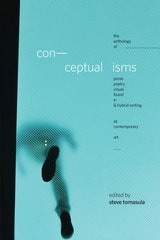
Conceptualisms
The Anthology of Prose, Poetry, Visual, Found, E- & Hybrid Writing as Contemporary ArtEdited by Steve Tomasula
University of Alabama Press, 2022
A wide-ranging anthology of experimental writing—prose, poetry, and hybrid—from its most significant practitioners and innovators
A variety of names have been used to describe fiction, poetry, and hybrid writing that explore new forms and challenges mainstream traditions. Those phrases include experimental, conceptual, avant-garde, hybrid, surfiction, fusion, radical, slip-stream, avant-pop, postmodern, self-conscious, innovative, L=A=N=G=U=A=G=E writing, alternative, and anti- or new literature. Conceptualisms: The Anthology of Prose, Poetry, Visual, Found, E- & Hybrid Writing as Contemporary Art is the first major anthology of writing that offers readers an overview of this other tradition as it lives in the early decades of the 21st century.
Featuring over 100 pieces from more than 90 authors, this anthology offers a plethora of aesthetics and approaches to a wide variety subjects. Editor Steve Tomasula has gathered poems, prose, and hybrid pieces that all challenge our understanding of what literature means. Intended as a collection of the most exciting and bold literary work being made today, Tomasula has put a spotlight on the many possibilities available to writers and readers wishing for a glimpse of literature’s future.
Readers will recognize authors who have shaped contemporary writing, as among them Lydia Davis, Charles Bernstein, Jonathan Safran Foer, Shelley Jackson, Nathaniel Mackey, David Foster Wallace, and Claudia Rankine. Even seasoned readers will find authors, and responses to the canon, not yet encountered. Conceptualisms is a book of ideas for writers, teachers and scholars, as well as readers who wonder how many ways literature can live.
The text features headnotes to chapters on themes such as sound writing, electronic literature, found text, and other forms, offering accessible introductions for readers new to this work. An online companion presents statements about the work and biographies of the authors in addition to audio, video, and electronic writing that can’t be presented in print. Visit www.conceptualisms.info to read more.
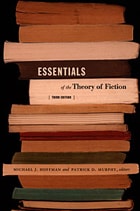
Essentials of the Theory of Fiction
Michael J. Hoffman and Patrick D. Murphy, eds.
Duke University Press, 2005
Contributors. M. M. Bakhtin, John Barth, Roland Barthes, Wayne Booth, John Brenkman, Peter Brooks, Catherine Burgass, Seymour Chatman, J. Yellowlees Douglas, Rachel Blau DuPlessis, Wendy B. Faris, Barbara Foley, E. M. Forster, Joseph Frank, Joanne S. Frye, William H. Gass, Henry Louis Gates Jr., Gérard Genette, Ursula K. Heise, Michael J. Hoffman, Linda Hutcheon, Henry James, Susan S. Lanser, Helen Lock, Georg Lukács, Patrick D. Murphy, Ruth Ronen, Joseph Tabbi, Jon Thiem, Tzvetan Todorov, Virginia Woolf
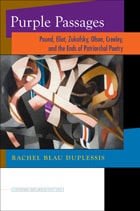
Purple Passages
Pound, Eliot, Zukofsky, Olson, Creeley, and the Ends of Patriarchal PoetryRachel Blau DuPlessis
University of Iowa Press, 2012
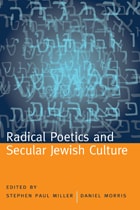
Radical Poetics and Secular Jewish Culture
Edited by Stephen Paul Miller and Daniel Morris
University of Alabama Press, 2009
--Franz Kafka
Kafka's quip--paradoxical, self-questioning, ironic--highlights vividly some of the key issues of identity and self-representation for Jewish writers in the 20th century. No group of writers better represents the problems of Jewish identity than Jewish poets writing in the American modernist tradition--specifically secular Jews: those disdainful or suspicious of organized religion, yet forever shaped by those traditions.
This collection of essays is the first to address this often obscured dimension of modern and contemporary poetry: the secular Jewish dimension. Editors Daniel Morris and Stephen Paul Miller asked their contributors to address what constitutes radical poetry written by Jews defined as "secular," and whether or not there is a Jewish component or dimension to radical and modernist poetic practice in general. These poets and critics address these questions by exploring the legacy of those poets who preceded and influenced them--Stein, Zukofsky, Reznikoff, Oppen, and Ginsberg, among others.
While there is no easy answer for these writers about what it means to be a Jew, in their responses there is a rich sense of how being Jewish reflects on their aesthetics and practices as poets, and how the tradition of the avant-garde informs their identities as Jews. Fragmented identities, irony, skepticism, a sense of self as "other" or "outsider," distrust of the literal, and belief in a tradition that questions rather than answers--these are some of the qualities these poets see as common to themselves, the poetry they make, and the tradition they work within.
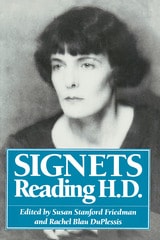
Signets
Reading H.D.Susan S. Friedman
University of Wisconsin Press, 1991
Signets brings together the best essays of H.D. (Hilda Doolittle). Susan Stanford Friedman and Rachel Blau DuPlessis have gathered the most influential and generative studies of H. D.’s work and complemented them with photobiographical, chronological, and bibliographical portraits unique to this volume.
The essays in Signets span H. D.’s career from the origins of Imagism to late modernism, from the early poems of Sea Garden to the novel HER and the epic poems Trilogy and Helen in Egypt. In addition to the editors, the contributors are Diana Collecott, Robert Duncan, Albert Gelpi, Eileen Gregory, Susan Gubar, Barbara Guest, Elizabeth A. Hirsch, Deborah Kelly Kloepfer, Cassandar Laity, Adalaide Morris, Alicia Ostriker, Cyrena N. Pondrom, Perdita Schaffner, and Louis H. Silverstein.
Signets is an essential resource for those interested in H. D., modernism, and feminist criticism and writing.
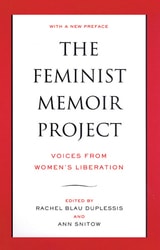
The Feminist Memoir Project
Voices from Women's LiberationDuPlessis, Rachel B
Rutgers University Press, 2007
What made these particular women rebel? And what experiences, ideas, feelings, and beliefs shaped their activism? How did they maintain the will and energy to keep such a struggle going for so long, and continuing still?
Memoirs and responses by Kate Millett, Vivian Gornick, Michele Wallace, Alix Kates Shulman, Joan Nestle, Jo Freeman, Yvonne Rainer, Barbara Smith, Ellen Willis, Eve Ensler, Shirley Geok-lin Lim, Roxanne Dunbar, Naomi Weisstein, Alice Wolfson and many more embody the excitement that fueled the movement and the conflicts that threatened it from within. Their stories trace the ways the world has changed.
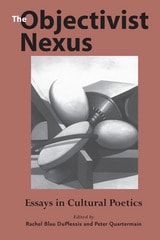
The Objectivist Nexus
Essays in Cultural PoeticsPeter Quartermain
University of Alabama Press, 1999
Outstanding poets and critics present cultural readings of the Objectivist poets, a group whose works have been largely unexamined.
"Objectivist" writers, conjoined through a variety of personal, ideological, and literary-historical links, have, from the late 1920s to the present, attracted emulation and suspicion. Representing a nonsymbolist, postimagist poetics and characterized by a historical, realist, antimythological worldview, Objectivists have retained their outsider status. Despite such status, however, the formal, intellectual, ideological, and ethical concerns of the Objectivist nexus have increasingly influenced poetry and poetics in the United States.
Thus, argue editors Rachel Blau DuPlessis and Peter Quartermain, the time has come for an anthology that unites essential works on Objectivist practices and presents Objectivist writing as an enlargement of the possibilities of poetry rather than as a determinable and definable literary movement. The authors' collective aim is to bring attention to this group of poets and to exemplify and specify cultural readings for poetic texts--readings alert to the material world, politics, society, and history, and readings concerned with the production, dissemination, and reception of poetic texts.
The contributors consider Basil Bunting, Lorine Niedecker, George Oppen, Carl Rakosi, Charles Reznikoff, and Louis Zukofsky within both their historical milieu and our own. The essays insist on poetry as a mode of thought; analyze and evaluate Objectivist politics; focus on the ethical, spiritual, and religious issues raised by certain Objectivist affiliations with Judaism; and explore the dissemination of poetic texts and the vagaries of Objectivist reception. Running throughout the book are two related threads: Objectivist writing as generally a practice aware of its own historical and social contingency and Objectivist writing as a site of complexity, contestation, interrogation, and disagreement.
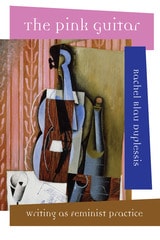
The Pink Guitar
Writing as Feminist PracticeRachel Blau DuPlessis
University of Alabama Press, 2006

The Selected Letters of George Oppen
Rachel Blau DuPlessis, ed.
Duke University Press, 1990
These working papers include a rich correspondence, letters which provide access to the sustained, perceptive body of critical and aesthetic thinking of Oppen’s poetic career. Provocative and witty comments on poetry and poetics, especially interesting for the development of an Objectivist aesthetics, and shrewd, deeply felt assessments about the politics of the twentieth century and its moral dilemmas are some of the issues attended to. This edition offers primary documentation about an influential poetics, a little-known movement, and its active figures. Given the aggressive studies of the politics of canon-formation, the interest in describing a historical context for individual literary achievement, and current debates about mainstream poetry, the rethinking of the Objectivist movement, and the collection of documents contributing to its poetics, is an important achievement in literary scholarship.
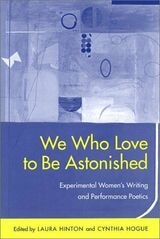
We Who Love to Be Astonished
Experimental Women's Writing and Performance PoeticsLaura Hinton
University of Alabama Press, 2001
The first critical volume devoted to the full range of women's postmodern works
We Who Love to Be Astonished collects a powerful group of previously unpublished essays to fill a gap in the critical evaluation of women's contributions to postmodern experimental writing. Contributors include Alan Golding, Aldon Nielsen, and Rachel Blau DuPlessis; discussions include analyses of the work of Kathleen Fraser, Harryette Mullen, and Kathy Acker, among others. The editors take as their title a line from the work of Lyn Hejinian, one of the most respected of innovative women poets writing today.
The volume is organized into four sections: the first two seek to identify, from two different angles, the ways women of different sociocultural backgrounds are exploring their relationships to their cultures' inherited traditions; the third section investigates the issue of visuality and the problems and challenges it creates; and the fourth section expands on the role of the body as material and performance.
The collection will breach a once irreconcilable divide between those who theorize about women's writing and those who focus on formalist practice. By embracing "astonishment" as the site of formalist-feminist investigation, the editors seek to show how form configures feminist thought, and, likewise, how feminist thought informs words and letters on a page. Students and scholars of avant-garde poetry, women's writing, and late-20th-century American literature will welcome this lively discussion.