Results by title
4 books match the query 'Early American Republic'
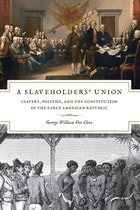
A Slaveholders' Union
Slavery, Politics, and the Constitution in the Early American RepublicGeorge William Van Cleve
University of Chicago Press, 2010
After its early introduction into the English colonies in North America, slavery in the United States lasted as a legal institution until the passage of the Thirteenth Amendment to the Constitution in 1865. But increasingly during the contested politics of the early republic, abolitionists cried out that the Constitution itself was a slaveowners’ document, produced to protect and further their rights. A Slaveholders’ Union furthers this unsettling claim by demonstrating once and for all that slavery was indeed an essential part of the foundation of the nascent republic.
In this powerful book, George William Van Cleve demonstrates that the Constitution was pro-slavery in its politics, its economics, and its law. He convincingly shows that the Constitutional provisions protecting slavery were much more than mere “political” compromises—they were integral to the principles of the new nation. By the late 1780s, a majority of Americans wanted to create a strong federal republic that would be capable of expanding into a continental empire. In order for America to become an empire on such a scale, Van Cleve argues, the Southern states had to be willing partners in the endeavor, and the cost of their allegiance was the deliberate long-term protection of slavery by America’s leaders through the nation’s early expansion. Reconsidering the role played by the gradual abolition of slavery in the North, Van Cleve also shows that abolition there was much less progressive in its origins—and had much less influence on slavery’s expansion—than previously thought.
Deftly interweaving historical and political analyses, A Slaveholders’ Union will likely become the definitive explanation of slavery’s persistence and growth—and of its influence on American constitutional development—from the Revolutionary War through the Missouri Compromise of 1821.

Imagining Deliberative Democracy in the Early American Republic
Sandra M. Gustafson
University of Chicago Press, 2011
Deliberation, in recent years, has emerged as a form of civic engagement worth reclaiming. In this persuasive book, Sandra M. Gustafson combines historical literary analysis and political theory in order to demonstrate that current democratic practices of deliberation are rooted in the civic rhetoric that flourished in the early American republic.
Though the U.S. Constitution made deliberation central to republican self-governance, the ethical emphasis on group deliberation often conflicted with the rhetorical focus on persuasive speech. From Alexis de Tocqueville’s ideas about the deliberative basis of American democracy through the works of Walt Whitman, John Dewey, John F. Kennedy, and Martin Luther King Jr., Gustafson shows how writers and speakers have made the aesthetic and political possibilities of deliberation central to their autobiographies, manifestos, novels, and orations. Examining seven key writers from the early American republic—including James Fenimore Cooper, David Crockett, and Daniel Webster—whose works of deliberative imagination explored the intersections of style and democratic substance, Gustafson offers a mode of historical and textual analysis that displays the wide range of resources imaginative language can contribute to political life.
Reconstructing the National Bank Controversy
Politics and Law in the Early American RepublicEric Lomazoff
University of Chicago Press, 2018
With Reconstructing the National Bank Controversy, Eric Lomazoff offers a far more robust account of the constitutional politics of national banking between 1791 and 1832. During that time, three forces—changes within the Bank itself, growing tension over federal power within the Republican coalition, and the endurance of monetary turmoil beyond the War of 1812 —drove the development of our first major debate over the scope of federal power at least as much as the formal dimensions of the Constitution or the absence of a shared legal definition for the word “necessary.” These three forces—sometimes alone, sometimes in combination—repeatedly reshaped the terms on which the Bank’s constitutionality was contested. Lomazoff documents how these three dimensions of the polity changed over time and traces the manner in which they periodically led federal officials to adjust their claims about the Bank’s constitutionality. This includes the emergence of the Coinage Clause—which gives Congress power to “coin money, regulate the value thereof”—as a novel justification for the institution. He concludes the book by explaining why a more robust account of the national bank controversy can help us understand the constitutional basis for modern American monetary politics.
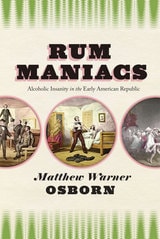
Rum Maniacs
Alcoholic Insanity in the Early American RepublicMatthew Warner Osborn
University of Chicago Press, 2014
In Rum Maniacs, Matthew Warner Osborn reveals how and why pathological drinking became a subject of medical interest, social controversy, and lurid fascination in the early American republic. At the heart of that story is the disease that Poe suffered: delirium tremens. First described in 1813, delirium tremens and its characteristic hallucinations inspired sweeping changes in how the medical profession saw and treated the problems of alcohol abuse. Based on new theories of pathological anatomy, human physiology, and mental illness, the new diagnosis founded the medical conviction and popular belief that habitual drinking could become a psychological and physiological disease. By midcentury, delirium tremens had inspired a wide range of popular theater, poetry, fiction, and illustration. This romantic fascination endured into the twentieth century, most notably in the classic Disney cartoon Dumbo, in which a pink pachyderm marching band haunts a drunken young elephant. Rum Maniacs reveals just how delirium tremens shaped the modern experience of alcohol addiction as a psychic struggle with inner demons.