Results by title
25 books match the query 'Early Childhood (incl. Preschool & Kindergarten)'
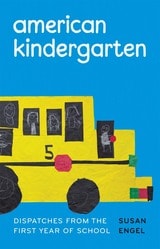
American Kindergarten
Dispatches from the First Year of SchoolSusan Engel
University of Chicago Press, 2026
When we think of kindergarten, many might imagine joyous free play, and a tangle of trucks, dress-up clothes, and blocks, as five-year-olds explore their vivid imaginations and budding social skills. Others might envision a quiet group sitting cross-legged in a circle during story time. Neither of these scenes would be an inaccurate representation of the pivotal year of entry into traditional education in this country. However, neither offers a complete picture of what children do every day in those seemingly transparent, yet actually mysterious, classrooms. What can or should we expect during the first year of school? How are children learning and growing during those hours spent away from their homes?
Susan Engel embarked on finding these answers in American Kindergarten: Dispatches from the First Year of School. Engel toured twenty-nine classrooms across fourteen states, observing each closely, with a special eye toward the ways each classroom’s goals reflect its community. As she made her way across the country, Engel found that on the surface, kindergarten students are similar: good-natured, eager to learn, and deeply affectionate. Their classrooms, too, feature many of the same expectations, routines, and activities. But the differences between the classrooms were striking and often surprising. Over the two years of her classroom visits, Engel identified five promises that teachers and their classrooms make to their students: reading, order, thinking, identity, and love. Engel found that schools differ in how they prioritize and keep the promises they make; some make all five promises, while others emphasize only one or two. The five promises capture a set of values, aspirations, and goals that drive everything that happens in a classroom.
Engaging and incisive, American Kindergarten is the story of the promises our country’s schools make to five-year-old children, and how those promises are kept and sometimes broken.

American Kindergarten
Dispatches from the First Year of SchoolSusan Engel
University of Chicago Press, 2026
An unexpected portrait of the first year of school for America’s youngest learners.
When we think of kindergarten, many might imagine joyous free play, and a tangle of trucks, dress-up clothes, and blocks, as five-year-olds explore their vivid imaginations and budding social skills. Others might envision a quiet group sitting cross-legged in a circle during story time. Neither of these scenes would be an inaccurate representation of the pivotal year of entry into traditional education in this country. However, neither offers a complete picture of what children do every day in those seemingly transparent, yet actually mysterious, classrooms. What can or should we expect during the first year of school? How are children learning and growing during those hours spent away from their homes?
Susan Engel embarked on finding these answers in American Kindergarten: Dispatches from the First Year of School. Engel toured twenty-nine classrooms across fourteen states, observing each closely, with a special eye toward the ways each classroom’s goals reflect its community. As she made her way across the country, Engel found that on the surface, kindergarten students are similar: good-natured, eager to learn, and deeply affectionate. Their classrooms, too, feature many of the same expectations, routines, and activities. But the differences between the classrooms were striking and often surprising. Over the two years of her classroom visits, Engel identified five promises that teachers and their classrooms make to their students: reading, order, thinking, identity, and love. Engel found that schools differ in how they prioritize and keep the promises they make; some make all five promises, while others emphasize only one or two. The five promises capture a set of values, aspirations, and goals that drive everything that happens in a classroom.
Engaging and incisive, American Kindergarten is the story of the promises our country’s schools make to five-year-old children, and how those promises are kept and sometimes broken.
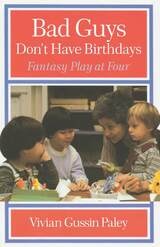
Bad Guys Don't Have Birthdays
Fantasy Play at FourVivian Gussin Paley
University of Chicago Press, 1991
Their play is filled with warnings. They invent chaos in order to show that everything is under control. They portray fear to prove that it can be conquered. No theme is too large or too small for their intense scrutiny. Fantasy play is their ever dependable pathway to knowledge and certainty.
" It . . . takes a special teacher to value the young child's communications sufficiently, enter into a meaningful dialogue with the youngster, and thereby stimulate more productivity without overwhelming the child with her own ideas. Vivian Paley is such a teacher."—Maria W. Piers, in the American Journal of Education
"[Mrs. Paley's books] should be required reading wherever children are growing. Mrs. Paley does not presume to understand preschool children, or to theorize. Her strength lies equally in knowing that she does not know and in trying to learn. When she cannot help children—because she can neither anticipate nor follow their thinking—she strives not to hinder them. She avoids the arrogance of adult to small child; of teacher to student; or writer to reader."—Penelope Leach, author of Your Baby & Child in the New York Times Book Review
"[Paley's] stories and interpretation argue for a new type of early childhood education . . . a form of teaching that builds upon the considerable knowledge children already have and grapple with daily in fantasy play."—Alex Raskin, Los Angeles Times Book Review
"Through the 'intuitive language' of fantasy play, Paley believes, children express their deepest concerns. They act out different roles and invent imaginative scenarios to better understand the real world. Fantasy play helps them cope with uncomfortable feelings. . . . In fantasy, any device may be used to draw safe boundaries."—Ruth J. Moss, Psychology Today
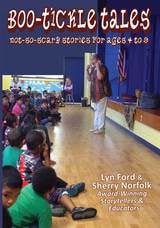
Boo-Tickle Tales
Not-So-Scary Stories for Ages 4-9Lynette Ford & Sherry Norfolk
Parkhurst Brothers, Inc., 2016
The attraction of scary stories begins very early in childhood, but the fortitude to be truly scared comes later. So where are the scary stories for young children? Educators and storytellers, Ford and Norfolk deliver a silly and gently spooky collection of jumps, laughs, interactive moments, and mostly happy endings to satisfy the curious-for-creepy Pre-K through Grade 4 set. Their weirdly funny and gently scary collection of adapted folktales, original stories, and verses will delight those who enjoy being surprised more than being scared.
This book is for:
Parents, grandparents, and other mentors who work with children developmentally aged 4 to 9
Educators, librarians and others serving young listeners, who like silly and creepy stories, but may not like very scary material
Audiences ages 4-9, who like creepy but not-too-scary stories.
Twelve pen-and-ink drawings based on folktale motifs complement the fanciful tone of the book.
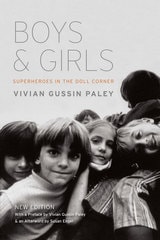
Boys and Girls
Superheroes in the Doll CornerVivian Gussin Paley
University of Chicago Press, 2014
For more than forty years, Boys and Girls has a classic account of the little-known world that young children create together when they play. Vivian Gussin Paley takes readers inside a kindergarten classroom to show them in detail how boys and girls play—and how, by playing and fantasizing in different ways, they work through complicated notions of gender roles and identity. The children’s own conversations, stories, playacting, and scuffles are interwoven with Paley’s observations and accounts of her vain attempts to alter their stereotyped play. In the decades since the book's original publication, play in kindergarten and early years of school has lost ground to structured teaching and even testing, which makes Paley's book, updated for a new era, more important than ever. To teach kids successfully, we must make space for play.
Children as Social Butterflies
Navigating Belonging in a Diverse Swiss KindergartenUrsina Jaeger
Rutgers University Press, 2025
This book is also freely available online as an open-access digital edition, published with the support of the Swiss National Science Foundation.
Cradle to Kindergarten
A New Plan to Combat InequalityAjay Chaudry
Russell Sage Foundation, 2017
The U.S. government invests less in children under the age of five than do most other developed nations. Most working families must seek private childcare, which means that children from low-income households, who would benefit most from high-quality early education, are the least likely to attend them. Existing policies, such as pre-kindergarten in some states are only partial solutions. To address these deficiencies, the authors propose to overhaul the early care system, beginning with a federal paid parental leave policy that provides both mothers and fathers with time and financial support after the birth of a child. They also advocate increased public benefits, including an expansion of the child care tax credit, and a new child care assurance program that subsidizes the cost of early care for low- and moderate-income families. They also propose that universal, high-quality early education in the states should start by age three, and a reform of the Head Start program that would include more intensive services for families living in areas of concentrated poverty and experiencing multiple adversities from the earliest point in these most disadvantaged children’s lives. They conclude with an implementation plan and contend that these reforms are attainable within a ten-year timeline.
Reducing educational and economic inequalities requires that all children have robust opportunities to learn, fully develop their capacities, and have a fair shot at success. Cradle to Kindergarten presents a blueprint for fulfilling this promise by expanding access to educational and financial resources at a critical stage of child development.
Cradle to Kindergarten
A New Plan to Combat InequalityAjay Chaudry
Russell Sage Foundation, 2021
The U.S. government invests less in children under the age of five than do most other developed nations. Most working families must seek private child care, but high-quality child care options are expensive relative to the means of most families. This means that children from lower-income households, who would benefit most from high-quality early education, are the least likely to attend them. Existing policies, such as pre-kindergarten in some states, are only partial solutions, and what exists varies tremendously in terms of access and quality.
To address these deficiencies, the authors propose to overhaul the early care and education system, beginning with a federal paid parental leave policy that provides both mothers and fathers with time and financial support after the birth of a child. They also advance an expansion of the child care tax credit, and a new child care assurance program that provides grant assistance towards the cost of high-quality early care for low- and moderate-income families. Their plan establishes universal, high-quality early education in the states starting by age three, and a reform of the Head Start program that would include more intensive services for families living in areas of concentrated poverty and experiencing multiple adversities from the earliest point in these most disadvantaged children’s lives. They conclude with an implementation plan and contend that these reforms are attainable well within a ten-year timeline.
Reducing educational and economic inequalities requires that all children have robust opportunities to learn and fully develop their capacities and have a fair shot at success. Cradle to Kindergarten presents a blueprint for fulfilling this promise by expanding access to educational and financial resources at a critical stage of child development.

Deaf Children in China
Alison Callaway
Gallaudet University Press, 1999

Developmental Programming for Infants and Young Children
Volume 1. Assessment and ApplicationD. Sue Schafer and Martha S. Moersch, Editors
University of Michigan Press, 1981
Developmental Programming for Infants and Young Children: Volume 1 provides detailed instructions for the use of Volume 2: Early Intervention Developmental Profile, including administration and evaluation techniques, scoring and interpretation of results, validity and reliability of findings, and complete item descriptions. To be used with children functioning in the 0-to-36-month developmental age range. Volume 1 includes the scoring sheet (Volume 2).
Developmental Programming for Infants and Young Children has proven to be an invaluable tool for teachers, therapists, and other professionals who assess and facilitate the development of children functioning primarily in the 0-to-60 month range. The authors address six areas of development: perceptual/fine motor, cognition, language, social/emotional, self-care, and gross motor. Volumes 1, 2, and 3 are designed for use with children functioning in the 0-to-36-month developmental age range, while Volumes 4 and 5 extend assessment and programming guidelines to 5-year (preschool) levels.
Carefully designed and tested by the University of Michigan's Institute for the Study of Mental Retardation and Related Disabilities, all volumes bridge the gap between assessment and program implementation.
Developmental Programming for Infants and Young Children
Volume 3. Stimulation ActivitiesD. Sue Schafer and Martha S. Moersch, Editors
University of Michigan Press, 1981
Developmental Programming for Infants and Young Children: Volume 3 provides a reservoir of ideas for carrying out planned program objectives. Each developmental area contains sequenced develop mental behaviors that would be expected in a normal child, with adaptations for specific handicapping conditions noted. This volume describes ways to handle, stimulate, and interact with a young child functioning in the developmental age range 0-to-36 months. It can be used by parents for at-home activities.
This volume is available as a set in combination with Volumes 1 and 2.
Developmental Programming for Infants and Young Children has proven to be an invaluable tool for teachers, therapists, and other professionals who assess and facilitate the development of children functioning primarily in the 0-to-60 month range. The authors address six areas of development: perceptual/fine motor, cognition, language, social/emotional, self-care, and gross motor. Volumes 1, 2, and 3 are designed for use with children functioning in the 0-to-36-month developmental age range, while Volumes 4 and 5 extend assessment and programming guidelines to 5-year (preschool) levels.
Carefully designed and tested by the University of Michigan's Institute for the Study of Mental Retardation and Related Disabilities, all volumes bridge the gap between assessment and program implementation.
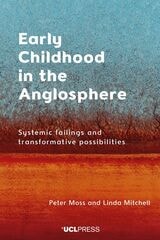
Early Childhood in the Anglosphere
Systemic Failings and Transformative PossibilitiesPeter Moss and Linda Mitchell
University College London, 2024
Written by two leading experts in early childhood education, Early Childhood in the Anglosphere offers a unique comparison of early childhood education and care services and parenting leave across seven high-income Anglophone countries. Peter Moss and Linda Mitchell explore what these systems have in common, including the dominance of childcare services, widespread privatization and marketization, and weak parenting leave. They highlight the substantial failings of these systems and the causes and consequences of these failings. But this book is ultimately about hope, about how these failings might be made good through major changes. In other words, it is about transformation: Why transformation is both necessary and possible at this particular time? What transformation might look like? And how it might happen? Part of that transformation concerns the need for new policies and structures. Furthermore, it is about how the Anglosphere thinks about early childhood.
The authors call for a turn away from speaking of early childhood services as “childcare,” conceptualizing it in terms of business and marketized commodities. Instead, they should be envisaged as a public good with universal access for children, supported by well-paid, individual entitlements to parenting leave. Using examples from the Anglosphere and beyond, the book argues that a transformation of thinking, policies, and structures is desirable and doable.
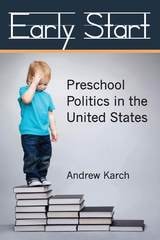
Early Start
Preschool Politics in the United StatesAndrew Karch
University of Michigan Press, 2014
In the United States, preschool education is characterized by the dominance of a variegated private sector and patchy, uncoordinated oversight of the public sector. Tracing the history of the American debate over preschool education, Andrew Karch argues that the current state of decentralization and fragmentation is the consequence of a chain of reactions and counterreactions to policy decisions dating from the late 1960s and early 1970s, when preschool advocates did not achieve their vision for a comprehensive national program but did manage to foster initiatives at both the state and national levels. Over time, beneficiaries of these initiatives and officials with jurisdiction over preschool education have become ardent defenders of the status quo. Today, advocates of greater government involvement must take on a diverse and entrenched set of constituencies resistant to policy change.
In his close analysis of the politics of preschool education, Karch demonstrates how to apply the concepts of policy feedback, critical junctures, and venue shopping to the study of social policy.
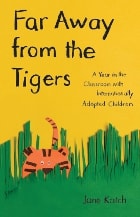
Far Away from the Tigers
A Year in the Classroom with Internationally Adopted ChildrenJane Katch
University of Chicago Press, 2011
Over the past three decades, more than a quarter of a million children have become citizens of the United States through international adoption. Kindergarten teacher Jane Katch recently found herself with three such children in her class: Katya, born in Russia, Jasper, from Cambodia, and Caleb, from Romania. Each child had spent early years in an orphanage, and each had unique educational and emotional needs. How Katch came to recognize and respond to those needs makes up the journey of discovery in this moving and insightful book.
Interspersing vignettes from the classroom and conversations with the children’s parents, Far Away from the Tigers first explores Katch’s misunderstandings and mistakes as she struggles to help the children adjust to school. As Katch learns more about each child’s preadoption past, she gradually realizes that they were deprived of some basic learning experiences and she needs to find ways to fill those gaps. Before Caleb can learn to read or write, he must improve his verbal skills by learning nursery rhymes, stories, and songs. Katya, who came from an overcrowded orphanage, now needs to be the center of attention; before learning how to form real friendships, she first must gain control over more basic functions such as eating and sleeping. And the youngest, Jasper, needs steady encouragement to play with classmates instead of sitting alone practicing his handwriting.
Slowly, through trial and error and by drawing on the deep understanding and intense commitment of the children’s parents, Katch discovers the importance—and joy—of allowing each child time to develop in his or her own way. Beautifully told, wise, and candid, Far Away from the Tigers is a gift for parents, teachers, and anyone who cares for children growing up in a new home.
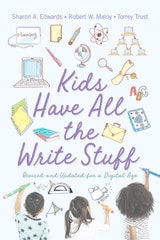
Kids Have All the Write Stuff
Revised and Updated for a Digital AgeRobert W. Maloy
University of Massachusetts Press, 2019
You'll discover:
· how to implement writing as a part of daily life with family and friends;
· processes and invitations fit for young writers;
· strategies for connecting writing to math and coding;
· writing materials and technologies; and
· creative and practical writing ideas, from fiction, nonfiction, and videos to blogs and emails.
In order to connect writing to today's digital revolution, veteran educators Sharon A. Edwards, Robert W. Maloy, and Torrey Trust reveal how digital tools can inspire children to write, and a helpful companion website brings together a range of resources and technologies. This essential book offers enjoyment and inspiration to young writers!
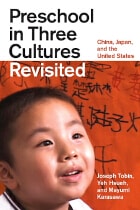
Preschool in Three Cultures Revisited
China, Japan, and the United StatesJoseph Tobin, Yeh Hsueh, and Mayumi Karasawa
University of Chicago Press, 2009
Published twenty years ago, the original Preschool in Three Cultures was a landmark in the study of education: a profoundly enlightening exploration of the different ways preschoolers are taught in China, Japan, and the United States. Here, lead author Joseph Tobin—along with new collaborators Yeh Hsueh and Mayumi Karasawa—revisits his original research to discover how two decades of globalization and sweeping social transformation have affected the way these three cultures educate and care for their youngest pupils. Putting their subjects’ responses into historical perspective, Tobin, Hsueh, and Karasawa analyze the pressures put on schools to evolve and to stay the same, discuss how the teachers adapt to these demands, and examine the patterns and processes of continuity and change in each country.
Featuring nearly one hundred stills from the videotapes, Preschool in Three Cultures Revisited artfully and insightfully illustrates the surprising, illuminating, and at times entertaining experiences of four-year-olds—and their teachers—on both sides of the Pacific.
RSF
The Russell Sage Foundation Journal of the Social Sciences: The Fiftieth Anniversary of the Kerner Commission ReportSusan T. Gooden
Russell Sage Foundation, 2018
Articles in the issue examine the extent to which the recommendations in the Kerner Report contributed to policy changes and improvements in the social and economic well-being of urban residents . In their introduction, Gooden and Myers analyze changes in socioeconomic inequality between whites and blacks over the last five decades. They find that while the black poverty rate has declined and black educational attainment has increased, disparities still remain. Additionally, the income gap and disparities in unemployment between blacks and whites remain virtually unchanged. Rick Loessberg and John Koskinen similarly note the persistence of these disparities, but also show that some of the Kerner Report’s recommendations were adopted at local levels and have provided the foundation for increased racial diversity in media, law enforcement reforms, and public housing desegregation.
Other contributors study the urban areas that were sites of the riots. Reynolds Farley shows that in Detroit, residential segregation has declined and interracial marriage has increased over the last fifty years. However, on key economic measures such as income and wealth, African Americans have fallen even further behind whites than they were in 1967 due to dramatic changes in Detroit’s labor market. In their study of wealth inequality in Los Angeles, Melany De La Cruz-Viesca and coauthors show that much of the wealth gap between blacks and whites is due to disparities in home ownership, a subject neglected in the Kerner Report. Marcus Casey and Bradley Hardy study the evolution of African American neighborhoods since the Kerner Report and find that neighborhoods directly affected by riots in the 1960s still remain among the most economically disadvantaged today.
The Kerner Report endures as a classic touchstone in the nation’s search for a path toward equality. Together, the articles in this special issue demonstrate the long-term influence of the report and show where further progress is needed to close the racial divide.
Segregation by Experience
Agency, Racism, and Learning in the Early GradesJennifer Keys Adair and Kiyomi Sánchez-Suzuki Colegrove
University of Chicago Press, 2021
Early childhood can be a time of rich discovery, a period when educators have an opportunity to harness their students’ fascination to create unique learning opportunities. Some teachers engage with their students’ ideas in ways that make learning collaborative--but not all students have access to these kinds of learning environments.
In Segregation by Experience, the authors filmed and studied a a first-grade classroom led by a Black immigrant teacher who encouraged her diverse group of students to exercise their agency. When the researchers showed the film to other schools, everyone struggled. Educators admired the teacher but didn’t think her practices would work with their own Black and brown students. Parents of color—many of them immigrants—liked many of the practices, but worried that they would compromise their children. And the young children who viewed the film thought that the kids in the film were terrible, loud, and badly behaved; they told the authors that learning was supposed to be quiet, still, and obedient. In Segregation by Experience Jennifer Keys Adair and Kiyomi Sánchez-Suzuki Colegrove show us just how much our expectations of children of color affect what and how they learn at school, and they ask us to consider which children get to have sophisticated, dynamic learning experiences at school and which children are denied such experiences because of our continued racist assumptions about them.
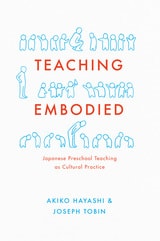
Teaching Embodied
Cultural Practice in Japanese PreschoolsAkiko Hayashi and Joseph Tobin
University of Chicago Press, 2015
Akiko Hayashi and Joseph Tobin embed themselves in the classrooms of three different teachers at three different schools to examine how teachers act, think, and talk. Drawing on extended interviews, their own real-time observations, and hours of video footage, they focus on how teachers embody their lessons: how they use their hands to gesture, comfort, or discipline; how they direct their posture, gaze, or physical location to indicate degrees of attention; and how they use the tone of their voice to communicate empathy, frustration, disapproval, or enthusiasm. Comparing teachers across schools and over time, they offer an illuminating analysis of the gestures that comprise a total body language, something that, while hardly ever explicitly discussed, the teachers all share to a remarkable degree. Showcasing the tremendous importance of—and dearth of attention to—this body language, they offer a powerful new inroad into educational study and practice, a deeper understanding of how teaching actually works, no matter what culture or country it is being practiced in.

The Boy on the Beach
Building Community through PlayVivian Gussin Paley
University of Chicago Press, 2010
Four-year-old Eli plays alone at the shore, inventing dramas out of sand and water. He is Builder, Fireman, Protector, and Scout, overcoming waves and conquering monsters. Enter Marianne and doll, Mother and Baby, eager to redefine Eli as a good father and homesteader. Their separate visions intertwine in a search for a common ground on which howling wolves and butterfly sisters can learn to understand and need one another.
What can the richly imagined, impressively adaptable fantasy world of these children tell us about childhood, development, education, and even life itself? For fifty years, teacher and writer Vivian Gussin Paley has been exploring the imagery, language, and lore of young children, asking the questions they ask of themselves.
In The Boy on the Beach she continues to do so, going deeper into the mystery of play as she follows Eli and Marianne through the kindergarten year, finding more answers and more questions. How does their teacher, Mrs. Olson, manage to honor and utilize the genius of play to create an all-inclusive community in which boys and girls like each other and listen to each other’s stories? Why is Paley’s fellow teacher Yu-ching in Taiwan certain that her children pretend to be kittens in order to become necessary to the group? And why do teachers in London see their childrens’ role-playing as the natural end to loneliness in the school community?
Rich with the words of children and teachers themselves, The Boy on the Beach is vintage Paley, a wise and provocative appreciation of the importance of play and enduring curiosity about the nature of childhood and the imagination.
The Classrooms All Young Children Need
Lessons in Teaching from Vivian PaleyPatricia M. Cooper
University of Chicago Press, 2009
Teacher and author Vivian Paley is highly regarded by parents, educators, and other professionals for her original insights into such seemingly everyday issues as play, story, gender, and how young children think. In The Classrooms All Young Children Need, Patricia M. Cooper takes a synoptic view of Paley’s many books and articles, charting the evolution of Paley’s thinking while revealing the seminal characteristics of her teaching philosophy. This careful analysis leads Cooper to identify a pedagogical model organized around two complementary principles: a curriculum that promotes play and imagination, and the idea of classrooms as fair places where young children of every color, ability, and disposition are welcome.
With timely attention paid to debates about the reduction in time for play in the early childhood classroom, the role of race in education, and No Child Left Behind, The Classrooms All Young Children Need will be embraced by anyone tasked with teaching our youngest pupils.
The Good-bye Window
A Year in the Life of a Day-Care CenterHarriet Brown
University of Wisconsin Press, 1998
Have you ever wondered what really goes on at your child’s day-care center after you say good-bye? Harriet Brown did. To satisfy her curiosity, she spent an entire year observing Red Caboose, a center in Madison, Wisconsin. This engaging and thought-provoking book is the story of that year.
In her beautifully written personal account, journalist and mother Brown takes us behind the scenes at a day-care center that works. At Red Caboose, one of the oldest independent centers in the country, we meet teachers who have worked with young children for more than twenty years. We watch the child-care union and parents struggle to negotiate a contract without ripping apart the fabric of trust and love that holds the Red Caboose community together.
We look at the center’s finances, to see what keeps Red Caboose going at a time when other good centers are disappearing. Best of all, we get to know the children, families, and teachers of Red Caboose—their struggles, their sorrows, their triumphs.
Started twenty-five years ago by a group of idealistic parents, the center has not only survived but thrived through some pretty tough times. In the world of day care, Red Caboose is a special place, a model for what child care in this country could and should be: not just babysitting, not just a service to working parents, but a benefit for children, families, teachers, and the community at large.
Brown sets her rich and engaging stories in the greater political and social context of our time. Why is so much child care bad? Why should working Americans worry about the link between welfare reform and child care? What can we learn from the history of child care?
This book is a must-read for parents, educators, and anyone who enjoys first-rate writing and dead-on insight into the lives of our youngest children and those who care for them.
“[Brown’s] writing is beautiful and her scholarship sound. Students considering day-care careers, day-care professionals, and concerned parents will gain insight by reading this provocative book, as will anyone who cares about the future of young children in this country.”—Choice
“I admire enormously the ambition of this book—its eagle-eyed witness and engrossing detail, plus the social importance of the project. I wish there were in the world more books like it.”—Lorrie Moore, author of Who Will Run the Frog Hospital?
“The Good-bye Window is a fascinating peek into the secret world of children. With the poignancy of Anne LaMott, and the reportorial grace of Tracy Kidder, Harriet Brown has written a terrific and worthwhile book.”—Meg Wolitzer, author of This Is Your Life
“Harriet Brown’s well-told story of the Red Caboose child-care center should be read by teachers and parents, but also by every legislator and politician in the land. Only a writer as good as Ms. Brown could display the dramatic complexities of a school community in which the youngest members enter crawling and emerge a few years later as articulate, empathetic, and well-socialized individuals, ready for the ‘real world.’”—Vivian Gussin Paley, author of The Boy Who Would Be a Helicopter
The High-Performing Preschool
Story Acting in Head Start ClassroomsGillian Dowley McNamee
University of Chicago Press, 2015
McNamee outlines how story acting cultivates children’s oral and written language skills. She shows how it creates a crucial opportunity for teachers to guide children inside the interior logic and premises of an idea, and how it fosters the creation of a literary community. Starting with Vygotsky and Paley, McNamee paints a detailed portrait of high-quality preschool teaching, showing how educators can deliver on the promise of Head Start and provide a setting for all young children to become articulate, thoughtful, and literate learners.
Transforming Early Childhood in England
Towards a Democratic EducationEdited by Claire Cameron and Peter Moss
University College London, 2020
Transforming Early Childhood in England offers a critical analysis of the current system and proposes change based on a universal right to education. The book calls for revisions built on democratic principles, where all learning by all children is visible and recognized, educators are trusted and respected, and outcomes-driven targets are replaced. Combining criticism and hope, and drawing on inspiring research, the book is essential reading for students, educators, practitioners, parents, academics, and policymakers.
Visual Encounters in the Study of Rural Childhoods
Mandrona, April R.
Rutgers University Press, 2018