Results by title
4 books match the query 'Early printed books'
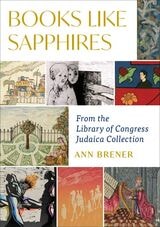
Books Like Sapphires
From the Library of Congress Judaica CollectionAnn Brener
Brandeis University Press, 2024
Illustrated highlights from the Judaica Collection of the Library of Congress.
Books Like Sapphires showcases a wide range of Hebraic treasures from the storied collection at the Library of Congress, many of them for the first time. Tracing the history of Judaica collecting in the twentieth-century United States, the book illuminates varied works, telling their stories alongside vibrant color images. These include a unique manuscript about a betrothal scandal in Renaissance Crete, an illustrated Esther Scroll, a poem from 1477 celebrating the new technology of printing, amusing rhymed couplets in sixteenth-century Padua, and the Washington Haggadah. This book also tells the story of the patrons and collectors, first among them Jacob Schiff, as well as archivists and curators, who made the storied Judaica archive at the Library of Congress the precious resource that it is today.
Books Like Sapphires showcases a wide range of Hebraic treasures from the storied collection at the Library of Congress, many of them for the first time. Tracing the history of Judaica collecting in the twentieth-century United States, the book illuminates varied works, telling their stories alongside vibrant color images. These include a unique manuscript about a betrothal scandal in Renaissance Crete, an illustrated Esther Scroll, a poem from 1477 celebrating the new technology of printing, amusing rhymed couplets in sixteenth-century Padua, and the Washington Haggadah. This book also tells the story of the patrons and collectors, first among them Jacob Schiff, as well as archivists and curators, who made the storied Judaica archive at the Library of Congress the precious resource that it is today.
[more]
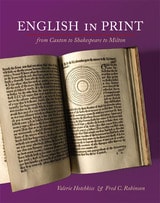
English in Print from Caxton to Shakespeare to Milton
Valerie Hotchkiss and Fred C. Robinson
University of Illinois Press, 2007
English in Print from Caxton to Shakespeare to Milton examines the history of early English books, exploring the concept of putting the English language into print with close study of the texts, the formats, the audiences, and the functions of English books. Lavishly illustrated with more than 130 full-color images of stunning rare books, this volume investigates a full range of issues regarding the dissemination of English language and culture through printed works, including the standardization of typography, grammar, and spelling; the appearance of popular literature; and the development of school grammars and dictionaries. Valerie Hotchkiss and Fred C. Robinson provide engaging descriptions of more than a hundred early English books drawn from the Rare Book and Manuscript Library at the University of Illinois, Urbana-Champaign, and the Elizabethan Club of Yale University. The study nearly mirrors the chronological coverage of Pollard and Redgrave's famous Short-Title Catalogue (1475-1640), beginning with William Caxton, England's first printer, and ending with John Milton, the English language's most eloquent defender of the freedom of the press in his Areopagitica of 1644. William Shakespeare, neither a printer nor a writer much concerned with publishing his own plays, nonetheless deserves his central place in this study because Shakespeare imprints, and Renaissance drama in general, provide a fascinating window on the world of English printing in the period between Caxton and Milton.
[more]
Managing Readers
Printed Marginalia in English Renaissance BooksWilliam W. E. Slights
University of Michigan Press, 2001
Managing Readers explores the fascinating interchange between text and margin, authorship and readership in early modern England. Printed marginalia did more than any other material feature of book production in the period between 1540 and 1700 to shape the experience of reading. William W. E. Slights considers overlooked evidence of the ways that early modern readers were instructed to process information, to contest opinions, and to make themselves into fully responsive consumers of texts.
The recent revolution in the protocols of reading brought on by computer technology has forced questions about the nature of book-based knowledge in our global culture. Managing Readers traces changes in the protocols of annotation and directed reading--from medieval religious manuscripts and Renaissance handbooks for explorers, rhetoricians, and politicians to the elegant clear-text editions of the Enlightenment and the hypertexts of our own time. Developing such concepts as textual authority, generic difference, and reader-response, Slights demonstrates that printed marginalia were used to confirm the authority of the text and to undermine it, to supplement "dark" passages, and to colonize strategic hermeneutic spaces. The book contains twenty-two illustrations of pages from rare-book archives that make immediately clear how distinctive the management of the reading experience was during the first century-and-a-half of printing in England.
William W. E. Slights is Professor of English, University of Saskatchewan. He is also author of Ben Jonson and the Art of Secrecy.
[more]
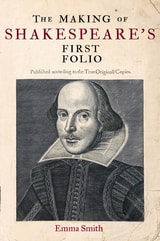
The Making of Shakespeare's First Folio
Emma Smith
Bodleian Library Publishing, 2015
Shakespeare is synonymous with English literature. Well-loved the world over, his work endures for its ability to speak powerfully to the follies and foibles of human nature. We endlessly debate not only the finer points of each of his plays and sonnets but also the identity of the Bard himself. Yet no fanfare surrounded the initial publication of Shakespeare’s First Folio—no queue of eager readers, no launch to the top of the best seller list. It wasn’t until four hundred years after Shakespeare’s death that the book would be the subject of a national book tour.
The Making of Shakespeare’s First Folio offers the first comprehensive biography of the earliest collected edition of Shakespeare’s plays. In November 1623, the book arrived in the bookshop of the London publisher Edward Blount at the Black Bear. Long in the making, Master William Shakespeare’s Comedies, Histories, and Tragedies—as the First Folio was then known—appeared seven years after Shakespeare’s death. Nearly one thousand pages in length, the collection comprised thirty-six plays, half of which had never been previously published. Emma Smith tells the story of the First Folio’s origins, locating it within the social and political context of Jacobean London and bringing in the latest scholarship on the seventeenth-century book trade.
Extensively illustrated, The Making of Shakespeare’s First Folio is a landmark addition to the copious literature on Shakespeare. It will shed much-needed light on the birth of the First Folio—of which fewer than 250 copies remain—and the birth of Shakespeare’s towering reputation.
[more]