Results by title
15 books match the query 'East South Central (AL, KY, MS, TN)'

Alabama Canoe Rides and Float Trips
John Foshee
University of Alabama Press, 1986
A detailed guide to 102 canoe trips on the Cahaba River and 40 other creeks and rivers within the state.
John H. Foshee’s popular and informative Alabama Canoe Rides and Float Trips has been a favorite of canoeing enthusiasts since 1975, providing a detailed guide to 102 canoe trips on the Cahaba River and 40 other creeks and rivers within the state. The trips highlighted in the book range from 3½ to 14 miles in length, with difficulty factors varying from leisurely float trips to Class 4 rapids.
This handy guide will assist beginning and expert canoeists in the selection of and preparation for a variety of float experiences. The author gives suggestions for river safety and makes recommendations for equipment. In addition, he points out major danger areas and obstacles that may be encountered and includes information on river access and use of topographical maps. An appendix contains brief descriptions of the rides, including their put-ins and take-outs, and follows the general format of the individual trip descriptions.
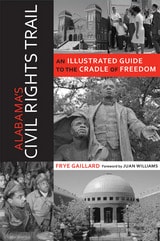
Alabama's Civil Rights Trail
An Illustrated Guide to the Cradle of FreedomFrye Gaillard
University of Alabama Press, 2009
Alabama’s great civil rights events in a compact and accessible narrative, paired with a practical guide to Alabama’s preserved civil rights sites and monuments
No other state has embraced and preserved its civil rights history more thoroughly than Alabama. Nor is there a place where that history is richer. Alabama’s Civil Rights Trail tells of Alabama’s great civil rights events, as well as its lesser-known moments, in a compact and accessible narrative, paired with a practical guide to Alabama’s preserved civil rights sites and monuments.
In this history of Alabama’s civil rights movement, Cradle of Freedom (University of Alabama Press, 2004), Frye Gaillard contends that Alabama played the lead role in a historic movement that made all citizens of the nation, black and white, more free. This book, geared toward the casual traveler and the serious student alike, showcases in a vividly illustrated and compelling manner, valuable and rich details. It provides a user-friendly, graphic tool for the growing number of travelers, students, and civil rights pilgrims who visit the state annually.
The story of the civil rights movement in Alabama is told city by city, region by region, and town by town, with entries on Montgomery, Birmingham, Selma, Tuscaloosa, Tuskegee, and Mobile, as well as chapters on the Black Belt and the Alabama hill country. Smaller but important locales such as Greensboro, Monroeville, and Scottsboro are included, as are more obscure sites like Hale County’s Safe House Black History Museum and the birthplace of the Black Panther Party in Lowndes County.

Back Home
Journeys through MobileRoy Hoffman
University of Alabama Press, 2007
After twenty years in New York City, a prize-winning writer takes a "long look back" at his hometown of Mobile, Alabama.
In Back Home: Journeys through Mobile, Roy Hoffman tells stories—through essays, feature articles, and memoir—of one of the South's oldest and most colorful port cities. Many of the pieces here grew out of Hoffman's work as Writer-in-Residence for his hometown newspaper, the Mobile Register, a position he took after working in New York City for twenty years as a journalist, fiction writer, book critic, teacher, and speech writer. Other pieces were first published in the New York Times, Southern Living, Preservation, and other publications. Together, this collection comprises a long, second look at the Mobile of Hoffman's childhood and the city it has since become.
Like a photo album, Back Home presents close-up portraits of everyday places and ordinary people. There are meditations on downtown Mobile, where Hoffman's grandparents arrived as immigrants a century ago; the waterfront where longshoremen labor and shrimpers work their nets; the back roads leading to obscure but intriguing destinations. Hoffman records local people telling their own tales of race relations, sports, agriculture, and Mardi Gras celebrations. Fishermen, baseball players, bakers, authors, political figures--a strikingly diverse population walks across the stage of Back Home.
Throughout, Hoffman is concerned with stories and their enduring nature. As he writes, "When buildings are leveled, when land is developed, when money is spent, when our loved ones pass on, when we take our places a little farther back every year on the historical time-line, what we have still are stories."
Greetings from New Nashville
How a Sleepy Southern Town Became "It" CitySteve Haruch
Vanderbilt University Press, 2020
In that span of two decades, the boundaries of Nashville did not change. But something did. Or rather, many somethings changed, and kept changing, until many who lived in Nashville began to feel they no longer recognized their own city. And some began to feel it wasn't their own city at all anymore as they were pushed to its fringes by rising housing costs. Between 1998 and 2018, the population of Nashville grew by 150,000. On some level, Nashville has always packaged itself for consumption, but something clicked and suddenly everyone wanted a taste. But why Nashville? Why now? What made all this change possible?
This book is an attempt to understand those transformations, or, if not to understand them, exactly, then to at least grapple with the question: What happened?
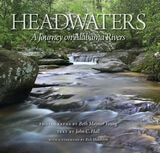
Headwaters
A Journey on Alabama RiversJohn C. Hall and Beth Maynor Young
University of Alabama Press, 2009
A breathtaking portrait of Alabama rivers.
From their primal seepages in the Appalachian highlands or along the broad Chunnenuggee Hills, Alabama’s rivers carve through the rocky uplands and down the Fall Line rapids, then ease across the coastal plain to their eventual confluence with the Gulf of Mexico.
Beth Maynor Young’s 155 full-color photographs constitute art through a lens; the colors, the light, and the angles all converge for a tender praise of her subject. Her stunning visuals are supported by tantalizing captions and introductory text from John C. Hall, a master field trip leader. Together, they tell a proud story of the native beauty and complexity of these Alabama watercourses that shepherd fully 20% of the nation’s fresh water to sea.
The intimate close-up of verdant mosses or pebbled beaches pulls one into their space just as surely as does a sweeping scene of a watershed valley or a sparkling sunset over water. We all become eager listeners and observers on this guided “paddle to the Gulf,” drinking in the peace, delight, and beauty offered by the experience. At the end, we know we won’t be the same as before beginning the journey.
In addition to being a celebration of their richness, Headwaters serves as a call to greater stewardship of these riverine resources. Conservation sidebars describe the current efforts in this direction and encourage further study and protection. This book tells us, in glorious color and instructive word, why we’ll always treasure these wonderful rivers.

Motorcycling Alabama
50 Ride Loops through the Heart of DixieDavid Haynes
University of Alabama Press, 2011
A much-needed guidebook for one of the most beautiful states to explore on two wheels.
David Haynes offers fifty ride loops of between 75 and 150 miles in length throughout every region of the state. The start and stop points for each ride are identical and easy to locate. This handy guide, which is designed to fit in a tank bag, features both streetbike and dual-sport rides. Also included are detailed, color-coded maps of the routes and turn-by-turn directions. Stunning full-color photographs accompany each ride description, highlighting scenes and points of interest along the way. There are introductory chapters on motorcycle safety, gear, and the use of global positioning devices, as well as pointers on motorcycle camping.
Motorcycle touring is one of the fastest-growing outdoor recreational pursuits in the country. For both the in-state and out-of-state motorcycle enthusiast, Motorcycling Alabama is a valuable and complete guide to a state rich in diverse types of scenery and with many unsung treasures yet to be discovered.
Published in cooperation with the Barber Vintage Motorsports Museum, Birmingham.
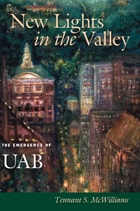
New Lights in the Valley
The Emergence of UABTennant S. McWilliams
University of Alabama Press, 2007
A scholarly narrative of UAB from its nascent beginnings through the mid 1990s.
While the economy and culture of the post—World War II South changed from an era of material capital (e.g., cotton and iron ore) to a period of social capital (intellectual development and networked approaches to social change), one of the most important components of urban life, the university, emerged as both a creator and a reflector of such modernization.
This is the case with Birmingham and its youthful institution of higher learning, the University of Alabama at Birmingham. From its early days as a struggling offshoot of the capstone campus in Tuscaloosa, UAB’s journey to its current status as a major university has been a bumpy but interesting one. Tennant McWilliams, a longtime UAB history professor, explores the whole range of historical considerations, including UAB’s similarities and connections to trans-Atlantic civic universities; the irony of the shift from Big Steel to Big Medicine in Birmingham; the visionary administrations of Joseph F. Volker and others; and the evolving decision to make non-medical life at UAB less of a commuter experience and more of a traditional campus experience.
McWilliams does not palliate the missteps and disputes that have, from time to time, impeded the institution’s progress. But he explains why, despite various hurdles and distractions, UAB has risen to be Alabama’s largest employer and can rightly boast that its complex of health care services, especially organ transplantation and neuroscience, as well as such fields as philosophy and psychology, are among the best in the nation.

Pilgrimage to Dollywood
A Country Music Road Trip through TennesseeHelen Morales
University of Chicago Press, 2014
In Pilgrimage to Dollywood, Morales sets out to discover Parton’s Tennessee. Her travels begin at the top celebrity pilgrimage site of Elvis Presley’s Graceland, then take her to Loretta Lynn’s ranch in Hurricane Mills; the Country Music Hall of Fame and the Grand Ole Opry in Nashville; to Sevierville, Gatlinburg, and the Great Smoky Mountains National Park; and finally to Pigeon Forge, home of the “Dolly Homecoming Parade,” featuring the star herself as grand marshall. Morales’s adventure allows her to compare the imaginary Tennessee of Parton’s lyrics with the real Tennessee where the singer grew up, looking at essential connections between country music, the land, and a way of life. It’s also a personal pilgrimage for Morales. Accompanied by her partner, Tony, and their nine-year-old daughter, Athena (who respectively prefer Mozart and Miley Cyrus), Morales, a recent transplant from England, seeks to understand America and American values through the celebrity sites and attractions of Tennessee.
This celebration of Dolly and Americana is for anyone with an old country soul who relies on music to help understand the world, and it is guaranteed to make a Dolly Parton fan of anyone who has not yet fallen for her music or charisma.

Place Names in Alabama
Virginia O. Foscue
University of Alabama Press, 1988
Discover the stories, people, and histories behind the names on Alabama's map.
Place Names in Alabama is the first comprehensive and systematic study of the names that define Alabama's geographic landscape. In this indispensable reference work, Virginia O. Foscue examines more than 2,600 place names drawn from across the state, including counties, cities, towns, rivers, lakes, streams, mountains, and other significant geographic features. Each entry provides detailed information on location, historical development, etymology, naming history, and documented sources, creating a rich portrait of the people, cultures, and events that have shaped Alabama over time.
Drawing upon archival records, historical documents, maps, and interviews with local informants, Foscue uncovers the stories behind the names that appear on Alabama's maps. The volume reveals the influence of Native American languages, European settlement, transportation networks, natural features, political leaders, local families, and regional traditions on the state's evolving identity. By tracing how communities and landmarks acquired their names, the book illuminates broader patterns of migration, settlement, economic development, and cultural exchange throughout Alabama's history.
More than a dictionary of place names, this work offers a unique window into Alabama's social and cultural heritage. Readers discover not only the origins of familiar names but also the histories of the individuals and communities that helped build the state. Whether used as a scholarly resource, a genealogical tool, or a source of fascinating historical insights, Place Names in Alabama remains an essential guide to understanding the connections between geography, language, and history in the American South.
Valuable for historians, genealogists, geographers, librarians, educators, students, journalists, and local history enthusiasts, this landmark volume continues to serve as the definitive reference on Alabama's geographic names and the stories they preserve.
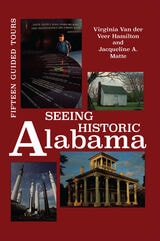
Seeing Historic Alabama
Fifteen Guided ToursVirginia Van der Veer Hamilton
University of Alabama Press, 1996
Revised and updated.
A trusted guide to Alabama's historic treasures and cultural landmarks.
Don’t drive anywhere in this state without taking along this useful, handy guide. Originally published in 1982, Professor Hamilton’s much acclaimed Seeing Historic Alabama: Fifteen Guided Tours was enthusiastically received around the state. Reviewers throughout Alabama praised her work, her artist’s eye for landscape and architecture, as well as her “historian’s devotion to fact and motorist’s appreciation for specific directions.” This praise extended beyond the state lines to publications in the greater Southeast, which recommend the volume to readers planning travel to or through Alabama.
Hamilton and Matte's thoroughly revised and updated edition of Seeing Historic Alabama introduces readers to the history of Alabama by way of visits to the buildings and sites where historic events took place, from prehistoric time to the present. Its aim is to appeal to a wide range of readers and travelers—natives and residents of Alabama, students of all ages, newcomers to the state, and tourists. This guide offers tours arranged in geographical segments that can be taken in a few hours, in a day trip, or over the course of several days. A handy guide to keep at ready in the glove compartment for easy reference wherever you travel.

Selma
A Bicentennial HistoryAlston Fitts III
University of Alabama Press, 2017
Exploring the people, politics, and events that shaped Selma from 1815 through the twentieth century.
In 1989, Alston Fitts published a brief history of the city of Selma, Alabama, from its founding through the aftermath of the civil rights movement. Selma: A Bicentennial History is a greatly revised and expanded version of Fitts’s history of the city, replete with a wealth of new, never-before-published illustrations, which further develops a number of significant events, corrects critical errors, and, most importantly, incorporates many new stories and materials that document Selma’s establishment, growth, and development.
Comprehensive, thoroughly researched, and nonpartisan, Fitts’s pleasantly accessible history addresses every major issue, movement, and trend from the city’s settlement in 1815 to the end of the twentieth century. Its commerce, institutions, governance, as well as its evolving racial, religious, and class composition are all treated with candor and depth. Selma’s transformative role within the state and the nation is fully explored, and most notable is a nuanced and complex discussion of race relations from the rise of the civil rights era to modern times.
Historians, scholars, and Alabamians will find great use for this updated and fully developed exploration of Selma’s rich, complex, and significant history.
Sketches of Alabama
Mary Duffee, edited by Jane Porter Nabers and Virginia Pounds Brown
University of Alabama Press, 1970
Rediscover the spirit, stories, and landscapes of Alabama through a timeless collection of observations and historical reflections.
In Sketches of Alabama, Mary Duffee offers a richly detailed portrait of a state shaped by diverse communities, enduring traditions, and a deeply rooted cultural identity. Through a series of engaging sketches, Duffee captures the essence of Alabama’s towns, people, and everyday life, preserving moments that might otherwise be lost to time.
Blending historical insight with narrative charm, this collection explores the character of Alabama from multiple perspectives—rural and urban, past and present. Readers encounter vivid depictions of local customs, notable figures, and the evolving social fabric of the region. Duffee’s work not only chronicles the state’s development but also reflects the broader story of the American South, illuminating its complexities, resilience, and sense of place.
This collection contains typescripts of some of Mary Gordon Duffee's Iron Age columns "Sketches of Alabama," manuscripts of seven of Duffee's poems, a typed biographical sketch of Duffee, undated, and Duffee's obituary from the Birmingham Age-Herald. Ideal for students, historians, and general readers alike, Sketches of Alabama serves as both a literary work and a cultural record. Its accessible style makes it an excellent introduction to Alabama’s heritage, while its thoughtful observations reward those seeking deeper understanding of Southern history and identity.
Whether you are drawn to regional storytelling, historical narrative, or the rich traditions of the Deep South, this work offers a compelling journey into Alabama’s past—one sketch at a time.
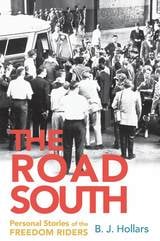
The Road South
Personal Stories of the Freedom RidersB. J. Hollars
University of Alabama Press, 2018
Revisits the inspiring and heroic stories of the Freedom Riders, through their own words.
In May 1961, despite multiple Supreme Court rulings, segregation remained alive and well within the system of interstate travel. All across the American South, interstate buses as well as their travel facilities were divided racially. This blatant disregard for law and morality spurred the Congress of Racial Equality to send thirteen individuals—seven black, six white—on a harrowing bus trip throughout the South as a sign of protest.
These original riders were met with disapproval, arrests and violence along the way, but that did not stop the movement. That summer, more than four hundred Freedom Riders continued their journey—many of them concluding their ride at Mississippi’s notorious Parchman Farm, where they endured further abuses and indignities. As a result of the riders sacrifice, by November of 1961, the Interstate Commerce Commission finally put an end to interstate commerce segregation, and in the process, elevated the riders to become a source of inspiration for other civil rights campaigns such as voter registration rights and school desegregation.
While much has been written on the Freedom Rides, far less has been published about the individual riders. Join award-winning author B. J. Hollars as he sets out on his own journey to meet them, retracing the historic route and learning the stories of as many surviving riders as he could. The Road South: Personal Stories of the Freedom Riders offers an intimate look into the lives and legacies of the riders. Throughout the book these civil rights veterans’ poignant, personal stories offer timely insights into America’s racial past and hopeful future.
Weaving the past with the present, Hollars aims to demystify the legendary journey, while also confronting more modern concerns related to race in America. The Road South is part memoir and part research-based journalism. It transcends the traditional textbook version of this historical journey to highlight the fascinating stories of the many riders—both black and white—who risked their lives to move the country forward.

The Tensaw River
Alabama's Hidden Heritage CorridorMike Bunn
University of Alabama Press, 2025
Where nature meets history—explore Alabama’s hidden river legacy.
The Tensaw River introduces one of the American South’s richest and most fertile natural features. Author Mike Bunn is director of Historic Blakeley State Park, which is nestled in a prominent bend of the majestic Tensaw River. Reading Bunn is like sailing with a knowledgeable captain along the river’s natural and cultural byways as he offers a treasury of stories and facts that illuminate the river’s astonishing flora and fauna and the sweep of human history along the river’s ageless, meandering waterways.
Forming the eastern boundary of the expansive Mobile-Tensaw Delta, the Tensaw has had little industrial development. Left largely undisturbed, the river still flows free and bountiful into the grand estuary of Mobile Bay in ways and along vistas that would be recognizable to Native Americans centuries ago and to pioneers who arrived before Alabama became a state.
Bunn’s unforgettable stories in The Tensaw River trace the construction and occupation of the Bottle Creek site, an important mound complex built by Southeastern Native Americans a millennia ago. Nearby Blakeley is a spectral antebellum ghost town whose lost memories also tease the imagination. During the Civil War, the boom of artillery fire in the battle that sealed the fate of the city of Mobile echoed along the bends in the Tensaw.
Located near popular Gulf Coast travel destinations, the Tensaw’s forty-one-mile-long “Forgotten Cultural Heritage Corridor” is a gateway to the enchanting beauty of—and humankind’s enduring relationship to—the landscape of the American South.
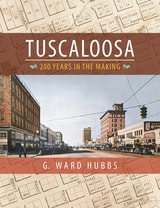
Tuscaloosa
200 Years in the MakingG. Ward Hubbs
University of Alabama Press, 2019
A lavishly illustrated history of this distinctive city’s origins as a settlement on the banks of the Black Warrior River to its development into a thriving nexus of higher education, sports, and culture
In both its subject and its approach, Tuscaloosa: 200 Years in the Making is an account unlike any other of a city unlike any other—storied, inimitable, and thriving. G. Ward Hubbs has written a lively and enlightening bicentennial history of Tuscaloosa that is by turns enthralling, dramatic, disturbing, and uplifting. Far from a traditional chronicle listing one event after another, the narrative focuses instead on six key turning points that dramatically altered the fabric of the city over the past two centuries.
The selection of this frontier village as the state capital gave rise to a building boom, some extraordinary architecture, and the founding of The University of Alabama. The state’s secession in 1861 brought on a devastating war and the burning of the university by Union cavalry; decades of social adjustments followed, ultimately leading to legalized racial segregation. Meanwhile, town boosters set out to lure various industries, but with varying success.
The decision to adopt new inventions, ranging from electricity to telephones to automobiles, revolutionized the daily lives of Tuscaloosans in only a few short decades. Beginning with radio, and followed by the Second World War and television, the formerly isolated townspeople discovered an entirely different world that would culminate in Mercedes-Benz building its first overseas production plant nearby. At the same time, the world would watch as Tuscaloosa became the center of some pivotal moments in the civil rights movement—and great moments in college football as well.
An impressive amount of research is collected in this accessibly written history of the city and its evolution. Tuscaloosa is a versatile history that will be of interest to a general readership, for scholars to use as a starting point for further research, and for city and county school students to better understand their home locale.