Results by title
8 books match the query 'Ecologists'
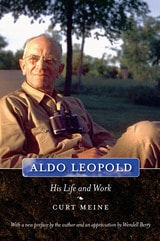
Aldo Leopold
His Life and WorkCurt D. Meine
University of Wisconsin Press, 2010
This biography of Aldo Leopold follows him from his childhood as a precocious naturalist to his profoundly influential role in the development of conservation and modern environmentalism in the United States. This edition includes a new preface by author Curt Meine and an appreciation by acclaimed Kentucky writer and farmer Wendell Berry.
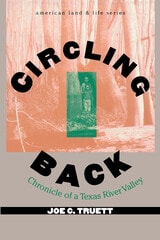
Circling Back
Chronicle of a Texas River ValleyJoe C. Truett
University of Iowa Press, 1996
“There was so much space.” These words epitomize ecologist Joe Truett's boyhood memories of the Angelina River valley in East Texas. Years and miles later, back home for the funeral of his grandfather, Truett began a long meditation on the world Corbett Graham had known and he himself had glimpsed, a now-vanished world where wild hogs and countless other animals rustled through the leaves, cows ate pinewoods grass instead of corn, oaks and hickories and longleaf pines were untouched by the corporate ax, and the river flowed freely. Truett's meditation resulted in this clear-sighted portrait of a place over time, its layers revealed by his love and care and curiosity.Truett celebrates his family's heritage and the unspoiled natural world of the Piney Woods without nostalgia. He recreates an older, simpler, more worthy age, but he knows that we have lost touch with it because we wanted to: he laments the loss but understands it. What makes his prose so moving and so redeeming is this precise combination of honesty and sorrow, overlaid by a quiet passion for both the natural and the human worlds.
Ecologists and Environmental Politics
A History of Contemporary EcologyStephen Bocking
West Virginia University Press, 2017
Bocking tells this history through four case studies: the origins and early research of the Nature Conservancy in Great Britain; the development of ecology at the Oak Ridge National Laboratory in Tennessee; the work of the Hubbard Brook Ecosystem Study in New Hampshire; and research in fisheries ecology at the University of Toronto. By comparing these case studies, Bocking demonstrates how the places of contemporary science—laboratories, landscapes, and funding agencies—and science’s purposes, as expressed through the political roles of expertise and specific managerial and regulatory responsibilities, have shaped contemporary ecology and its application to pressing environmental problems.
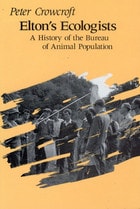
Elton's Ecologists
A History of the Bureau of Animal PopulationPeter Crowcroft
University of Chicago Press, 1991
"[This] is a very good account of the work and personal interactions of a group that played an important part in the development of animal ecology in the period 1930-60."—John Krebs, TREE
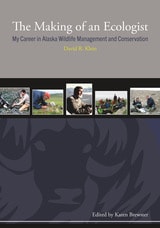
Making of an Ecologist
My Career in Alaska Wildlife Management and ConservationDavid R. Klein
University of Alaska Press, 2019
The first portion of the book is comprised of stories from Klein’s life collected during oral history interviews, while the latter section contains essays written by Klein about philosophical topics of importance to him, such as eco-philosophy, the definition of wilderness, and the morality of hunting.
Many of Klein’s graduate students have gone on to become successful wildlife managers themselves, in Alaska and around the globe. Through The Making of an Ecologist, Klein’s outlook, philosophy, and approach toward sustainability, wildlife management, and conservation can now inspire even more readers to ensure the survival of our fragile planet in an ever-changing global society.
The Ecology of Ecologists
Harnessing Diverse Approaches for a Stronger ScienceJeremy Fox
University of Chicago Press, 2025
Open any ecology textbook, and you will find a heterogeneous mix of material that puzzles many newcomers. How do levels of organization from individual organisms to ecosystems, abstract concepts like food webs and biodiversity, and applied topics, like climate change and conservation, all fit together? New ecological research can be equally puzzling. Ecology journals publish studies using different methods in different study systems to ask different questions and achieve different goals. Is this all really Ecology? Yes, ecologist Jeremy Fox says in this eye-opening book. Ecology contains multitudes, and that is its power. In an essential book for all ecologists, Fox builds on insights developed in his popular blog, Dynamic Ecology, to argue that it is better for a scientific discipline to be messy than monolithic.
Analyzing and accessibly explaining a broad range of scientific literature, Fox shows that ecology grew from disparate sources with profoundly different motivations, methods, and goals. We see the differences in those origins reflected in today’s research, in the pull between those who want to establish ecological laws akin to physical ones and those who see ecology’s value as inherent in its species- or system-specific case studies. Neither group, Fox argues, is doing ecology wrong. Instead, he says, the strength of this science—as in most ecological systems—is diversity. It is good when two ecologists look at similar problems differently. We now need the community to know enough about those different approaches to improve how they work together.
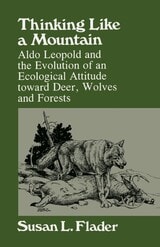
Thinking Like a Mountain
Aldo Leopold and the Evolution of an Ecological Attitude toward Deer, Wolves, and ForestsSusan L. Flader
University of Wisconsin Press, 1994
When initially published more than twenty years ago, Thinking Like a Mountain was the first of a handful of efforts to capture the work and thought of America's most significant environmental thinker, Aldo Leopold. This new edition of Susan Flader's masterful account of Leopold's philosophical journey, including a new preface reviewing recent Leopold scholarship, makes this classic case study available again and brings much-deserved attention to the continuing influence and importance of Leopold today.
Thinking Like a Mountain unfolds with Flader's close analysis of Leopold's essay of the same title, which explores issues of predation by studying the interrelationships between deer, wolves, and forests. Flader shows how his approach to wildlife management and species preservation evolved from his experiences restoring the deer population in the Southwestern United States, his study of the German system of forest and wildlife management, and his efforts to combat the overpopulation of deer in Wisconsin. His own intellectual development parallels the formation of the conservation movement, reflecting his struggle to understand the relationship between the land and its human and animal inhabitants.
Drawing from the entire corpus of Leopold's works, including published and unpublished writing, correspondence, field notes, and journals, Flader places Leopold in his historical context. In addition, a biographical sketch draws on personal interviews with family, friends, and colleagues to illuminate his many roles as scientist, philosopher, citizen, policy maker, and teacher. Flader's insight and profound appreciation of the issues make Thinking Like a Mountain a standard source for readers interested in Leopold scholarship and the development of ecology and conservation in the twentieth century.
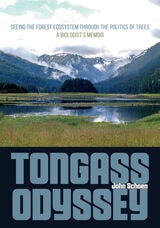
Tongass Odyssey
Seeing the Forest Ecosystem through the Politics of TreesJohn Schoen
University of Alaska Press, 2020