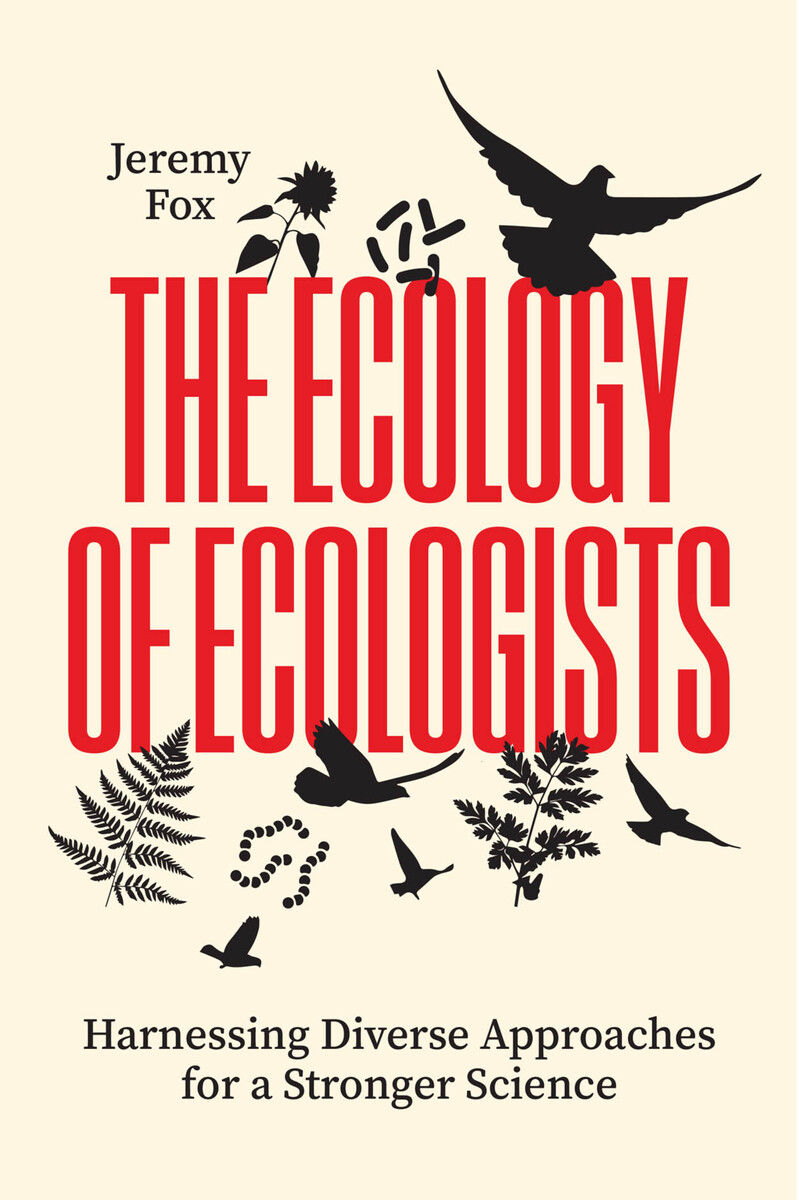
The Ecology of Ecologists: Harnessing Diverse Approaches for a Stronger Science
University of Chicago Press, 2025
Cloth: 978-0-226-84495-4 | Paper: 978-0-226-84494-7 | eISBN: 978-0-226-84496-1 (all)
Library of Congress Classification QH541.F69 2025
Dewey Decimal Classification 577
Cloth: 978-0-226-84495-4 | Paper: 978-0-226-84494-7 | eISBN: 978-0-226-84496-1 (all)
Library of Congress Classification QH541.F69 2025
Dewey Decimal Classification 577
ABOUT THIS BOOK | AUTHOR BIOGRAPHY | REVIEWS | TOC | REQUEST ACCESSIBLE FILE
ABOUT THIS BOOK
A celebration of ecology’s variety—as both subject and research endeavor—and a call for intradisciplinary understanding.
Open any ecology textbook, and you will find a heterogeneous mix of material that puzzles many newcomers. How do levels of organization from individual organisms to ecosystems, abstract concepts like food webs and biodiversity, and applied topics, like climate change and conservation, all fit together? New ecological research can be equally puzzling. Ecology journals publish studies using different methods in different study systems to ask different questions and achieve different goals. Is this all really Ecology? Yes, ecologist Jeremy Fox says in this eye-opening book. Ecology contains multitudes, and that is its power. In an essential book for all ecologists, Fox builds on insights developed in his popular blog, Dynamic Ecology, to argue that it is better for a scientific discipline to be messy than monolithic.
Analyzing and accessibly explaining a broad range of scientific literature, Fox shows that ecology grew from disparate sources with profoundly different motivations, methods, and goals. We see the differences in those origins reflected in today’s research, in the pull between those who want to establish ecological laws akin to physical ones and those who see ecology’s value as inherent in its species- or system-specific case studies. Neither group, Fox argues, is doing ecology wrong. Instead, he says, the strength of this science—as in most ecological systems—is diversity. It is good when two ecologists look at similar problems differently. We now need the community to know enough about those different approaches to improve how they work together.
See other books on: Ecologists | Ecology | Environmental Conservation & Protection | Life Sciences | Philosophy & Social Aspects
See other titles from University of Chicago Press