Results by title
6 books match the query 'Economic Analysis'
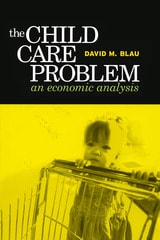
Child Care Problem
An Economic AnalysisDavid M. Blau
Russell Sage Foundation, 2001
The child care system in the United States is widely criticized, yet the underlying structural problems are difficult to pin down. In The Child Care Problem, David M. Blau sets aside the often emotional terms of the debate and applies a rigorous economic analysis to the state of the child care system in this country, arriving at a surprising diagnosis of the root of the problem. Blau approaches child care as a service that is bought and sold in markets, addressing such questions as: What kinds of child care are available? Is good care really hard to find? How do costs affect the services families choose? Why are child care workers underpaid relative to other professions? He finds that the child care market functions much better than is commonly believed. The supply of providers has kept pace with the number of mothers entering the workforce, and costs remain relatively modest. Yet most families place a relatively low value on high-quality child care, and are unwilling to pay more for better care. Blau sees this lack of demand—rather than the market's inadequate supply—as the cause of the nation's child care dilemma. The Child Care Problem also faults government welfare policies—which treat child care subsidies mainly as a means to increase employment of mothers, but set no standards regarding the quality of child care their subsidies can purchase. Blau trains an economic lens on research by child psychologists, evaluating the evidence that the day care environment has a genuine impact on early development. The failure of families and government to place a priority on improving such critical conditions for their children provides a compelling reason to advocate change. The Child Care Problem concludes with a balanced proposal for reform. Blau outlines a systematic effort to provide families of all incomes with the information they need to make more prudent decisions. And he suggests specific revisions to welfare policy, including both an allowance to defray the expenses of families with children, and a child care voucher that is worth more when used for higher quality care. The Child Care Problem provides a straightforward evaluation of the many contradictory claims about the problems with child care, and lays out a reasoned blueprint for reform which will help guide both social scientists and non-academics alike toward improving the quality of child care in this country.
[more]
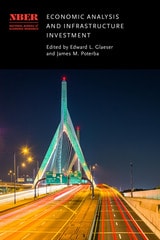
Economic Analysis and Infrastructure Investment
Edited by Edward L. Glaeser and James M. Poterba
University of Chicago Press, 2021
Policy makers often call for increased spending on infrastructure, which can encompass a broad range of investments, from roads and bridges to digital networks that will expand access to high-speed broadband. Some point to the near-term macroeconomic benefits, such as job creation, associated with infrastructure spending; others point to the long-term effects of such spending on productivity and economic growth.
Economic Analysis and Infrastructure Investment explores the links between infrastructure investment and economic outcomes, analyzing key economic issues in the funding and management of infrastructure projects. It includes new research on the short-run stimulus effects of infrastructure spending, develops new estimates of the stock of US infrastructure capital, and explores incentive aspects of public-private partnerships with particular attention to their allocation of risk. The volume provides a reference for researchers seeking to study infrastructure issues and for policymakers tasked with determining the appropriate level and allocation of infrastructure spending.
Economic Analysis and Infrastructure Investment explores the links between infrastructure investment and economic outcomes, analyzing key economic issues in the funding and management of infrastructure projects. It includes new research on the short-run stimulus effects of infrastructure spending, develops new estimates of the stock of US infrastructure capital, and explores incentive aspects of public-private partnerships with particular attention to their allocation of risk. The volume provides a reference for researchers seeking to study infrastructure issues and for policymakers tasked with determining the appropriate level and allocation of infrastructure spending.
[more]
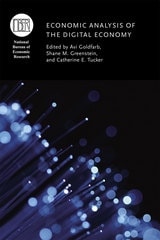
Economic Analysis of the Digital Economy
Edited by Avi Goldfarb, Shane M. Greenstein, and Catherine E. Tucker
University of Chicago Press, 2015
As the cost of storing, sharing, and analyzing data has decreased, economic activity has become increasingly digital. But while the effects of digital technology and improved digital communication have been explored in a variety of contexts, the impact on economic activity—from consumer and entrepreneurial behavior to the ways in which governments determine policy—is less well understood.
Economic Analysis of the Digital Economy explores the economic impact of digitization, with each chapter identifying a promising new area of research. The Internet is one of the key drivers of growth in digital communication, and the first set of chapters discusses basic supply-and-demand factors related to access. Later chapters discuss new opportunities and challenges created by digital technology and describe some of the most pressing policy issues. As digital technologies continue to gain in momentum and importance, it has become clear that digitization has features that do not fit well into traditional economic models. This suggests a need for a better understanding of the impact of digital technology on economic activity, and Economic Analysis of the Digital Economy brings together leading scholars to explore this emerging area of research.
Economic Analysis of the Digital Economy explores the economic impact of digitization, with each chapter identifying a promising new area of research. The Internet is one of the key drivers of growth in digital communication, and the first set of chapters discusses basic supply-and-demand factors related to access. Later chapters discuss new opportunities and challenges created by digital technology and describe some of the most pressing policy issues. As digital technologies continue to gain in momentum and importance, it has become clear that digitization has features that do not fit well into traditional economic models. This suggests a need for a better understanding of the impact of digital technology on economic activity, and Economic Analysis of the Digital Economy brings together leading scholars to explore this emerging area of research.
[more]
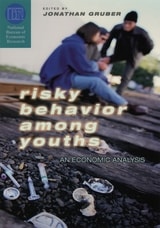
Risky Behavior among Youths
An Economic AnalysisEdited by Jonathan Gruber
University of Chicago Press, 2001
Every day young people engage in risky behaviors that affect not only their immediate well-being but their long-term health and safety. These well-honed essays apply diverse economic analyses to a wide range of unsafe activities, including teen drinking and driving, smoking, drug use, unprotected sex, and criminal activity. Economic principles are further applied to mental health and performance issues such as teenage depression, suicide, nutritional disorders, and high school dropout rates. Together, the essays yield notable findings: price and regulatory incentives are critical determinants of high-risk behavior, suggesting that youths do apply some sort of cost/benefit calculation when making decisions; the macroeconomic environment in which those decisions are made matters greatly; and youths who pursue high-risk behaviors are significantly more likely to engage in similar behaviors as adults.
This important volume provides both a key data source for public policy makers and a clear affirmation of the usefulness of economic analysis to our understanding of risky behavior.
This important volume provides both a key data source for public policy makers and a clear affirmation of the usefulness of economic analysis to our understanding of risky behavior.
[more]

Selected Writings on Agricultural Policy and Economic Analysis
Frederick V. WaughJames P. Houck and Martin E. Abel, Editors
University of Minnesota Press, 1984
Selected Writings on Agricultural Policy and Economic Analysis was first published in
1984. Minnesota Archive Editions uses digital technology to make long-unavailable books once again accessible, and are published unaltered from the original University of Minnesota Press editions.[more]
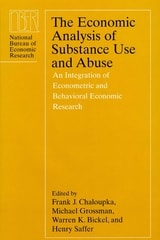
The Economic Analysis of Substance Use and Abuse
An Integration of Econometric and Behavioral Economic ResearchEdited by Frank J. Chaloupka, Michael Grossman, Warren K. Bickel, and Henry Saffer
University of Chicago Press, 1999
Conventional wisdom once held that the demand for addictive substances like cigarettes, alcohol, and drugs was unlike that for any other economic good and, therefore, unresponsive to traditional market forces. Recently, however, researchers from two disparate fields, economics and behavioral psychology, have found that increases in the overall price of an addictive substance can significantly reduce both the number of users and the amounts those users consume. Changes in the "full price" of addictive substances—including monetary value, time outlay, effort to obtain, and potential penalties for illegal use—yield marked variations in behavioral outcomes and demand.
The Economic Analysis of Substance Use and Abuse brings these distinctive fields of study together and presents for the first time an integrated assessment of their data and results. Unique and innovative, this multidisciplinary volume will serve as an important resource in the current debates concerning alcohol and drug use and abuse and the impacts of legalizing illicit drugs.
The Economic Analysis of Substance Use and Abuse brings these distinctive fields of study together and presents for the first time an integrated assessment of their data and results. Unique and innovative, this multidisciplinary volume will serve as an important resource in the current debates concerning alcohol and drug use and abuse and the impacts of legalizing illicit drugs.
[more]