Results by title
14 books match the query 'Economic Change'
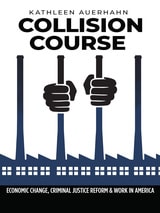
Collision Course
Economic Change, Criminal Justice Reform, and Work in AmericaKathleen Auerhahn
Rutgers University Press, 2022
Recently, a widespread consensus has emerged that the era of “mass incarceration” is at an end, reflected in a declining prison population. Criminal justice reforms such as diversion and problem-solving courts, a renewed focus on reentry, and drug policy reform have as their goal keeping more individuals with justice system involvement out of prisons, in the community and subsequently in the labor force, which lacks the capacity to accommodate these additional would-be workers. This poses significant problems for criminal justice practice, which relies heavily on employment as a signal of offenders’ intentions to live a law-abiding lifestyle. The diminished capacity of the economy to utilize the labor of all who have historically been expected to work presents significant challenges for American society. Work, in the American ethos is the marker of success, masculinity and how one “contributes to society.” What are the consequences of ignoring these converging structural trends? This book examines these potential consequences, the meaning of work in American society, and suggests alternative redistributive and policy solutions to avert the collision course of these economic and criminal justice policy trends.

Economic Change in Precolonial Africa
Supplementary EvidencePhilip D. Curtin
University of Wisconsin Press, 0
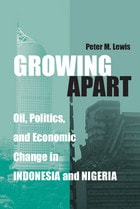
Growing Apart
Oil, Politics, and Economic Change in Indonesia and NigeriaPeter M. Lewis
University of Michigan Press, 2007
"Growing Apart is an important and distinguished contribution to the literature on the political economy of development. Indonesia and Nigeria have long presented one of the most natural opportunities for comparative study. Peter Lewis, one of America's best scholars of Nigeria, has produced the definitive treatment of their divergent development paths. In the process, he tells us much theoretically about when, why, and how political institutions shape economic growth."
—Larry Diamond, Senior Fellow, Hoover Institution
"Growing Apart is a careful and sophisticated analysis of the political factors that have shaped the economic fortunes of Indonesia and Nigeria. Both scholars and policymakers will benefit from this book's valuable insights."
—Michael L. Ross, Associate Professor of Political Science, Chair of International Development Studies, UCLA
"Lewis presents an extraordinarily well-documented comparative case study of two countries with a great deal in common, and yet with remarkably different postcolonial histories. His approach is a welcome departure from currently fashionable attempts to explain development using large, multi-country databases packed with often dubious measures of various aspects of 'governance.'"
—Ross H. McLeod, Editor, Bulletin of Indonesian Economic Studies
—Nicolas van de Walle, John S. Knight Professor of International Studies, Cornell University
Peter M. Lewis is Associate Professor and Director of the African Studies Program, Johns Hopkins University, School of Advanced International Studies.
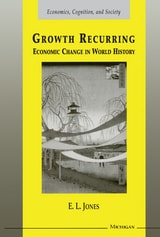
Growth Recurring
Economic Change in World HistoryE.L. Jones
University of Michigan Press, 2000
Eric Jones has written a substantial new introduction for this edition, which includes discussions of early evidence of growth episodes and the relation of these points to the Industrial Revolution, and the relevance of the East Asian "miracle" to his thesis.

Hawai'i
Eight Hundred Years of Political and Economic ChangeSumner La Croix
University of Chicago Press, 2019
Building on new archaeological and historical research, Sumner La Croix assembles here the economic history of Hawai‘i from the first Polynesian settlements in 1200 through US colonization, the formation of statehood, and to the present day. He shows how the political and economic institutions that emerged and evolved in Hawai‘i during its three centuries of global isolation allowed an economically and culturally rich society to emerge, flourish, and ultimately survive annexation and colonization by the United States. The story of a small, open economy struggling to adapt its institutions to changes in the global economy, Hawai‘i offers broadly instructive conclusions about economic evolution and development, political institutions, and native Hawaiian rights.

Life on the Periphery
Economic Change in Late Prehistoric Southeastern New MexicoEdited by John D. Speth
University of Michigan Press, 2004

National Growth and Economic Change in the Upper Midwest
James M. Henderson
University of Minnesota Press, 1965
This volume constitutes the final, general report of the comprehensive research conducted by the Upper Midwest Economic Study, a joint undertaking of the Upper Midwest Research and Development Council and the University of Minnesota. The authors present a detailed analysis of the economy of the Upper Midwest, the region coincident with the Ninth Federal Reserve District, which includes Montana, North Dakota, South Dakota, Minnesota, twenty-six counties in northwestern Wisconsin, and Michigan’s Upper Peninsula.
The present study analyzes the region’s past economic growth, its current structure, and possible future development. The region’s initial economic growth was based upon its natural resources—land, forest, and minerals. Today productivity growth is increasing more rapidly than demand in most of these sectors. Hence, total employment opportunities in resource-based industries are declining. Future employment growth generally must be based on the region’s advantage in human resources. This is the challenge for economic growth in the Upper Midwest. The same challenge exists on a nation-wide basis, but the severity of transition away from natural resources industries is greater in the Upper Midwest because of its above-average reliance on such industries.
The authors analyze economic change in the region from 1950 to 1960 and possible future development through 1975, with projections of employment, income, population, and migration for 1975. The projections, based on an assumption of no new action to facilitate economic growth in the region, serve mainly as a departure point for the analysis of regional policy and action.

Nevada's Turbulent 50's
Decade Of Political And Economic ChangeAl Glass
University of Nevada Press, 1981
The 1950s marked a period of significant changes for Nevada--gambling came under national and local scrutiny, atomic bombs were tested regularly near Las Vegas, and labor disputes made national headlines. Glass examines the events of the decade and their impact on Nevada and on the rest of the country.
Population and Economic Change in Developing Countries
Edited by Richard A. Easterlin
University of Chicago Press, 1987
"An important landmark in the growing field of economic demography."—Dudley Kirk, Journal of Developing Areas
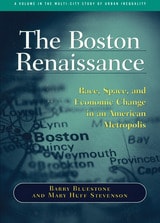
The Boston Renaissance
Race, Space, and Economic Change in an American MetropolisBarry Bluestone
Russell Sage Foundation, 2000

The Paradox of Progress
Economic Change, Individual Enterprise, and Politic Culture in Michigan, 1837-1878Martin J. Hershock
Ohio University Press, 2003
Guiding this transformation was the nineteenth-century Republican party. Drawing heavily from both the pro-market commitments of the early Whig party and the anti-capitalist culture of Jackson's Democratic party, the early Republican party found itself torn between these competing values. Nowhere was this contested process more obvious or more absorbing than in Civil War-era Michigan, the birthplace of the Republican party.
In The Paradox of Progress, a fascinating look at the central factors underlying the history of the GOP, Martin Hershock reveals how in their determination to resolve their ideological dilemma, Republicans of the Civil War era struggled to contrive a formula that wo uld enable them to win popular elections and to model America's acceptance of Gilded Age capitalism.

The Road to Spindletop
Economic Change in Texas, 1875–1901By John Stricklin Spratt; drawings by Ed Bearden
University of Texas Press, 1955
This book is an economic history of Texas at the end of the nineteenth century. In 1875, Texas was an agrarian state with limited industry. A generation later, agriculture was heavily commercialized, thousands of miles of railroads carried people and goods around the state, and urban populations increased rapidly. Even before the Spindletop gusher that irrevocably changed the state’s future, Texas had already moved far from its days as a Mexican and American frontier.
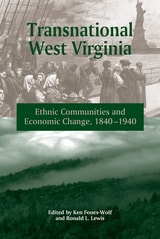
Transnational West Virginia
Ethnic Communities and Economic Change, 1840 - 1940KEN FONES-WOLF
West Virginia University Press, 2002
West Virginia is one of the most homogeneous states in the nation, with among the lowest ratios of foreign-born and minority populations among the states. But as this collection of historical studies demonstrates, this state was built by successive waves of immigrant labors, from the antebellum railroad builders to the twentieth-century coal miners. Transnational West Virginia offers a new understanding of how laborers and their communities shape a region's history. Transnational West Virginia includes essays and studies on immigrant networks, such as Irish workers along the B&O Railroad, Wheeling Germans in the Civil War era, Swiss immigration to West Virginia, and European Jews in Southern West Virginia. This work also covers Belgian glassworkers in West Virginia, black migration to Southern West Virginia, Italians in the Upper Kanawha Valley, Italian immigration to Marion County, Wheeling Iron and the Welsh, West Virginia and immigrant labor to 1920, Monongalia miners between the World Wars, and West Virginia rubber workers in Akron. Transnational West Virginia is the first volume in the West Virginia and Appalachia series, which is under the general editorship of West Virginia University Stuart and Joyce Robbins Chair of History Ronald L. Lewis. Kenneth Fones-Wolf, Associate Professor of History at WVU, also helped edit this collection of essays by ten distinguished scholars.
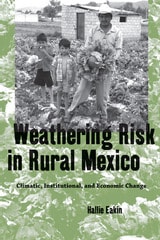
Weathering Risk in Rural Mexico
Climatic, Institutional, and Economic ChangeHallie Eakin
University of Arizona Press, 2006
In Weathering Risk in Rural Mexico, Hallie Eakin draws on ethnographic data collected in three agricultural communities in rural Mexico to show how economic and climatic change are not only linked in cause and effect at the planetary scale but also interact in unpredictable and complex ways in the context of regional political and trade relationships, national economic and social programs, and the decision making of institutions, enterprises, and individuals.She shows how the parallel processes of globalization and climatic change result in populations that are “doubly exposed” and thus particularly vulnerable.
Chapters trace the effects of El Niño in central Mexico in the late 1990s alongside some of the principal changes in the country’s agricultural policy. Eakin argues that in order to develop policies that effectively address rural poverty and agricultural development, we need an improved understanding of how households cope simultaneously with various sources of uncertainty and adjust their livelihoods to accommodate newly evolving environmental, political, and economic realities.