Results by title

21 books match the query 'Economic assistance, Domestic'
cover of Changing Poverty, Changing Policies

Changing Poverty, Changing Policies

Maria Cancian

Russell Sage Foundation, 2009
Poverty declined significantly in the decade after Lyndon Johnson's 1964 declaration of "War on Poverty." Dramatically increased federal funding for education and training programs, social security benefits, other income support programs, and a growing economy reduced poverty and raised expectations that income poverty could be eliminated within a generation. Yet the official poverty rate has never fallen below its 1973 level and remains higher than the rates in many other advanced economies. In this book, editors Maria Cancian and Sheldon Danziger and leading poverty researchers assess why the War on Poverty was not won and analyze the most promising strategies to reduce poverty in the twenty-first century economy. Changing Poverty, Changing Policies documents how economic, social, demographic, and public policy changes since the early 1970s have altered who is poor and where antipoverty initiatives have kept pace or fallen behind. Part I shows that little progress has been made in reducing poverty, except among the elderly, in the last three decades. The chapters examine how changing labor market opportunities for less-educated workers have increased their risk of poverty (Rebecca Blank), and how family structure changes (Maria Cancian and Deborah Reed) and immigration have affected poverty (Steven Raphael and Eugene Smolensky). Part II assesses the ways childhood poverty influences adult outcomes. Markus Jäntti finds that poor American children are more likely to be poor adults than are children in many other industrialized countries. Part III focuses on current antipoverty policies and possible alternatives. Jane Waldfogel demonstrates that policies in other countries—such as sick leave, subsidized child care, and schedule flexibility—help low-wage parents better balance work and family responsibilities. Part IV considers how rethinking and redefining poverty might take antipoverty policies in new directions. Mary Jo Bane assesses the politics of poverty since the 1996 welfare reform act. Robert Haveman argues that income-based poverty measures should be expanded, as they have been in Europe, to include social exclusion and multiple dimensions of material hardships. Changing Poverty, Changing Policies shows that thoughtful policy reforms can reduce poverty and promote opportunities for poor workers and their families. The authors' focus on pragmatic measures that have real possibilities of being implemented in the United States not only provides vital knowledge about what works but real hope for change.
[more]
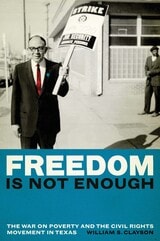
cover of Freedom Is Not Enough: The War on Poverty and the Civil Rights Movement in Texas

Freedom Is Not Enough

The War on Poverty and the Civil Rights Movement in Texas

By William S. Clayson

University of Texas Press, 2010

Led by the Office of Economic Opportunity, Lyndon Johnson's War on Poverty reflected the president's belief that, just as the civil rights movement and federal law tore down legalized segregation, progressive government and grassroots activism could eradicate poverty in the United States. Yet few have attempted to evaluate the relationship between the OEO and the freedom struggles of the 1960s. Focusing on the unique situation presented by Texas, Freedom Is Not Enough examines how the War on Poverty manifested itself in a state marked by racial division and diversity—and by endemic poverty.

Though the War on Poverty did not eradicate destitution in the United States, the history of the effort provides a unique window to examine the politics of race and social justice in the 1960s. William S. Clayson traces the rise and fall of postwar liberalism in the Lone Star State against a backdrop of dissent among Chicano militants and black nationalists who rejected Johnson's brand of liberalism. The conservative backlash that followed is another result of the dramatic political shifts revealed in the history of the OEO, completing this study of a unique facet in Texas's historical identity.
[more]
cover of From Cotton Belt to Sunbelt: Federal Policy, Economic Development, and the Transformation of the South 1938–1980

From Cotton Belt to Sunbelt

Federal Policy, Economic Development, and the Transformation of the South 1938–1980

Bruce J. Schulman

Duke University Press, 1994
From Cotton Belt to Sunbelt investigates the effects of federal policy on the American South from 1938 until 1980 and charts the close relationship between federal efforts to reform the South and the evolution of activist government in the modern United States. Decrying the South’s economic backwardness and political conservatism, the Roosevelt Administration launched a series of programs to reorder the Southern economy in the 1930s. After 1950, however, the social welfare state had been replaced by the national security state as the South’s principal benefactor. Bruce J. Schulman contrasts the diminished role of national welfare initiatives in the postwar South with the expansion of military and defense-related programs. He analyzes the contributions of these growth-oriented programs to the South’s remarkable economic expansion, to the development of American liberalism, and to the excruciating limits of Sunbelt prosperity, ultimately relating these developments to southern politics and race relations. By linking the history of the South with the history of national public policy, Schulman unites two issues that dominate the domestic history of postwar America—the emergence of the Sunbelt and the expansion of federal power over the nation’s economic and social life. A forcefully argued work, From Cotton Belt to Sunbelt, originally published in 1991(Oxford University Press), will be an important guide to students and scholars of federal policy and modern Southern history.
[more]
cover of Give a Man a Fish: Reflections on the New Politics of Distribution

Give a Man a Fish

Reflections on the New Politics of Distribution

James Ferguson

Duke University Press, 2015

In Give a Man a Fish James Ferguson examines the rise of social welfare programs in southern Africa, in which states make cash payments to their low income citizens. More than thirty percent of South Africa's population receive such payments, even as pundits elsewhere proclaim the neoliberal death of the welfare state. These programs' successes at reducing poverty under conditions of mass unemployment, Ferguson argues, provide an opportunity for rethinking contemporary capitalism and for developing new forms of political mobilization. Interested in an emerging "politics of distribution," Ferguson shows how new demands for direct income payments (including so-called "basic income") require us to reexamine the relation between production and distribution, and to ask new questions about markets, livelihoods, labor, and the future of progressive politics.
[more]
cover of Human Capital versus Basic Income: Ideology and Models for Anti-Poverty Programs in Latin America

Human Capital versus Basic Income

Ideology and Models for Anti-Poverty Programs in Latin America

Fabián A. Borges

University of Michigan Press, 2022

Latin America underwent two major transformations during the 2000s: the widespread election of left-leaning presidents (the so-called left turn) and the diffusion of conditional cash transfer programs (CCTs)—innovative social programs that award regular stipends to poor families on the condition that their children attend school. Combining cross-national quantitative research covering the entire region and in-depth case studies based on field research, Human Capital versus Basic Income: Ideology and Models for Anti-Poverty Programs in Latin America challenges the conventional wisdom that these two transformations were unrelated. In this book, author Fabián A. Borges demonstrates that this ideology greatly influenced both the adoption and design of CCTs.
 
There were two distinct models of CCTs: a “human capital” model based on means-tested targeting and strict enforcement of program conditions, exemplified by the program launched by Mexico’s right, and a more universalistic “basic income” model with more permissive enforcement of conditionality, exemplified by Brazil’s program under Lula. These two models then spread across the region. Whereas right and center governments, with assistance from international financial institutions, enacted CCTs based on the human capital model, the left, with assistance from Brazil, enacted CCTs based on the basic income model.
 
The existence of two distinct types of CCTs and their relation to ideology is supported by quantitative analyses covering the entire region and in-depth case studies based on field research in three countries. Left-wing governments operate CCTs that cover more people and spend more on those programs than their center or right-wing counterparts. Beyond coverage, a subsequent analysis of the 10 national programs adopted after Lula’s embrace of CCTs confirms that program design—evaluated in terms of scope of the target population, strictness of conditionality enforcement, and stipend structure—is shaped by government ideology. This finding is then fleshed out through case studies of the political processes that culminated in the adoption of basic income CCTs by left-wing governments in Argentina and Bolivia and a human capital CCT by a centrist president in Costa Rica.
 
[more]
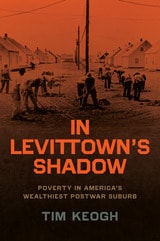
cover of In Levittown’s Shadow: Poverty in America’s Wealthiest Postwar Suburb

In Levittown’s Shadow

Poverty in America’s Wealthiest Postwar Suburb

Tim Keogh

University of Chicago Press, 2023

Named one of the best nonfiction books of 2023 by Publishers Weekly!
 
There is a familiar narrative about American suburbs: after 1945, white residents left cities for leafy, affluent subdivisions and the prosperity they seemed to embody. In Levittown’s Shadow tells us there’s more to this story, offering an eye-opening account of diverse, poor residents living and working in those same neighborhoods. Tim Keogh shows how public policies produced both suburban plenty and deprivation—and why ignoring suburban poverty doomed efforts to reduce inequality.
 
Keogh focuses on the suburbs of Long Island, home to Levittown, often considered the archetypal suburb. Here military contracts subsidized well-paid employment welding airplanes or filing paperwork, while weak labor laws impoverished suburbanites who mowed lawns, built houses, scrubbed kitchen floors, and stocked supermarket shelves. Federal mortgage programs helped some families buy orderly single-family homes and enter the middle class but also underwrote landlord efforts to cram poor families into suburban attics, basements, and sheds. Keogh explores how policymakers ignored suburban inequality, addressing housing segregation between cities and suburbs rather than suburbanites’ demands for decent jobs, housing, and schools.
 
By turning our attention to the suburban poor, Keogh reveals poverty wasn’t just an urban problem but a suburban one, too. In Levittown’s Shadow deepens our understanding of suburbia’s history—and points us toward more effective ways to combat poverty today.
[more]
cover of Intergovernmental Relations in the American Administrative State: The Johnson Presidency

Intergovernmental Relations in the American Administrative State

The Johnson Presidency

By David M. Welborn and Jesse Burkhead

University of Texas Press, 1989

During the 1960s, President Lyndon Johnson and his administration substantially altered the structure of the American administrative state. Creating intergovernmental programs to forward the goal of the Great Society, they changed the contours of national-state-local relationships, and these changes largely have remained, despite the attempts of later administrations to reverse them. Intergovernmental Relations in the American Administrative State is the first comprehensive study of how and why these changes occurred.

Drawn from a wealth of primary material in the Lyndon Baines Johnson Library, the study probes the objectives of the president and other framers of new policies and programs, within the institutional and political context of the time. The authors give special attention to the inherent incongruities that arise when intergovernmental programs are used to address problems defined in national terms. In addition, they reveal how certain programs actually challenged the power of established national bureaucracies. They conclude with a thoughtful overview of the Johnson legacy in intergovernmental relations during subsequent administrations.
[more]
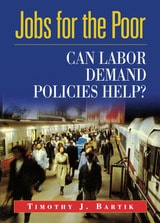
cover of Jobs for the Poor: Can Labor Demand Policies Help?

Jobs for the Poor

Can Labor Demand Policies Help?

Timothy J. Bartik

Russell Sage Foundation, 2001
Even as the United States enjoys a booming economy and historically low levels of unemployment, millions of Americans remain out of work or underemployed, and joblessness continues to plague many urban communities, racial minorities, and people with little education. In Jobs for the Poor, Timothy Bartik calls for a dramatic shift in the way the United States confronts this problem. Today, most efforts to address this problem focus on ways to make workers more employable, such as job training and welfare reform. But Bartik argues that the United States should put more emphasis on ways to increase the interest of employers in creating jobs for the poor—or the labor demand side of the labor market. Bartik's bases his case for labor demand policies on a comprehensive review of the low-wage labor market. He examines the effectiveness of government interventions in the labor market, such as Welfare Reform, the Earned Income Tax Credit, and Welfare-to-Work programs, and asks if having a job makes a person more employable. Bartik finds that public service employment and targeted employer wage subsidies can increase employment among the poor. In turn, job experience significantly increases the poor's long-run earnings by enhancing their skills and reputation with employers. And labor demand policies can avoid causing inflation or displacing other workers by targeting high-unemployment labor markets and persons who would otherwise be unemployed. Bartik concludes by proposing a large-scale labor demand program. One component of the program would give a tax credit to employers in areas of high unemployment. To provide disadvantaged workers with more targeted help, Bartik also recommends offering short-term subsidies to employers—particularly small businesses and nonprofit organizations—that hire people who otherwise would be unlikely to find jobs. With experience from subsidized jobs, the new workers should find it easier to obtain future year-round employment. Although these efforts would not catapult poor families into the middle class overnight, Bartik offers a powerful argument that having a full-time worker in every household would help improve the lives of millions. Jobs for the Poor makes a compelling case that full employment can be achieved if the country has the political will and adopts policies that address both sides of the labor market. Copublished with the W. E. Upjohn Institute for Economic Research
[more]
cover of Organizing Access To Capital: Advocacy And The Democratization

Organizing Access To Capital

Advocacy And The Democratization

edited by Gregory D. Squires

Temple University Press, 2003
Community activists were delighted with the passage of the Community Reinvestment Act, but they came to realize that it would take more than the word of law to bring about real change. This book gives voice to the activists who took it upon themselves to agitate for increased investment by financial institutions in their local communities. They tell of their struggles to get banks, mortgage companies and others to rethink their lending policies. Their stories, drawn from experiences in Chicago, New York, Milwaukee, Boston, Pittsburgh, and other cities around the country, offer insight into the way our political/economic system really works.
[more]
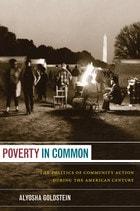
cover of Poverty in Common: The Politics of Community Action during the American Century

Poverty in Common

The Politics of Community Action during the American Century

Alyosha Goldstein

Duke University Press, 2012
After the Second World War, the idea that local community action was indispensable for the alleviation of poverty was broadly embraced by US policymakers, social scientists, international development specialists, and grassroots activists. Governmental efforts to mobilize community action in the name of democracy served as a volatile condition of possibility for poor people and dispossessed groups negotiating the tension between calls for self-help and demands for self-determination in the era of the Cold War and global decolonization. In Poverty in Common, Alyosha Goldstein suggests new ways to think about the relationship among liberalism, government, and inequality in the United States. He does so by analyzing historical dynamics including Progressive-era reform as a precursor to community development during the Cold War, the ways that the language of "underdevelopment" articulated ideas about poverty and foreignness, the use of poverty as a crucible of interest group politics, and radical groups' critical reframing of community action in anticolonial terms. During the mid-twentieth century, approaches to poverty in the United States were linked to the racialized and gendered negotiation of boundaries—between the foreign and the domestic, empire and nation, violence and order, and dependency and autonomy.
[more]
cover of President Johnson's War On Poverty: Rhetoric and History

President Johnson's War On Poverty

Rhetoric and History

David Zarefsky

University of Alabama Press, 1986

How words waged war—and shaped the fate of a nation’s boldest social crusade.

In January 1964, in his first State of the Union address, President Lyndon Johnson announced a declaration of “unconditional war” on poverty. By the end of the year the Economic Opportunity Act became law.

War on Poverty illustrates the interweaving of rhetorical and historical forces in shaping public policy. Zarefsky suggests that an important problem lay in its discourse. He assumes that language plays a central role in the formulation of social policy by shaping the context within which people view the social world. By terming the anti-poverty effort a war, President Johnson imparted significant symbolism to the effort: it called for total victory and gave confidence that the “war” was winnable. It influenced the definition of the enemy as an intergenerational cycle of poverty, rather than the shortcomings of the individual; and it led to the choice of community action, manpower programs, and prudent management as weapons and tactics. Each of these implications involves a choice of language and symbols, a decision about how to characterize and discuss the world. Zarefsky contends that each of these rhetorical choices was helpful to the Johnson administration in obtaining passage of the Economic Opportunity Ac of 1964, but that each choice invited redefinition or reinterpretation of a symbol in a way that threatened the program.
[more]
cover of Public Policy and the Income Distribution

Public Policy and the Income Distribution

Alan J. Auerbach

Russell Sage Foundation, 2006
Over the last forty years, rising national income has helped reduce poverty rates, but this has been accompanied by an increase in economic inequality. While these trends are largely attributed to technological change and demographic shifts, such as changing birth rates, labor force patterns, and immigration, public policies have also exerted a profound affect on the welfare of Americans. In Public Policy and the Income Distribution, editors Alan Auerbach, David Card, and John Quigley assemble a distinguished roster of policy analysts to confront the key questions about the role of government policy in altering the level and distribution of economic well being. Public Policy and the Income Distribution tackles many of the most difficult and intriguing questions about how government intervention—or lack thereof—has affected the incomes of everyday Americans. Rebecca Blank analyzes welfare reform, and presents systematic research on income, poverty rates, and welfare and labor force participation of single mothers. She finds that single mothers worked more and were less dependent on public assistance following welfare reform, and that low-skilled single mothers had no greater difficulty finding work than others. Timothy Smeeding compares poverty reduction programs in the United States with policies in other developed countries. Poverty and inequality are higher in the United States than in other advanced economies, but Smeeding argues that this is largely a result of policy choices. Poverty rates based on market incomes alone are actually lower in the United States than elsewhere, but government interventions in the United States were less than half as effective at reducing poverty as were programs in the other countries. The most dramatic poverty reduction story of twentieth century America was seen among the elderly, who went from being the age group most likely to live in poverty in the 1960s to the group least likely to be poor at the end of the century. Gary Englehardt and Jonathan Gruber examine the role of policy in alleviating old-age poverty by estimating the impact of Social Security benefits on the income of the elderly poor. They find that the growth in Social Security almost completely explains the large decline in elderly poverty in the United States The twentieth century was remarkable in the extent to which advances in public policy helped improve the economic well being of Americans. Synthesizing existing knowledge on the effectiveness of public policy and contributing valuable new research, Public Policy and the Income Distribution examines public policy's successes, and points out the areas in which progress remains to be made.
[more]
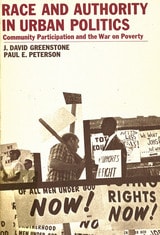
cover of Race and Authority in Urban Politics

Race and Authority in Urban Politics

David J. Greenstone

Russell Sage Foundation, 1974
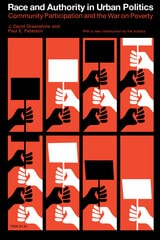
What really happened when citizens were asked to participate in their community’s poverty programs? In this revealing new book, the authors provide an answer to this question through a systematic empirical analysis of a single public policy issue—citizen participation in the Community Action Program of the Johnson Administration’s “War on Poverty.” Beginning with a brief case study description and analysis of the politics of community action in each of America’s five largest cities—New York, Chicago, Los Angeles, Detroit, and Philadelphia—the authors move on to a fascinating examination of race and authority structures in our urban life. In a series of lively chapters, Professors Greenstone and Peterson show how the coalitions that formed around the community action question developed not out of electoral or organizational interests alone, but were strongly influenced by our conceptions of the nature of authority in America. They discuss the factors that affected the development of the action program and they note that democratic elections of low-income representatives, however much preferred by democratic reformers, were an ineffective way of representing the interests of the poor. The book stresses the way in which both machine and reform structures affected the ability of minority groups to organize effectively and to form alliances in urban politics. It considers the wide-ranging critiques made of the Community Action Program by conservative, liberal, and radical analysts and finds that all of them fail to appreciate the significance and intensity of the racial cleavage in American politics.
[more]
cover of Race and Authority in Urban Politics: Community Relations and the War on Poverty

Race and Authority in Urban Politics

Community Relations and the War on Poverty

David Greenstone and Paul E. Peterson

University of Chicago Press, 1976

In this penetrating book, the authors provide a systematic empirical analysis of an important public policy issue—citizen participation in the Community Action Program of the Johnson administration's "War on Poverty." This Phoenix edition includes a new introduction in which the authors explicate the most important themes in their analysis.

In a series of lively chapters, Greenstone and Peterson show how the coalitions that formed around the community action question developed not out of electoral or organizational interests alone but were strongly influenced by prevailing conceptions of the nature of authority in America. The book stresses the way in which both machine and reform structures affected the ability of minority groups to organize effectively and to form alliances in urban politics. It considers the wide-ranging critiques made of the Community Action Program by conservative, liberal, and radical analysts and finds that all of them fail to appreciate the significance and intensity of the racial cleavage in American politics.
[more]
cover of Targeting Investments in Children: Fighting Poverty When Resources Are Limited

Targeting Investments in Children

Fighting Poverty When Resources Are Limited

Edited by Phillip B. Levine and David J. Zimmerman

University of Chicago Press, 2010

A substantial number of American children experience poverty: about 17 percent of those under the age of eighteen meet the government’s definition, and the proportion is even greater within minority groups. Childhood poverty can have lifelong effects, resulting in poor educational, labor market, and physical and mental health outcomes for adults. These problems have long been recognized, and there are numerous programs designed to alleviate or even eliminate poverty; as these programs compete for scarce resources, it is important to develop a clear view of their impact as tools for poverty alleviation.

Targeting Investments in Children
tackles the problem of evaluating these programs by examining them using a common metric: their impact on earnings in adulthood. The volume’s contributors explore a variety of issues, such as the effect of interventions targeted at children of different ages, and study a range of programs, including child care, after-school care, and drug prevention. The results will be invaluable to educational leaders and researchers as well as policy makers.
[more]
cover of The Other Side of the Coin: Public Opinion toward Social Tax Expenditures

The Other Side of the Coin

Public Opinion toward Social Tax Expenditures

Christopher G. Faricy

Russell Sage Foundation, 2021

Despite high levels of inequality and wage stagnation over several decades, the United States has done relatively little to address these problems—at least in part due to public opinion, which remains highly influential in determining the size and scope of social welfare programs that provide direct benefits to retirees, unemployed workers or poor families. On the other hand, social tax expenditures—or tax subsidies that help citizens pay for expenses such as health insurance or the cost of college and invest in retirement plans—have been widely and successfully implemented, and they now comprise nearly 40 percent of the spending of the American social welfare state.  In The Other Side of the Coin, political scientists Christopher Ellis and Christopher Faricy examine public opinion towards social tax expenditures—the other side of the American social welfare state—and their potential to expand support for such social investment.
 
Tax expenditures seek to accomplish many of the goals of direct government expenditures, but they distribute money indirectly, through tax refunds or reductions in taxable income, rather than direct payments on goods and services or benefits. They tend to privilege market-based solutions to social problems such as employer-based tax subsidies for purchasing health insurance versus government-provided health insurance. Drawing on nationally representative surveys and survey experiments, Ellis and Faricy show that social welfare policies designed as tax expenditures, as opposed to direct spending on social welfare programs, are widely popular with the general public. Contrary to previous research suggesting that recipients of these subsidies are often unaware of indirect government aid—sometimes called “the hidden welfare state”—Ellis and Faricy find that citizens are well aware of them and act in their economic self-interest in supporting tax breaks for social welfare purposes. The authors find that many people view the beneficiaries of social tax expenditures to be more deserving of government aid than recipients of direct public social programs, indicating that how government benefits are delivered affects people’s views of recipients’ worthiness. Importantly, tax expenditures are more likely to appeal to citizens with anti-government attitudes, low levels of trust in government, or racial prejudices. As a result, social spending conducted through the tax code is likely to be far more popular than direct government spending on public programs that have the same goals. 
 
The first empirical examination of the broad popularity of tax expenditures, The Other Side of the Coin provides compelling insights into constructing a politically feasible—and potentially bipartisan—way to expand the scope of the American welfare state.
 
[more]
cover of The Paradox of Agrarian Change: Food Security and the Politics of Social Protection in Indonesia

The Paradox of Agrarian Change

Food Security and the Politics of Social Protection in Indonesia

Edited by John McCarthy, Andrew McWilliam, and Gerben Nooteboom

National University of Singapore Press, 2023

A detailed study of agrarian change, the persistence of food insecurity, and the most significant policy to address poverty in rural Indonesia.
 
Economic growth in the middle-income countries of Southeast Asia over the past few decades has been widely praised for reducing poverty in both absolute and relative terms. Indonesia is a prime example. But while poverty has declined in Indonesia, patterns of food poverty persist across Indonesia. What explains this troubling paradox? How does it relate to Indonesia’s enthusiastic embrace of the “entitlements revolution,” the use of direct cash transfers as a tool for reducing poverty and building social inclusion?
 
This book analyzes the nature and social consequences of economic development and agrarian change processes in rural Indonesia in relation to the scope and effectiveness of Indonesia’s social protection programs. The findings are based on a series of extensive ground-up case studies in Indonesian communities in a variety of eco-agrarian settings that seek to understand the drivers of food insecurity and vulnerability at a household level. The results show that while high-value farming, diversification, and migration may offer a means of economic progress for poor households, opportunities for accumulation are limited. This, the authors show, is due to the way class, gender, and power work in remote local contexts, and the fact that much surplus income is used for enhanced consumption and changing lifestyles. There are few signs of the classical structural transformation of the countryside which has historically been considered the most decisive pathway out of rural poverty. The authors conclude that social assistance is unlikely to counter the persistence of rural poverty, food insecurity, and precarity in the absence of other redistributive strategies that shift the structural drivers of inequality.
 
[more]
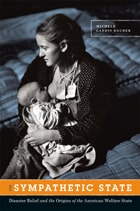
cover of The Sympathetic State: Disaster Relief and the Origins of the American Welfare State

The Sympathetic State

Disaster Relief and the Origins of the American Welfare State

Michele Landis Dauber

University of Chicago Press, 2012
Even as unemployment rates soared during the Great Depression, FDR’s relief and social security programs faced attacks in Congress and the courts on the legitimacy of federal aid to the growing population of poor. In response, New Dealers pointed to a long tradition—dating back to 1790 and now largely forgotten—of federal aid to victims of disaster. In The Sympathetic State, Michele Landis Dauber recovers this crucial aspect of American history, tracing the roots of the modern American welfare state beyond the New Deal and the Progressive Era back to the earliest days of the republic when relief was forthcoming for the victims of wars, fires, floods, hurricanes, and earthquakes.
 
Drawing on a variety of materials, including newspapers, legal briefs, political speeches, the art and literature of the time, and letters from thousands of ordinary Americans, Dauber shows that while this long history of government disaster relief has faded from our memory today, it was extremely well known to advocates for an expanded role for the national government in the 1930s, including the Social Security Act. Making this connection required framing the Great Depression as a disaster afflicting citizens though no fault of their own. Dauber argues that the disaster paradigm, though successful in defending the New Deal, would ultimately come back to haunt advocates for social welfare. By not making a more radical case for relief, proponents of the New Deal helped create the weak, uniquely American welfare state we have today—one torn between the desire to come to the aid of those suffering and the deeply rooted suspicion that those in need are responsible for their own deprivation.
 
Contrary to conventional thought, the history of federal disaster relief is one of remarkable consistency, despite significant political and ideological change. Dauber’s pathbreaking and highly readable book uncovers the historical origins of the modern American welfare state.
[more]
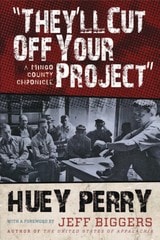
cover of They'll Cut Off Your Project: A Mingo County Chronicle

They'll Cut Off Your Project

A Mingo County Chronicle

Huey Perry, with a foreword by Jeff Biggers

West Virginia University Press, 2010

In old England, if a king didn’t like you, he would cut off your head. Now, if they don’t like you, they’ll cut off your project!

As the Johnson Administration initiated its war on poverty in the 1960s, the Mingo County Economic Opportunity Commission project was established in southern West Virginia. Huey Perry, a young, local history teacher was named the director of this program and soon he began to promote self-sufficiency among low-income and vulnerable populations. As the poor of Mingo County worked together to improve conditions, the local political infrastructure felt threatened by a shift in power. Bloody Mingo County, known for its violent labor movements, corrupt government, and the infamous Hatfield-McCoy rivalry, met Perry’s revolution with opposition and resistance. 

In They’ll Cut Off Your Project, Huey Perry reveals his efforts to help the poor of an Appalachian community challenge a local regime. He describes this community’s attempts to improve school programs and conditions, establish cooperative grocery stores to bypass inflated prices, and expose electoral fraud. Along the way, Perry unfolds the local authority’s hostile backlash to such change and the extreme measures that led to an eventual investigation by the FBI. They’ll Cut Off Your Project chronicles the triumphs and failures of the war on poverty, illustrating why and how a local government that purports to work for the public’s welfare cuts off a project for social reform.
[more]
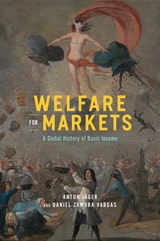
cover of Welfare for Markets: A Global History of Basic Income

Welfare for Markets

A Global History of Basic Income

Anton Jäger and Daniel Zamora Vargas

University of Chicago Press, 2023

A sweeping intellectual history of the welfare state’s policy-in-waiting.

The idea of a government paying its citizens to keep them out of poverty—now known as basic income—is hardly new. Often dated as far back as ancient Rome, basic income’s modern conception truly emerged in the late nineteenth century. Yet as one of today’s most controversial proposals, it draws supporters from across the political spectrum.

In this eye-opening work, Anton Jäger and Daniel Zamora Vargas trace basic income from its rise in American and British policy debates following periods of economic tumult to its modern relationship with technopopulist figures in Silicon Valley. They chronicle how the idea first arose in the United States and Europe as a market-friendly alternative to the postwar welfare state and how interest in the policy has grown in the wake of the 2008 credit crisis and COVID-19 crash.

An incisive, comprehensive history, Welfare for Markets tells the story of how a fringe idea conceived in economics seminars went global, revealing the most significant shift in political culture since the end of the Cold War.
[more]
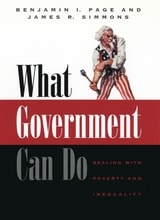
cover of What Government Can Do: Dealing with Poverty and Inequality

What Government Can Do

Dealing with Poverty and Inequality

Benjamin I. Page and James R. Simmons

University of Chicago Press, 2000

It is often said that the federal government cannot or should not attempt to address America's problems of poverty and inequality—because its bureaucracy is wasteful or its programs ineffective. But is this true? In this book, Benjamin I. Page and James R. Simmons examine a number of federal and local programs, detailing what government action already does for its citizens and assessing how efficient it is at solving the problems it seeks to address. Their conclusion, surprisingly, is the polar opposite of the prevailing rhetoric—What Government Can Do is an insightful and compelling argument that it both can and should do more.
[more]