Results by title
3 books match the query 'Economic sanctions'
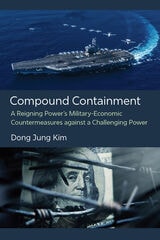
Compound Containment
A Reigning Power's Military-Economic Countermeasures against a Challenging PowerDong Jung Kim
University of Michigan Press, 2022
When does a reigning great power of the international system supplement military containment of a challenging power by restricting its economic exchanges with that state? Scholars of great power politics have traditionally focused on examining a reigning power’s military containment of a challenging power. In direct contrast, Compound Containment demonstrates that these conventional studies are flawed without a sound understanding of the multilayered aspects of containment strategy in great power politics. Since economic capacity and military power are intimately linked to one another, countering a challenging power requires addressing both economic and military dimensions. Nonetheless, this nexus of security and economy in a reigning power’s response to a challenging power cannot be explained by traditional theories that dominate research in international security. Author Dong Jung Kim fills a gap in the scholarship on great power competition by investigating when a reigning power will make its military containment of a challenging power “compound” by simultaneously employing restrictive economic measures. Its main theoretical claims are corroborated by an analysis of key historical cases of reigning power-challenging power competition. This book also offers policy prescriptions for the United States by examining whether the United States is in a position to complement military containment of China with restrictive economic measures.
The Political Economy of Regional Peacemaking
Edited by Steven E. Lobell and Norrin M. Ripsman
University of Michigan Press, 2016
The chapters that follow are grouped in three sections, corresponding to the three stages of peacemaking: reduction or management of regional conflict; peacemaking or progress toward a peace treaty; and maintenance of bilateral peace and the regionalization of the peace settlement. In each chapter, the contributors consider the five key questions from a variety of methodological, historical, cultural, and empirical perspectives, drawing data from the Pacific, the Middle East, Europe, Asia, and Latin America. The conclusion expands on several themes found in the chapters and proposes an agenda for future research.
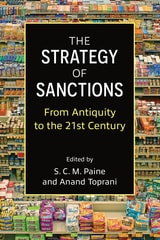
The Strategy of Sanctions
From Antiquity to the 21st CenturyEdited by S.C.M. Paine and Anand Toprani
University of Michigan Press, 2026
In recent decades, sanctions have become the preferred tool for the nonviolent coercion of other nations. The US government employs sanctions and embargoes to pressure not only enemies but sometimes even its friends. Despite their ubiquity, the debate over their efficacy continues. Measuring their success is controversial since many sanctions are economic, while the desired outcomes are political. Under what circumstances can sanctions or embargoes deliver their intended policy objectives at an acceptable cost? How can they best be integrated with other available instruments of national power?
The Strategy of Sanctions uses case studies from antiquity to the present to evaluate the strategic utility of sanctions and embargoes. The authors utilize a blended approach combining earlier definitions of sanctions, concepts from teaching of strategy, as well as terms of their own creation. They apply a common framework for teaching strategy, which disaggregates operational-level from strategic-level goals, and goals from strategies. By examining sanctions in different eras and contexts, the book highlights the circumstances that are most conducive to their efficacy.