Results by title
8 books match the query 'Economics and literature'

A Passion for Consumption
The Gothic Novel in AmericaAnna Sonser
University of Wisconsin Press, 2001
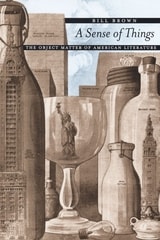
A Sense of Things
The Object Matter of American LiteratureBill Brown
University of Chicago Press, 2003
Brown's captivating new study explores the roots of modern America's fascination with things and the problem that objects posed for American literature at the turn of the century. This was an era when the invention, production, distribution, and consumption of things suddenly came to define a national culture. Brown shows how crucial novels of the time made things not a solution to problems, but problems in their own right. Writers such as Mark Twain, Frank Norris, Sarah Orne Jewett, and Henry James ask why and how we use objects to make meaning, to make or remake ourselves, to organize our anxieties and affections, to sublimate our fears, and to shape our wildest dreams. Offering a remarkably new way to think about materialism, A Sense of Things will be essential reading for anyone interested in American literature and culture.
A/MORAL ECONOMICS
CLASSICAL POLITICAL ECONOMY AND CULTURAL AUTHORITY IN NINETEENTH-CENTURY ENGLANDClaudia C. Klaver
The Ohio State University Press, 2003
A/Moral Economics is an interdisciplinary historical study that examines the ways which social “science” of economics emerged through the discourse of the literary, namely the dominant moral and fictional narrative genres of early and mid-Victorian England. In particular, this book argues that the classical economic theory of early-nineteenth-century England gained its broad cultural authority not directly, through the well- known texts of such canonical economic theorists as David Ricardo, but indirectly through the narratives constructed by Ricardo’s popularizers John Ramsey McCulloch and Harriet Martineau.
By reexamining the rhetorical and institutional contexts of classical political economy in the nineteenth century, A/Moral Economics repositions the popular writings of both supporters and detractors of political economy as central to early political economists’ bids for a cultural voice. The now marginalized economic writings of McCulloch, Martineau, Henry Mayhew, and John Ruskin, as well as the texts of Charles Dickens and J. S. Mill, must be read as constituting in part the entities they have been read as merely criticizing. It is this repressed moral logic that resurfaces in a range of textual contradictions—not only in the writings of Ricardo’s supporters, but, ironically, in those of his critics as well.
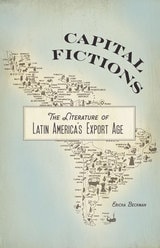
Capital Fictions
The Literature of Latin America's Export AgeEricka Beckman
University of Minnesota Press, 2012
Between 1870 and 1930, Latin American countries were incorporated into global capitalist networks like never before, mainly as exporters of raw materials and importers of manufactured goods. During this Export Age, entire regions were given over to the cultivation of export commodities such as coffee and bananas, capital and labor were relocated to new production centers, and barriers to foreign investment were removed. Capital Fictions investigates the key role played by literature in imagining and interpreting the rapid transformations unleashed by Latin America’s first major wave of capitalist modernization.
Using an innovative blend of literary and economic analysis and drawing from a rich interdisciplinary archive, Ericka Beckman provides the first extended evaluation of Export Age literary production. She traces the emergence of a distinct set of fictions, fantasies, and illusions that accompanied the rise of export-led, dependent capitalism. These “capital fictions” range from promotional pamphlets for Guatemalan coffee and advertisements for French fashions, to novels about stock market collapse in Argentina and rubber extraction in the Amazon.
Beckman explores how Export Age literature anticipated some of the key contradictions faced by contemporary capitalist societies, including extreme financial volatility, vast social inequality, and ever-more-intense means of exploitation. Questioning the opposition between culture and economics in Latin America and elsewhere, Capital Fictions shows that literature operated as a powerful form of political economy during this period.

Folded Selves
Colonial New England Writing in the World SystemMichelle Burnham
Dartmouth College Press, 2014
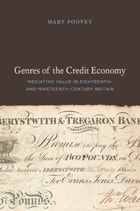
Genres of the Credit Economy
Mediating Value in Eighteenth- and Nineteenth-Century BritainMary Poovey
University of Chicago Press, 2008
Chronicling the process by which some of our most important conceptual categories were naturalized, Mary Poovey explores complex relationships among forms of writing that are not usually viewed together, from bills of exchange and bank checks, to realist novels and Romantic poems, to economic theory and financial journalism. Taking up all early forms of financial and monetarywriting, Poovey argues that these genres mediated for early modern Britons the operations of a market system organized around credit and debt. By arguing that genre is a critical tool for historical and theoretical analysis and an agent in the events that formed the modern world, Poovey offers a new way to appreciate the character of the credit economy and demonstrates the contribution historians and literary scholars can make to understanding its operations.
Much more than an exploration of writing on and around money, Genres of the Credit Economy offers startling insights about the evolution of disciplines and the separation of factual and fictional genres.
Queer Economic Dissonance and Victorian Literature
Meg Dobbins
The Ohio State University Press, 2022
The Insatiability of Human Wants
Economics and Aesthetics in Market SocietyRegenia Gagnier
University of Chicago Press, 2000
The Insatiability of Human Wants begins during a key transitional moment in aesthetic and economic theory, 1871, when both disciplines underwent a turn from production to consumption models. In economics, an emphasis on the theory of value and the social relations between land, labor, and capital gave way to more individualistic models of consumerism. Similarly, in aesthetics, theories of artistic production or creativity soon bowed to models of taste, pleasure, and reception.
Using these developments as a point of departure, Gagnier deftly traces the shift in Western thought from models of production to consumption. From its exploration of early market logic and Kantian thought to its look at the aestheticization of homelessness and our own market boom, The Insatiability of Human Wants invites us to contemplate alternative interpretations of economics, aesthetics, and history itself.