Results by title
12 books match the query 'Ecumenism & Interfaith'
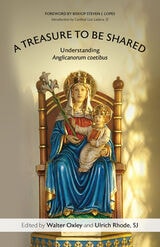
A Treasure to be Shared
Understanding <i>Anglicanorum coetibus</i>Walter Oxley
Catholic University of America Press, 2022
A Treasure to Be Shared is intended to promote a more widespread knowledge of the Apostolic Constitution Anglicanorum coetibus, promulgated by Pope Benedict XVI in 2009. The Apostolic Constitution provided for Personal Ordinariates for Anglicans entering into full communion with the Catholic Church. On the occasion of the 10th anniversary of the Apostolic Constitution, an academic symposium in the year 2019 sponsored by the Pontifical Gregorian University and the Congregation for the Doctrine of the Faith, provided historical, liturgical, canonical and ecumenical perspectives on the fruits of the Apostolic Constitution for the wider Church. The hope is that the reader will see the Personal Ordinariates of The Chair of Saint Peter in the United States and Canada, Our Lady of Walsingham in Great Britain and Our Lady of the Southern Cross in Australia as a gift to the Church, and a treasure to be shared by all.
[more]
Church and Communion
An Introduction to Ecumenical Theology, Second EditionPhilip Goyret
Catholic University of America Press, 2021
This book is about ecumenism, from a Catholic point of view. The first part, chapters 1 and 2, describe the history of divisions within the Church, as well as of the efforts to bring about Christian unity. The second part examines Ecumenism from a systematic theological perspective.
This first part takes into account the different factors that led to definitive ruptures within the Church, which usually are not only theological. The text gives useful information about what happened after the respective divisions as well as about the various attempts to restore unity, the development of the Ecumenical Movement in the 20th Century, and the current situation of ecumenical dialogue within the Catholic Church. While offering insight into the sad history that has led to the present disunity, this work also highlights the way Christians have sought to bring to fulfill the petition of Christ that his disciples might be one, as He and the Father are one.
The second part―chapters three, four and five―offers a systematic theological analysis of unity in the Church, from the point of view of dogmatic theology. We find here an explanation of the Catholic concept of ecumenism, of how Catholic theology understands the unity of the Church, and, finally, of the Catholic principles which sustain the efforts for regaining unity in the Church. The Second Vatican Council, and particularly the Constitution Lumen gentium and the Decree Unitatis redintegratio, are at the foundation of these reflections. At the same time, since the theology of the Church and the life of the Church are intimately connected, there is a profound link between this dogmatic section and the earlier historical section.
The last chapter, about the practice of ecumenism, is also written from a theological perspective, but with more links with life and spirituality. The chapter recalls that ecumenism can never simply remain a set of theological principles, but rather inspires an attitude and action in charity which are essential to the Christian life.
[more]
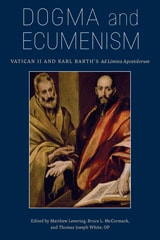
Dogma and Ecumenism
Vatican II and Karl Barth's 'Ad Limina Apostolorum'Matthew Levering
Catholic University of America Press, 2020
The conversation of this book is structured around five major documents from the Second Vatican Council, each of which Barth commented upon in his short but penetrating response to the Council, published as Ad Limina Apostolorum. In the two opening essays, Thomas Joseph White reflects upon the contribution that this book seeks to make to contemporary ecumenism rooted in awareness of the value of dogmatic theology; and Matthew Levering explores the way in which Barth’s Ad Limina Apostolorum flows from his preconciliar dialogues with Catholic representatives of the nouvelle théologie and remain relevant to the issues facing Catholic theology today. The next two essays turn to Dei Verbum, the Dogmatic Constitution on Divine Revelation; here Katherine Sonderegger (Protestant) reflects on scripture and Lewis Ayres (Catholic) reflects on tradition. The next two essays address the Dogmatic Constitution on the Church, Lumen Gentium, which touches upon central differences of Catholic and Protestant self-understanding. Christoph Schwöbel (Protestant) analyzes visible ecclesial identity as conceived in a Protestant context, while Thomas Joseph White (Catholic) engages Barth’s Reformed criticisms of the Catholic notion of the Church. The next two essays take up Nostra Aetate: Bruce Lindley McCormack (Protestant) asks whether it is true to say that Muslims worship the same God as Christians, and Bruce D. Marshall (Catholic) explores the implications of the Council’s reflections on the Jewish people. The next two essays take up the Pastoral Constitution on the Church in the Modern World, Gaudium et Spes: John Bowlin (Protestant) makes use of the thought of Aquinas to consider the promise and perils of the document, while Francesca Aran Murphy (Catholic) engages critically with George Lindbeck’s analysis of the document. The next two essays explore Unitatis Redintegratio: Hans Boersma (Protestant) asks whether the ecumenical intention of the document is impaired by its insistence that the unity of the Church is already present in the Catholic Church, and Reinhard Hütter (Catholic) systematically addresses Barth’s questions regarding the document. The noted ecumenist and Catholic theologian Richard Schenk brings the volume to a close by reflecting on “true and false ecumenism” in the post-conciliar period.
[more]
Eastern Catholic Theology in Action
Essays in Liturgy, Ecclesiology, and EcumenismAndrew J. Summerson
Catholic University of America Press, 2024
The Second Vatican Council urged Eastern Catholics to cultivate their share of divine revelation for the benefit of the entire Catholic Church. Yet, more than 50 years later, the Eastern Catholic Churches frequently remain on the margins, both in the theological academy and in the life of the Church more broadly. In an effort to remedy this situation, at least in part, this volume offers a scholarly reflection on the unique patrimony of the Eastern Catholic Churches, divided according to the categories of Liturgy, Theology, Spirituality, Discipline, and Culture. In so doing, it both follows the categories used to define a Church sui iuris in the Code of Canon Law for the Eastern Churches, and builds on the legacy of the Rev. Peter Galadza, to whom the volume is dedicated.
On one hand, the volume and its essays are intentionally introductory, revealing the worlds of Eastern Catholicism and the variety of theological approaches that take place there. Emerging in part from the experience of teaching and preaching by scholars of Eastern Christianity, who are frequently asked for a basic introduction to Eastern Catholic theology, and have little to offer in response, these essays gather an international group of scholars engaging in critical, theological reflection from an Eastern Catholic perspective. This approach is rounded out by contributions from Roman Catholic, Orthodox, and Protestant scholars, who articulate their own reception and appreciation of the Eastern Catholic theological heritage.
At the same time, however, several of the essays in this volume relate the history and current reality of Eastern Catholicism to the Orthodox and Roman Catholic Churches, yet without ignoring how frequently Eastern Catholics live, worship, and theologize without self-conscious regard for their unique ecclesial situation. Indeed, these authors show, Eastern Catholic theology can be unself-consciously grounded in the patristic tradition, and Eastern Catholics can simply “do” theology, without worrying about ecclesial politics. Readers will thus find here the best of both worlds: both an introduction to the unique and frequently ignored patrimony of the Eastern Catholic Churches, and a series of essays that avoids the all-to-common pitfall of reducing these traditions to a parody of other Churches, Eastern or Western. Instead, by engaging with the sources of the Christian tradition – as Eastern Catholics, yes, but first and foremost as Christians – the authors reveal how much their tradition can offer the Catholic Church as a whole.
[more]
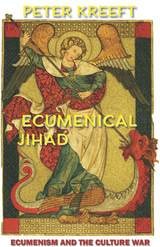
Ecumenical Jihad
Ecumenism and the Culture WarPeter Kreeft
St. Augustine's Press, 2015
Juxtaposing “ecumenism” and “jihad,” two words that many would consider strange and at odds with one another, Peter Kreeft argues that we need to change our current categories and alignments. We need to realize that we are at war and that the sides have changed radically. Documenting the spiritual and moral decay that has taken hold of modern society, Kreeft issues a wake-up call to all God-fearing Christians, Jews, and Muslims to unite together in a “religious war” against the common enemy of godless secular humanism, materialism, and immorality.
Aware of the deep theological differences of these monotheistic faiths, Kreeft calls for a moratorium on our polemics against one another so that we can form an alliance to fight together to save Western civilization.
Aware of the deep theological differences of these monotheistic faiths, Kreeft calls for a moratorium on our polemics against one another so that we can form an alliance to fight together to save Western civilization.
[more]
Faithful Interpretations
Truth and Islam in Catholic Theology of ReligionsPhilip Geister
Catholic University of America Press, 2021
”Theology of Religions” is among the most burning issues within Christian theology today. The challenge to study and discuss different ways of handling conflicting truth claims and religious narratives between religions is taken up by a growing number of theologians across denominational boundaries. This is a common and ecumenical effort undertaken by Christian theologians all over the world. And yet, the impact of specific ecclesiastical or theological traditions on different concepts of theology of religions should not be underestimated. As well known, the Second Vatican council with its pivotal decree Nostra Aetate (On the relation to other religions) not only set the agenda for Catholic theology, but even influenced the wider discussion on the topic. The papers of this volume were all given at a conference in Uppsala, Sweden in October 2017. The structure of Faithful Interpretations follows closely the way the conference was conducted.
A general introduction to the development and present status of ”Theology of Religions” by Marianne Moyaert opens the book. Archbishop J Augustine Di Noia of the Vatican Congregation for the Doctrine of Faith then treats the recent developments in the teaching of the Magisterium regarding theology of religions. Anna Bonta Moreland adresses the issue of Muhammad and Christian Prophecy. Diego R Sarrió Cucarella focuses on early Christian theological views of Islam and concludes that Islam has been from the begining a ”disturbing” factor in the Christian view of salvation history. Wilhelmus G B M Valkenberg discusses the impact of Nostra Aetate on the Church’s relation to Muslims, using especially the precedent of Nicolaus of Cues as regards a constructive approach to Islam. Klaus von Stosch adresses a sensitive issue in Muslim-Christian relations and illustrates the advantages of the comparative theology approach for the theology of religions.
Complementing this perspective, Peter Jonkers offers a hermeneutical perspective on truth claims, and reflects on ”the religious Other” with references to Jacques Derrida among others. Reinhold Bernhardt argues in favour of a biblically grounded “relational-existential” theory of truth, which would be most helpful with regard to other religions. To conclude, the prominent Catholic specialist on Theology of Religions, Gavin D’Costa, widened the perspective by addressing the relation to Judaism from the point of view of the covenant and the promises of the land. Altogether, the papers of this volume give a clear impression of the status of Roman Catholic Theology of Religions.
[more]
God Is Love
Thomas Aquinas on the Being and Action of the Holy SpiritMichael D. Torre
Catholic University of America Press, 2026
This book dedicates three essays each to three different theological problems regarding the Holy Spirit: In God and for Us (The "Filioque" and "Uncreated Grace"); Thomas's Understanding (Not His Commentators) of the Relation between nature and sanctifying grace; and our ability (and that of the angels at their creation) in fact to resist God' grace and thus be the first cause of sin. This later problem is developed in an "excursus" on the way God moves the free will, one that takes into consideration much recent work on this issue and situates the essays' position in relation to it. The book ends with a brief epilogue on the credibility of God, again giving Thomas's account of this.
The principal aim throughout is to understand the doctrine of Thomas Aquinas. It places his views in relation to three audiences: chiefly to the orthodox regarding the first issue; to Catholics in relation to the second; and to Protestants in relation to the third. Thus, its second aim is to join "ecumenical debate" about these matters. The essays were mostly written to be delivered orally, to an informed audience of philosophers and theologians., but one that consisted of "generalists" and serious students of Thomas, as well as of "professional" philosophers and theologians. All three of the debated issues discussed have generated an enormous amount of disagreement and debate, not a little of it being quite "technical." Thus, each issue would easily require a long and significant book to be addressed as it deserves. The essays do not do this, but they do indicate what Torre holds is the "directive line" of Thomas's thought that deserves to be defended and developed in each case, and, in each case, this line is held to be markedly different than many have thought it to be.
[more]
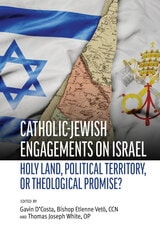
Jewish-Catholic Engagements on Israel
Holy Land, Political Territory, or Theological Promise?Gavin D'Costa
Catholic University of America Press, 2025
This is the first volume of its kind, bringing together a group of international Jewish and Catholic scholars in creative conversation addressing the question of the status of the land called Israel. Is Israel best viewed as political territory, the ‘Holy Land’, or part of the biblical promise? If committing to one of these options, what are the theological and political consequences?
The book is divided into sections that take the reader through several related questions that bear upon this topic. There is a preface with an overview of how far Catholic Jewish conversations have gone since Nostra Aetate, and how these conversations have now begun to address the land. Then there is an attempt to advance positive theological cases by Catholics and Jews affirming the people in the land as theologically significant, not without difficulties regarding the state itself. The next section deals with the bible/Tanakh as the basis of such claims and addresses the different reading strategies by each community. One of the central questions is then addressed: what of the Palestinian people, do the biblical promise to the Jewish people spell disaster for the Palestinians? Can revelation mean dispossession? The following essays address a stumbling block for both groups: do Jewish and Christian theologies underwrite a nation state? Isn’t this option perilously close to God underwriting nationalism? The book ends with subtle critiques of the entire venture undertaken in this volume.
Essential reading for Catholic Jewish relations and one that addresses one of the most pressing contemporary questions for both religions.
[more]
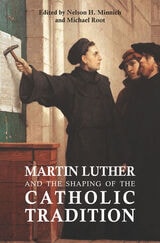
Martin Luther and the Shaping of the Catholic Tradtion
Nelson H. Minnich
Catholic University of America Press, 2022
When Martin Luther distributed his 95 Theses on indulgences on October 31, 1517, he set in motion a chain of events that profoundly transformed the face of Western Christianity. The 500th anniversary of the 95 Theses offered an opportunity to reassess the meaning of that event. The relation of the Catholic Church to the Reformation that Luther set in motion is complex. The Reformation had roots in the late-medieval Catholic tradition and the Catholic reaction to the Reformation altered Catholicism in complex ways, both positive and negative. The theology and practice of the Orthodox church also entered into the discussions. A conference entitled “Luther and the Shaping of the Catholic Tradition,” held at The Catholic University of America, with thirteen Catholic, Orthodox, and Protestant speakers from Germany, Finland, France, the Vatican, and the United States addressed these issues and shed new light on the historical, theological, cultural relationship between Luther and the Catholic tradition. It contributes to deepening and extending the recent ecumenical tradition of Luther-Catholic studies.
[more]

The Catholic Church and the Genesis of the Arab-Israeli Conflict
Vatican Diplomacy and Interfaith Relations During the Interwar Period, 1918-1939Bernhard Kronegger
Catholic University of America Press, 2026
This book delves into the history of how the Catholic Church’s leadership, both in the Vatican and in the Latin Patriarchate of Jerusalem, responded to the emerging conflict between Zionism and Palestinian nationalism for the future of the Holy Land. Beginning with the Balfour Declaration of 1917 and the conquest of Jerusalem by the Allied forces, it traces how the popes, Benedict XV (1914-1922) as well as Pius XI (1922-1939), anxiously and skeptically regarded British designs for what would become Mandatory Palestine. Through the economic crisis of the late 1920s, the violent clashes of the Arab Revolt, and ending with the outbreak of the Second World War, it examines how the relationship between the local Catholic community and British government officials developed, from evictions and expropriations following wartime upheavals to a careful co-operation filled with mistrust and tensions. Likewise, it investigates how the escalating hostility and violence between the Jewish and Muslim sections of the population influenced the interreligious relations between them and Catholics. Based on research in the Vatican Archives, it offers novel perspectives on the shifting policies of the Vatican, the maneuvrings of European governments and the schemes of the Latin Patriarch of Jerusalem, Luigi Barlassina, to further their interests in the struggle for the future of the Holy Land.
[more]
The Challenge of Catholic-Jewish Theological Dialogue
Matthew Tapie
Catholic University of America Press, 2024
[more]
The Power of Dialogue between Israelis and Palestinians
Stories of Change from the School for PeaceSonnenschein, Nava
Rutgers University Press, 2019
In The Power of Dialogue between Israelis and Palestinians, scholar and activist Nava Sonnenschein shares a collection of twenty-five powerful interviews she conducted with Palestinian and Jewish Israeli alumni of peacebuilding courses, a decade after their graduation. Participants with diverse personal and professional backgrounds completed a series of conflict transformation workshops using the model developed by the School for Peace at the world’s only intentional Jewish-Palestinian community, Neve Shalom-Wahat al-Salam (“Oasis of Peace” in Hebrew and Arabic). Critically, the interviews vividly demonstrate that peacebuilding does not end with the courses. Most of the graduates choose to work professionally in roles that contribute to peace-building. Sonnenschein shows the transformational potential of encounter between members of groups in conflict, sharing how ordinary Israelis and Palestinians coming together in an open and honest environment undergo life-changing experiences that provide concrete hope for a sustainable path to a peaceful shared existence as equals in Israel and Palestine.
[more]