Results by title
110 books match the query 'Education (Higher)' and 8 start with a
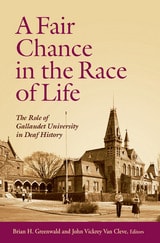
A Fair Chance in the Race of Life
The Role of Gallaudet University in Deaf HistoryBrian H. Greenwald
Gallaudet University Press, 2008
Despite its prominence as a world cultural center and a locus of research on deaf culture, history, education, and language for more than 150 years, Gallaudet University has only infrequently been the focal point of historical study. Eminent historians Brian H. Greenwald and John Vickrey Van Cleve have remedied this scarcity with A Fair Chance in the Race of Life: The Role of Gallaudet University in Deaf History. In this collection, a remarkable cast of scholars examine the university and its various roles through time, many conducting new research in the Gallaudet University Archives, an unsurpassed repository of primary sources of deaf history.
Pulitzer-Prize-winning historian James M. McPherson sets the stage in his essay “A Fair Chance in the Race of Life,” President Abraham Lincoln’s statement when he chartered the first college for deaf students. The papers that follow scrutinize Gallaudet’s long domination by hearing presidents, its struggle to find a place within higher education, its easy acquiescence to racism, its relationship with the federal government, and its role in creating, shaping, and nurturing the deaf community.
These studies do more than simply illuminate the university, however. They also confront broad issues that deal with the struggles of social conformity versus cultural distinctiveness, minority cohesiveness, and gender discrimination. “Deaf” themes, such as the role of English in deaf education, audism, and the paternalism of hearing educators receive analysis as well.
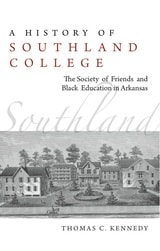
A History of Southland College
The Society of Friends and Black Education in ArkansasThomas Kennedy
University of Arkansas Press, 2009
Academic Ableism
Disability and Higher EducationJay Timothy Dolmage
University of Michigan Press, 2017
Academic Ableism
Disability and Higher EducationJay Timothy Dolmage
University of Michigan Press, 2017
Activist Rhetorics and American Higher Education, 1885-1937
Susan Kates
Southern Illinois University Press, 2000
In this study of the history of rhetoric education, Susan Kates focuses on the writing and speaking instruction developed at three academic institutions founded to serve three groups of students most often excluded from traditional institutions of higher education in late-nineteenth-and early-twentieth-century America: white middle-class women, African Americans, and members of the working class.
Kates provides a detailed look at the work of those students and teachers ostracized from rhetorical study at traditional colleges and universities. She explores the pedagogies of educators Mary Augusta Jordan of Smith College in Northhampton, Massachusetts; Hallie Quinn Brown of Wilberforce University in Wilberforce, Ohio; and Josephine Colby, Helen Norton, and Louise Budenz of Brookwood Labor College in Katonah, New York.
These teachers sought to enact forms of writing and speaking instruction incorporating social and political concerns in the very essence of their pedagogies. They designed rhetoric courses characterized by three important pedagogical features: a profound respect for and awareness of the relationship between language and identity and a desire to integrate this awareness into the curriculum; politicized writing and speaking assignments designed to help students interrogate their marginalized standing within the larger culture in terms of their gender, race, or social class; and an emphasis on service and social responsibility.
Affirmative Action and the University
A Philosophical Inquiryedited by Steven M. Cahn
Temple University Press, 1995

African Students in East Germany, 1949-1975
Sara Pugach
University of Michigan Press, 2022
This book explores the largely unexamined history of Africans who lived, studied, and worked in the German Democratic Republic. African students started coming to the East in 1951 as invited guests who were offered scholarships by the East German government to prepare them for primarily technical and scientific careers once they returned home to their own countries. Drawn from previously unexplored archives in Germany, Ghana, Kenya, Zambia, and the United Kingdom, African Students in East Germany, 1949–1975 uncovers individual stories and reconstructs the pathways that African students took in their journeys to the GDR and what happened once they got there. The book places these experiences within the larger context of German history, questioning how ideas of African racial difference that developed from the eighteenth through the early twentieth centuries impacted East German attitudes toward the students.
The book additionally situates African experiences in the overlapping contexts of the Cold War and decolonization. During this time, nations across the Western and Soviet blocs were inviting Africans to attend universities and vocational schools as part of a drive to offer development aid to newly independent countries and encourage them to side with either the United States or Soviet Union in the Cold War. African leaders recognized their significance to both Soviet and American blocs, and played on the desire of each to bring newly independent nations into their folds. Students also recognized their importance to Cold War competition, and used it to make demands of the East German state. The book is thus located at the juncture of many different histories, including those of modern Germany, modern Africa, the Global Cold War, and decolonization.
An American Phoenix
A History of Storer College from Slavery to Desegregation 1865-1955, Commemorative EditionDawne Raines Burke
West Virginia University Press, 2015
In the first book-length study of Storer College, Dawne Raines Burke tells the story of the historically black institution from its Reconstruction origins to its demise in 1955. Established by Northern Baptists in the abolitionist flashpoint of Harpers Ferry, Storer was the first college open to African Americans in West Virginia, and it played a central role in regional and national history. In addition to educating generations of students of all races, genders, and creeds, Storer served as the second meeting place (and the first on U.S. soil) for the Niagara Movement, a precursor to the NAACP.
An American Phoenix provides a comprehensive and extensively illustrated history of this historically black college, bringing to life not just the institution but many of the individuals who taught or were educated there. It fills a significant gap in our knowledge of African American history and the struggle for rights in West Virginia and the wider world.