Results by title
17 books match the query 'Educational Law & Legislation'
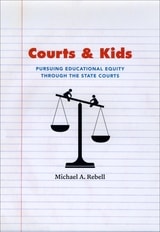
Courts and Kids
Pursuing Educational Equity through the State CourtsMichael A. Rebell
University of Chicago Press, 2009
Over the past thirty-five years, federal courts have dramatically retreated from actively promoting school desegregation. In the meantime, state courts have taken up the mantle of promoting the vision of educational equity originally articulated in Brown v. Board of Education. Courts and Kids is the first detailed analysis of why the state courts have taken on this active role and how successful their efforts have been.
Since 1973, litigants have challenged the constitutionality of education finance systems in forty-five states on the grounds that they deprive many poor and minority students of adequate access to a sound education. While the plaintiffs have won in the majority of these cases, the decisions are often branded “judicial activism”—a stigma that has reduced their impact. To counter the charge, Michael A. Rebell persuasively defends the courts’ authority and responsibility to pursue the goal of educational equity. He envisions their ideal role as supervisory, and in Courts and Kids he offers innovative recommendations on how the courts can collaborate with the executive and legislative branches to create a truly democratic educational system.
ENACTing Change
A Handbook for Teaching Advocacy and Civic EngagementKathleen Cole, Robert W. Glover, Richard J. Meagher, and Katharine A. Owens
Brandeis University Press, 2025
ENACT: The Educational Network for Active Civic Transformation aims to teach college students about democracy through engagement with the state legislative process. Built on the values of knowledge, cooperation, justice, and integrity, ENACT is a national, intercollegiate nonpartisan network. The program empowers students to be active participants in democratic processes by connecting with policymakers and community organizations, conducting research and analysis, and informing public policy with evidence and expertise.
ENACTing Change introduces teachers to the philosophy and practice of the ENACT model—which includes workshops, courses, an online network, as well as pilot projects and other initiatives—while providing detailed guidance on how to incorporate the model into their courses, regardless of discipline or educational settings. The book offers instructors recommendations for developing and teaching courses that engage in state-level policy advocacy with a focus on learning outcomes. ENACTing Change takes instructors through each step of the course design process, from how to build the relationships needed to teach the class to the next steps for students to work in the community after ENACT.
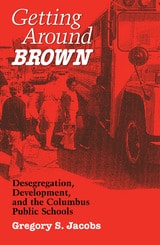
Getting around Brown
Desegregation, Development, and the Columbus Public SchoolsGregory S. Jacobs
The Ohio State University Press, 1998
Getting Around Brown is both the first history of school desegregation in Columbus, Ohio, and the first case study to explore the interplay of desegregation, business, and urban development in America.
Drawing on a broad range of sources, including over sixty interviews, the book details the causes and consequences of Penick v. Columbus Board of Education (1977). Gregory S. Jacobs argues that school desegregation in Columbus failed to produce equal educational opportunity, not because it was inherently detrimental to learning, but because it was incompatible with urban development. As a consequence, the long-term health of the city school district was sacrificed to preserve the growth of the city itself. The resulting middle-class abandonment of urban education in Columbus produced an increasingly poor, African-American city school system and a powerful form of defensive activism within the overwhelmingly white suburban systems.
The title of the book refers not only to the elaborate tools used to circumvent the spirit of the Supreme Court’s landmark 1954 Brown v. Board of Education decision but also to the need to move beyond the flawed dichotomies and failed policies that have come to define desegregation. The book calls for a reconsideration of the complicated relationship race, class, and housing patterns have with city school reform efforts, a relationship obscured by this country’s vitriolic and occasionally violent battle over busing. Jacobs concludes his study with a “modest proposal,” in which he recommends the abolition of the Columbus Public School District, the dispersal of its students throughout surrounding suburban systems, and the creation of a choice-based “experimental education zone” within the old city school district boundaries.
Readable and relevant, Getting around Brownis essential reading for scholars of recent American history, urban studies, civil rights and race relations, and educational policy, as well as anyone interested in public education and politics.
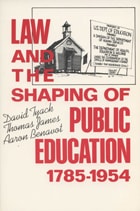
Law and the Shaping of Public Education, 1785-1954
Edited by David Tyack, Thomas James, and Aaron Benavot
University of Wisconsin Press, 1991
Promise of Justice
Essays on Brown v. Board of EducationMac A. Stewart
The Ohio State University Press, 2008

Race, Class, and Affirmative Action
Sigal Alon is an associate professor in the Department of Sociology and Anthropology at Tel-Aviv University.
Russell Sage Foundation, 2015
Alon finds that affirmative action at elite institutions in both countries is a key vehicle of mobility for disenfranchised students, whether they are racial and ethnic minorities or socioeconomically disadvantaged. Affirmative action improves their academic success and graduation rates and leads to better labor market outcomes. The beneficiaries of affirmative action in both countries thrive at elite colleges and in selective fields of study. As Alon demonstrates, they would not be better off attending less selective colleges instead.
Alon finds that Israel’s class-based affirmative action programs have provided much-needed entry slots at the elite universities to students from the geographic periphery, from high-poverty high schools, and from poor families. However, this approach has not generated as much ethnic diversity as a race-based policy would. By contrast, affirmative action policies in the United States have fostered racial and ethnic diversity at a level that cannot be matched with class-based policies. Yet, class-based policies would do a better job at boosting the socioeconomic diversity at these bastions of privilege. The findings from both countries suggest that neither race-based nor class-based models by themselves can generate broad diversity. According to Alon, the best route for promoting both racial and socioeconomic diversity is to embed the consideration of race within class-based affirmative action. Such a hybrid model would maximize the mobility benefits for both socioeconomically disadvantaged and minority students.
Race, Class, and Affirmative Action moves past political talking points to offer an innovative, evidence-based perspective on the merits and feasibility of different designs of affirmative action.
Realizing Educational Rights
Advancing School Reform through Courts and CommunitiesAnne Newman
University of Chicago Press, 2013
Newman argues that an adequate K–12 education is the right of all citizens, as a matter of equality, and emphasizes that this right must be shielded from the sway of partisan and majoritarian policy making far more than it currently is. She then examines how educational rights are realized in our current democratic structure, offering two case studies of leading types of rights-based activism: school finance litigation on the state level and the mobilization of citizens through community-based organizations. Bringing these case studies together with rich philosophical analysis, Realizing Educational Rights advances understanding of the relationships among moral and legal rights, education reform, and democratic politics.
Sunk Cost
Who’s to Blame for the Nation’s Broken Student Loan System and How to Fix ItJillian Berman
University of Chicago Press, 2025
Student-loan horror stories are a dime a dozen. But students today are faced with a seemingly insurmountable paradox: Research consistently shows that the clearest viable option to financial stability is a college degree. But if and when Americans decide to pursue diplomas, student loan payments quickly follow, and even after securing full-time employment, many borrowers struggle to make ends meet for years. In Sunk Cost, journalist Jillian Berman explores how the nation’s student loan program went from a well-intentioned initiative aimed at helping low- and middle-income students afford college to one that traps borrowers in long-term debt.
Berman interviewed dozens of borrowers and policymakers and dug into the archives to unearth the true causes of the student loan problem. A couple of generations ago, policy makers generously subsidized Americans’ college educations because they knew it would be advantageous for the entire country: a more educated population meant better quality of life for all. But today, higher education is viewed as an individual goal, so students and their families are expected to be on the hook for it themselves. Berman explains how this enormous shift happened, which industries benefit from it, and what it means for college-going Americans today. She shares real-life stories of college graduates who are being crushed under some of the harshest consequences of the student loan system. These borrowers pursued higher education in hopes of a better life and yet some have been trapped in debt for decades, making it difficult to put food on the table, much less imagine a life beyond debt.
By connecting personal accounts to the policy history of student loans, Berman makes clear that if American society continues to push students toward higher education, but fails to truly subsidize it, the financial strain will become unbearable for all but the most privileged. The current system is broken, but Berman proposes that significant changes are possible, and will require political will from state lawmakers and Congress, along with a philosophical shift, to tackle one of the largest consumer finance challenges of our time.
The Chicago Canon on Free Inquiry and Expression
Edited by Tony Banout and Tom Ginsburg
University of Chicago Press, 2024
Free inquiry and expression are hotly contested, both on campus and in social and political life. Since its founding in the late nineteenth century, the University of Chicago has been at the forefront of conversations around free speech and academic freedom in higher education. The University’s approach to free expression grew from a sterling reputation as a research university as well as a commitment to American pragmatism and democratic progress, all of which depended on what its first president referred to as the “complete freedom of speech on all subjects.” In 2015, more than 100 years later, then University provost and president J. D. Isaacs and Robert Zimmer echoed this commitment, releasing a statement by a faculty committee led by law professor Geoffrey R. Stone that has come to be known as the Chicago Principles, now adopted or endorsed by one hundred US colleges and universities. These principles are just a part of the long-standing dialogue at the University of Chicago around freedom of expression—its meaning and limits. The Chicago Canon on Free Inquiry and Expression brings together exemplary documents – some published for the first time here – that explain and situate this ongoing conversation with an introductory essay that brings the tradition to light.
Throughout waves of historical and societal challenges, this first principle of free expression has required rearticulation and new interpretations. The documents gathered here include, among others, William Rainey Harper’s “Freedom of Speech” (1900), the Kalven Committee’s report on the University’s role in political and social action (1967), and Geoffrey R. Stone’s “Free Speech on Campus: A Challenge of Our Times” (2016). Together, the writings of the canon reveal how the Chicago tradition is neither static nor stagnant, but a vibrant experiment; a lively struggle to understand, practice, and advance free inquiry and expression.
At a time of nationwide campus speech debates, engaging with these texts and the questions they raise is essential to sustaining an environment of broad intellectual and ideological diversity. This book offers a blueprint for the future of higher education’s vital work and points to the civic value of free expression.
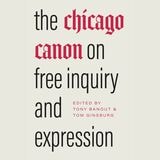
The Chicago Canon on Free Inquiry and Expression
Edited by Tony Banout and Tom Ginsburg
University of Chicago Press, 2024
A collection of texts that provide the foundation for the University of Chicago’s longstanding tradition of free expression, principles that are at the center of current debates within higher education and society more broadly.
Free inquiry and expression are hotly contested, both on campus and in social and political life. Since its founding in the late nineteenth century, the University of Chicago has been at the forefront of conversations around free speech and academic freedom in higher education. The University’s approach to free expression grew from a sterling reputation as a research university as well as a commitment to American pragmatism and democratic progress, all of which depended on what its first president referred to as the “complete freedom of speech on all subjects.” In 2015, more than 100 years later, then University provost and president J. D. Isaacs and Robert Zimmer echoed this commitment, releasing a statement by a faculty committee led by law professor Geoffrey R. Stone that has come to be known as the Chicago Principles, now adopted or endorsed by one hundred US colleges and universities. These principles are just a part of the long-standing dialogue at the University of Chicago around freedom of expression—its meaning and limits. The Chicago Canon on Free Inquiry and Expression brings together exemplary documents – some published for the first time here – that explain and situate this ongoing conversation with an introductory essay that brings the tradition to light.
Throughout waves of historical and societal challenges, this first principle of free expression has required rearticulation and new interpretations. The documents gathered here include, among others, William Rainey Harper’s “Freedom of Speech” (1900), the Kalven Committee’s report on the University’s role in political and social action (1967), and Geoffrey R. Stone’s “Free Speech on Campus: A Challenge of Our Times” (2016). Together, the writings of the canon reveal how the Chicago tradition is neither static nor stagnant, but a vibrant experiment; a lively struggle to understand, practice, and advance free inquiry and expression.
At a time of nationwide campus speech debates, engaging with these texts and the questions they raise is essential to sustaining an environment of broad intellectual and ideological diversity. This book offers a blueprint for the future of higher education’s vital work and points to the civic value of free expression.
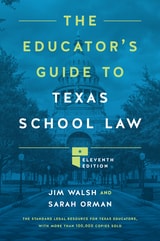
The Educator's Guide to Texas School Law
Eleventh EditionJim Walsh and Sarah Orman
University of Texas Press, 2026
A new edition of the most authoritative guide to Texas school law.
Over the past five years, the US Supreme Court, the White House, and the Texas legislature have collectively been responsible for seismic changes in the landscape of education in the Lone Star State. The eleventh edition of The Educator's Guide to Texas School Law is your up-to-date resource for understanding what the law is and what it means for effective school operations.
Intended for educators, school board members, attorneys, and taxpayers, the eleventh edition offers a comprehensive review of the evolving legal structure of schooling in Texas. Jim Walsh and Sarah Orman highlight pressing issues that educators encounter daily: What are teachers’ and students’ free speech rights? What about due process and religious exercise? Exactly how are teachers hired, and under what circumstances can they be fired? The Educators’ Guide also explains the role of the school board and important dimensions of school district governance, including procurement and compliance with the Open Meetings Act. This latest edition focuses intensively on recent areas of reform, including parents’ rights, special-needs law, and education savings accounts. More essential than ever, the Educator’s Guide provides clarity in uncertain times.
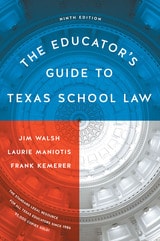
The Educator's Guide to Texas School Law
Ninth EditionBy Jim Walsh, Laurie Maniotis, and Frank Kemerer
University of Texas Press, 2018
Much has changed in the area of school law since the first edition of The Educator’s Guide was published in 1986. This new ninth edition offers an authoritative source on all major dimensions of Texas school law through the 2017 legislative sessions. Intended for educators, school board members, interested attorneys, and taxpayers, the ninth edition explains what the law is and what the implications are for effective school operations. It is designed to help professional educators avoid expensive and time-consuming lawsuits by taking effective preventive action. It is an especially valuable resource for school law courses and staff development sessions.
The ninth edition begins with a review of the legal structure of the Texas school system, incorporating recent innovative features such as charter schools and districts of innovation. Successive chapters address attendance, the instructional program, service to students with special needs, the rights of public school employees, the role of religion, student discipline, governmental transparency, privacy, parent rights, and the parameters of legal liability for schools and school personnel. The book includes discussion of major federal legislation, such as the Individuals with Disabilities Education Act, the Family Educational Rights and Privacy Act, Section 504 of the Rehabilitation Act of 1973, and the Every Student Succeeds Act. On the state level, the book incorporates new laws pertaining to cyberbullying and inappropriate relationships between students and employees. Key points are illustrated through case law, and a complete index of case citations is included.
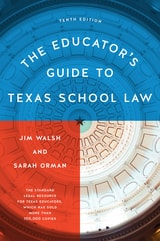
The Educator's Guide to Texas School Law
Tenth EditionJim Walsh and Sarah Orman
University of Texas Press, 2022
Much has changed in the area of school law since the first edition of The Educator’s Guide to Texas School Law was published in 1986. This new tenth edition of The Educator’s Guide offers an authoritative source on Texas school law through the 2021 legislative sessions. Intended for educators, school board members, attorneys, and taxpayers, it explains what the law is and what the implications are for effective school operations; it helps professional educators avoid expensive and time-consuming lawsuits by taking effective preventive action; and it serves as a highly valuable resource for school law courses and staff development sessions.
The tenth edition begins with a review of the legal structure of the Texas school system, incorporating recent features such as charter schools and districts of innovation, then addresses the instructional program, service to students with special needs, the rights of public school employees, the role of religion, student discipline, governmental transparency, privacy, parental rights, and the parameters of legal liability for schools and school personnel. The book includes discussion of major federal legislation, such as the Individuals with Disabilities Education Act, the Family Educational Rights and Privacy Act, Section 504 of the Rehabilitation Act of 1973, and Title IX. On the state level, the book incorporates laws pertaining to cyberbullying, inappropriate relationships between students and employees, and human sexuality instruction.
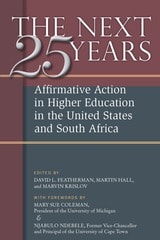
The Next Twenty-five Years
Affirmative Action in Higher Education in the United States and South AfricaDavid L. Featherman, Martin Hall, and Marvin Krislov, editors
University of Michigan Press, 2009
"Ambitious, provocative, and wide-ranging, this rich collection of essays from U.S. and South African perspectives reflects the thinking of thoughtful advocates of affirmative action."
---William G. Bowen, President Emeritus, The Andrew W. Mellon Foundation, and President Emeritus, Princeton University
"Thoughtful commentary from outstanding experts on affirmative action’s future in two countries struggling to overcome a legacy of racial injustice."
---Derek Bok, 300th Anniversary University Research Professor, and President Emeritus, Harvard University
"An enormously important comparative study and reflection on affirmative (U.S.) and corrective (South Africa) action with exhaustive and sensitive treatment of a vital topic."
---Kader Asmal, Professor of Law, University of the Western Cape, Cape Town, and former Minister of Education, South Africa
A penetrating exploration of affirmative action's continued place in 21st-century higher education, The Next Twenty-five Years assembles the viewpoints of some of the most influential scholars, educators, university leaders, and public officials. Its comparative essays span the political spectrum and dissect debates in two nations to elucidate the legal, political, social, economic, and moral dimensions of affirmative action in higher education and its role in contributing to a just, equitable, and vital society.
David L. Featherman is Professor of Sociology and Psychology and Founding Director of the Center for Advancing Research and Solutions for Society at the University of Michigan.
Martin Hall is Vice-Chancellor of the University of Salford, Greater Manchester, and previously was Deputy Vice-Chancellor at the University of Cape Town.
Marvin Krislov is President of Oberlin College and previously was Vice President and General Counsel at the University of Michigan.
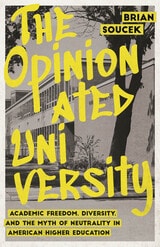
The Opinionated University
Academic Freedom, Diversity, and the Myth of Neutrality in American Higher EducationBrian Soucek
University of Chicago Press, 2026
Can a university ever truly be neutral in today’s social and political climate? Pushing against the tide of universities increasingly pledging to stay neutral about contentious issues, law professor Brian Soucek argues that their promises are doomed to fail—universities can’t help being opinionated.
In The Opinionated University, Soucek shows that neutrality is a myth by taking a deep dive into several prominent campus controversies of the day, including diversity, equity, and inclusion (DEI) efforts and restrictions on campus speech and protest. Each issue requires universities to choose a side in what they do, if not also in what they say. In everything from curricular and admissions decisions to their response to outside rankings and their evaluation of faculty, universities express the values at the heart of their mission. Soucek argues that those pushing for neutrality are only preventing universities from standing up for their values, whether in today’s current moment of crisis or in periods of political calm.
Both timely and deeply engaging, The Opinionated University calls on universities to dispense with neutrality as a governing principle and focus instead on what their mission should be, and who should determine it.
The Pursuit of Racial and Ethnic Equality in American Public Schools
Mendez, Brown, and BeyondKristi L. Bowman
Michigan State University Press, 2015
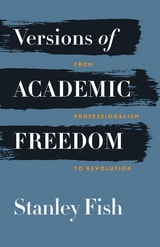
Versions of Academic Freedom
From Professionalism to RevolutionStanley Fish
University of Chicago Press, 2014
Depending on who’s talking, academic freedom is an essential bulwark of democracy, an absurd fig leaf disguising liberal agendas, or, most often, some in-between muddle that both exaggerates its own importance and misunderstands its actual value to scholarship. Fish enters the fray with his typical clear-eyed, no-nonsense analysis. The crucial question, he says, is located in the phrase “academic freedom” itself: Do you emphasize “academic” or “freedom”? The former, he shows, suggests a limited, professional freedom, while the conception of freedom implied by the latter could expand almost infinitely. Guided by that distinction, Fish analyzes various arguments for the value of academic freedom: Is academic freedom a contribution to society's common good? Does it authorize professors to critique the status quo, both inside and outside the university? Does it license and even require the overturning of all received ideas and policies? Is it an engine of revolution? Are academics inherently different from other professionals? Or is academia just a job, and academic freedom merely a tool for doing that job?
No reader of Fish will be surprised by the deftness with which he dismantles weak arguments, corrects misconceptions, and clarifies muddy arguments. And while his conclusion—that academic freedom is simply a tool, an essential one, for doing a job—may surprise, it is unquestionably bracing. Stripping away the mystifications that obscure academic freedom allows its beneficiaries to concentrate on what they should be doing: following their intellectual interests and furthering scholarship.