Results by title
3 books match the query 'Educational planning'
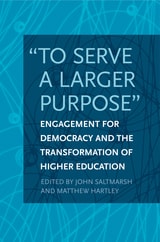
"To Serve a Larger Purpose"
Engagement for Democracy and the Transformation of Higher EducationEdited by John Saltmarsh and Matthew Hartley
Temple University Press, 2012
"To Serve a Larger Purpose" calls for the reclamation of the original democratic purposes of civic engagement and examines the requisite transformation of higher education required to achieve it. The contributors to this timely and relevant volume effectively highlight the current practice of civic engagement and point to the institutional change needed to realize its democratic ideals.
Using multiple perspectives, "To Serve a Larger Purpose" explores the democratic processes and purposes that reorient civic engagement to what the editors call "democratic engagement." The norms of democratic engagement are determined by values such as inclusiveness, collaboration, participation, task sharing, and reciprocity in public problem solving and an equality of respect for the knowledge and experience that everyone contributes to education, knowledge generation, and community building. This book shrewdly rethinks the culture of higher education.
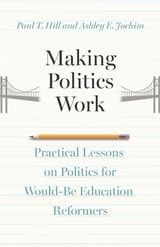
Making Politics Work
Practical Lessons on Politics for Would-Be Education ReformersPaul T. Hill and Ashley E. Jochim
University of Chicago Press, 2025
The education reform project has always been about making America’s schools more effective for the children who attend them. In Making Politics Work, authors Paul T. Hill and Ashley E. Jochim show that this project cannot succeed without mastering what is the single largest constraint on its success: politics.
Drawing upon more than a decade of work with dozens of school systems, Hill and Jochim show how failures to secure political support or mitigate inevitable opposition dooms the education reform project from the start. But this outcome is not inevitable. By tracing the evolution of the “portfolio strategy” across 27 localities that implemented it, they uncover practical lessons that superintendents, state leaders, and foundation officials can use to increase the likelihood that their ideas for improving public education don’t join the list of once-promising initiatives that could not be sustained in the face of intractable political conflict.

Planning Education Reforms in Developing Countries
The Contigency ApproachDennis A. Rondinelli, John Middleton, and Adriaan Verspoor
Duke University Press, 1990