Results by title
16 books match the query 'Edwards, Sebastian'
African Successes, Volume I
Government and InstitutionsEdited by Sebastian Edwards, Simon Johnson, and David N. Weil
University of Chicago Press, 2016
The first volume in the series, African Successes: Governments and Institutions considers the role governments and institutions have played in recent developments and identifies the factors that enable economists to predict the way institutions will function.
African Successes, Volume II
Human CapitalEdited by Sebastian Edwards, Simon Johnson, and David N. Weil
University of Chicago Press, 2016
The second volume in the series, African Successes: Human Capital turns the focus toward Africa’s human capital deficit, measured in terms of health and schooling. It offers a close look at the continent’s biggest challenges, including tropical disease and the spread of HIV.
African Successes, Volume III
Modernization and DevelopmentEdited by Sebastian Edwards, Simon Johnson, and David N. Weil
University of Chicago Press, 2016
The third volume in the series, African Successes: Modernization and Development looks at the rise in private production in spite of difficult institutional and physical environments. The volume emphasizes the ways that technologies, including mobile phones, have made growth in some areas especially dynamic.
African Successes, Volume IV
Sustainable GrowthEdited by Sebastian Edwards, Simon Johnson, and David N. Weil
University of Chicago Press, 2016
The fourth volume in the series, African Successes: Sustainable Growth combines informative case studies with careful empirical analysis to consider the prospects for future African growth.
Capital Controls and Capital Flows in Emerging Economies
Policies, Practices, and ConsequencesEdited by Sebastian Edwards
University of Chicago Press, 2007
Some scholars argue that the free movement of capital across borders enhances welfare; others claim it represents a clear peril, especially for emerging nations. In Capital Controls and Capital Flows in Emerging Economies, an esteemed group of contributors examines both the advantages and the pitfalls of restricting capital mobility in these emerging nations.
In the aftermath of the East Asian currency crises of 1997, the authors consider mechanisms that eight countries have used to control capital inflows and evaluate their effectiveness in altering the maturity of the resulting external debt and reducing macroeconomic vulnerability. This volume is essential reading for all those interested in emerging nations and the costs and benefits of restricting international capital flows.
Capital Flows and the Emerging Economies
Theory, Evidence, and ControversiesEdited by Sebastian Edwards
University of Chicago Press, 2000
Together these studies offer a new understanding of the empirical relationship between capital flows, international trade, and economic performance, and also afford key insights into realms of major policy concern.
Economic Adjustment and Exchange Rates in Developing Countries
Edited by Sebastian Edwards and Liaquat Ahamed
University of Chicago Press, 1986
The volume, divided into four main sections, addresses: the role of exchange rates in stabilization programs and the adjustment process; the importance of exchange rate policy during liberalization reform in developing countries; exchange rate problems relevant and unique to developing countries, illustrated by case studies; and the problems defining, measuring, and identifying determinants of real exchange rates. Authors of individual papers examine the relation between commercial policies and exchange rates, the role of exchange rate policy in stabilization programs, the effectiveness of devaluations as a policy tool, and the interaction between exchange rate terms of trade an capital flow. This research will not only prove crucial to our understanding of the role of exchange rates in developing countries, but will clearly set the standard for future work in the field.
Financial Markets Volatility and Performance in Emerging Markets
Edited by Sebastian Edwards and Márcio G. P. Garcia
University of Chicago Press, 2008
A group of experts here examine rapidly globalizing financial markets with regard to capital flows and crises, domestic credit, international financial integration, and economic policy. Featuring detailed analyses and cross-national comparisons of countries such as Brazil, Argentina, Uruguay, and Korea, this book will shape economists’ and policymakers’ understanding of the effectiveness of restrictions on capital mobility in the world’s most fragile economies.

Left Behind
Latin America and the False Promise of PopulismSebastian Edwards
University of Chicago Press, 2010
The political and economic history of Latin America has been marked by great hopes and even greater disappointments. Despite abundant resources—and a history of productivity and wealth—in recent decades the region has fallen further and further behind developed nations, surpassed even by other developing economies in Southeast Asia and elsewhere.
In Left Behind, Sebastian Edwards explains why the nations of Latin America have failed to share in the fruits of globalization and forcefully highlights the dangers of the recent turn to economic populism in the region. He begins by detailing the many ways Latin American governments have stifled economic development over the years through excessive regulation, currency manipulation, and thoroughgoing corruption. He then turns to the neoliberal reforms of the early 1990s, which called for the elimination of deficits, lowering of trade barriers, and privatization of inefficient public enterprises—and which, Edwards argues, held the promise of freeing Latin America from the burdens of the past. Flawed implementation, however, meant the promised gains of globalization were never felt by the mass of citizens, and growing frustration with stalled progress has led to a resurgence of populism throughout the region, exemplified by the economic policies of Venezuela’sHugo Chávez. But such measures, Edwards warns, are a recipe for disaster; instead, he argues, the way forward for Latin America lies in further market reforms, more honestly pursued and fairly implemented. As an example of the promise of that approach, Edwards points to Latin America's giant, Brazil, which under the successful administration of President Luis Inácio da Silva (Lula) has finally begun to show signs of reaching its true economic potential.
As the global financial crisis has reminded us, the risks posed by failing economies extend far beyond their national borders. Putting Latin America back on a path toward sustained growth is crucial not just for the region but for the world, and Left Behind offers a clear, concise blueprint for the way forward.

Monetarism and Liberalization
The Chilean ExperimentSebastian Edwards and Alejandra Cox Edwards
University of Chicago Press, 1991
"The Edwards's book is an indispensable guide to the policy reforms and mistakes that have taken the [Chilean] economy to its present state."—Philip L. Brock, Money, Credit, and Banking
"This book is a 'must' for anybody interested in development economies and the problems of liberalization."—Hansjorg Blochliger, Journal of International Economics
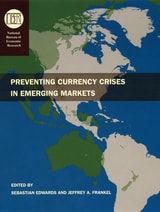
Preventing Currency Crises in Emerging Markets
Edited by Sebastian Edwards and Jeffrey A. Frankel
University of Chicago Press, 2002
Topics covered include exchange rate regimes, contagion (transmission of currency crises across countries), the current account of the balance of payments, the role of private sector investors and of speculators, the reaction of the official sector (including the multilaterals), capital controls, bank supervision and weaknesses, and the roles of cronyism, corruption, and large players (including hedge funds).
Ably balancing detailed case studies, cross-country comparisons, and theoretical concerns, this book will make a major contribution to ongoing efforts to understand and prevent international currency crises.
Reform, Recovery, and Growth
Latin America and the Middle EastEdited by Rudiger Dornbusch and Sebastian Edwards
University of Chicago Press, 1994
Among the questions addressed are: What are the requirements for a stabilization policy that reduces inflation in a reasonable amount of time at an acceptable cost? What are the effects of structural reforms, especially trade liberalization, deregulation, and privatization, on growth in the short and long runs? How do macroeconomic instability and adjustment policies affect income distribution and poverty? How does the specific design of structural adjustment efforts affect results?
In this companion to Macroeconomics of Populism in Latin America, the authors confirm that macroeconomic stability has a positive effect on income distribution. The volume presents case studies that describe in detail the stabilization experiences in Brazil, Israel, Argentina, and Bolivia, and also includes discussion of Chile, Mexico, Peru, and Turkey.
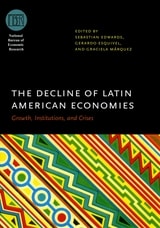
The Decline of Latin American Economies
Growth, Institutions, and CrisesEditied by Sebastian Edwards, Gerardo Esquivel, and Graciela Márquez
University of Chicago Press, 2007
Latin America’s economic performance is mediocre at best, despite abundant natural resources and flourishing neighbors to the north. The perplexing question of how some of the wealthiest nations in the world in the nineteenth century are now the most crisis-prone has long puzzled economists and historians. The Decline of Latin American Economies examines the reality behind the struggling economies of Argentina, Chile, and Mexico.
A distinguished panel of experts argues here that slow growth, rampant protectionism, and rising inflation plagued Latin America for years, where corrupt institutions and political unrest undermined the financial outlook of already besieged economies. Tracing Latin America’s growth and decline through two centuries, this volume illustrates how a once-prosperous continent now lags behind. Of interest to scholars and policymakers alike, it offers new insight into the relationship between political systems and economic development.

The Economics of Crime
Lessons For and From Latin AmericaEdited by Rafael Di Tella, Sebastian Edwards, and Ernesto Schargrodsky
University of Chicago Press, 2010
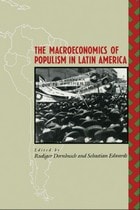
The Macroeconomics of Populism in Latin America
Edited by Rudiger Dornbusch and Sebastian Edwards
University of Chicago Press, 1991
Economists and political scientists from the United States and Latin America detail in this volume how and why such programs go wrong and what leads policymakers to repeatedly adopt these policies despite a history of failure. Authors examine this pattern in Argentina, Brazil, Chile, Mexico, Nicaragua, and Peru—and show how Colombia managed to avoid it. Despite differences in how each country implemented its policies, the macroeconomic consequences were remarkably similar.
Scholars of Latin America will find this work a valuable resource, offering a distinctive macroeconomic perspective on the continuing controversy over the dynamics of populism.

Two Lucky People
MemoirsMilton Friedman and Rose D. Friedman
University of Chicago Press, 2026
The story of Rose and Milton Friedman’s incredible lives and influential work told in their own words, now with a new foreword by Sebastian Edwards.
In Two Lucky People, Rose and Milton Friedman provide a memorable and lively account of their lives, the people they knew, and the work they shared. Their involvement with world leaders and many of this century's most important public policy issues moves their memoir beyond the merely personal and makes fascinating reading for anyone interested in the history of twentieth-century ideas.
This new edition of the Friedmans’ jointly authored memoir includes a foreword by economist Sebastian Edwards, the Henry Ford II Professor of International Economics at the University of California, Los Angeles.